
Why PHP is Quietly Becoming the Best Backend Language Again
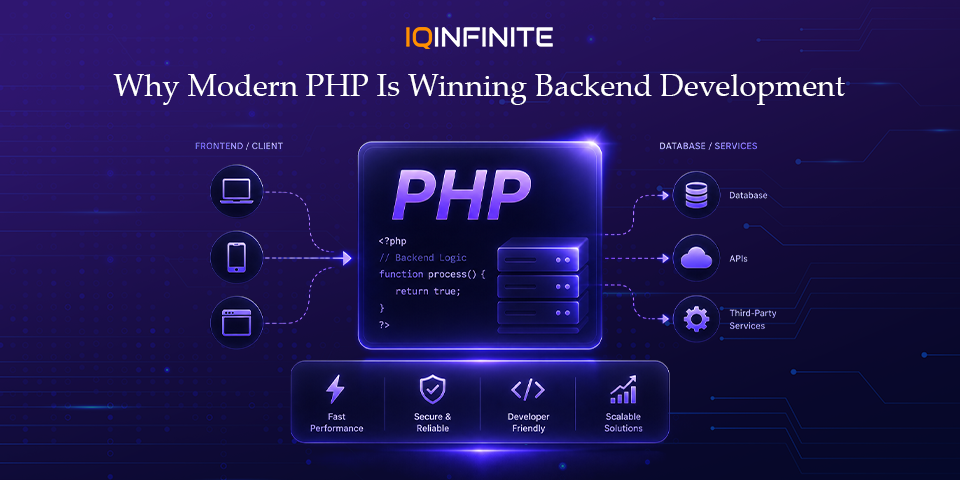
For years, PHP was treated as the “old language” of the web. Developers shifted attention toward Node.js, Go, Rust and Python while assuming PHP had stopped evolving.
But in 2026, something interesting is happening.
PHP is making one of the strongest backend comebacks in modern development quietly, efficiently and without hype.
Today’s PHP is no longer the slow, messy scripting language people remember from a decade ago. Modern PHP has become cleaner, faster, strongly typed, framework-friendly, AI-ready, cloud-compatible and surprisingly developer-focused.
With PHP 8.4, Laravel 12, async runtimes, property hooks, AI integrations, serverless deployment support and major performance upgrades, PHP is now competing directly with modern backend ecosystems again.
For many developers and businesses, PHP is quietly becoming the best backend language 2026 has to offer for scalable and cost-effective application development.
The Biggest Reason: Modern PHP Feels Completely Different
PHP 8.x transformed the language dramatically with:
- Strict typing
- Enums
- Attributes
- JIT improvements
- Constructor property promotion
- Readonly properties
- Fibers
- Advanced static analysis support
- Better memory optimization
- Cleaner OOP architecture
PHP 8.4 Is Changing Backend Development
1. Property Hooks (One of the Biggest PHP Updates Ever)
Instead of writing long accessor methods, developers can directly define logic inside properties.
Example concept:
public string $email {
  set(string $value) {
    $this->email = strtolower($value);
  }
}
• Cleaner
• Easier to maintain
• More readable
• Better for large enterprise applications
The PHP community widely considers property hooks a “game changer” because they modernize object-oriented PHP significantly.
This is especially important for teams building PHP for enterprise applications, where maintainability and scalability matter.
2. Asymmetric Visibility Makes Code Safer
Example idea:
public private(set) string $status;
• Anyone can read the value
• Only internal class logic can modify it
This improves:
• Security
• Domain-driven design
• Immutable architecture
• Enterprise-grade applications
This feature especially benefits Laravel applications, APIs, SaaS platforms and fintech systems.
3. PHP Performance Is No Longer a Joke
Modern PHP with:
- OPcache
- JIT compilation
- Octane
- RoadRunner
- Swoole
- FrankenPHP
Laravel Octane alone drastically improves request handling speed by keeping the application in memory instead of bootstrapping on every request.
This means:
- Faster APIs
- Lower server costs
- Better scalability
- Real-time application support
These modern PHP performance improvements allow PHP to power:
- AI dashboards
- Realtime chat systems
- Fintech products
- Multi-tenant SaaS platforms
- Event-driven systems
- High-traffic APIs
Laravel Is Powering Modern PHP Growth
Laravel has transformed into one of the world’s most productive backend ecosystems, helping startups and enterprises build scalable applications faster than ever.
In 2026, Laravel provides:
- AI integrations
- Advanced queue systems
- Realtime broadcasting
- Serverless deployment
- Native job batching
- API-first architecture
- Event sourcing support
- Scalable microservices architecture
- High-performance caching
- Laravel Reverb for WebSockets
- Laravel Pulse for monitoring
- Laravel Pennant for feature flags
And in today’s market, developer speed is a competitive advantage.
AI Is Making PHP More Relevant Again
Because Laravel follows structured conventions and predictable architecture patterns, AI coding assistants can generate cleaner, more accurate and production-ready code compared to many loosely structured ecosystems.
Developers are now using AI with PHP for:
- CRUD generation
- API development
- Automated testing
- Documentation generation
- Admin panel creation
- Query optimization
- SaaS boilerplate generation
PHP Hosting Remains Cost-Effective
Compared to many backend ecosystems:
- PHP hosting is cheaper
- Deployment workflows are simpler
- Shared hosting still supports PHP efficiently
- VPS optimization is easier
- Horizontal scaling is more affordable
Large Laravel applications can scale efficiently while maintaining significantly lower operational costs than many Node.js or Java-based stacks.
PHP’s Ecosystem Became Mature Instead of Trendy
Modern PHP offers:
- Mature frameworks
- Excellent documentation
- A massive package ecosystem
- Long-term hosting support
- Stable enterprise tooling
- Strong backward compatibility
Developers Are Burned Out by JavaScript Complexity
Constant breaking changes, dependency conflicts, build tool complexity and framework fragmentation are pushing many backend developers toward more stable technologies.
PHP provides:
- Simpler deployment
- Easier debugging
- Cleaner backend-focused architecture
- Faster onboarding for teams
- Less configuration overhead
Modern PHP Careers Are Growing Again
Companies are actively hiring:
- Laravel developers
- API engineers
- SaaS backend developers
- Backend architects
- Enterprise WordPress developers
- Fintech backend engineers
- Remote startups
- SaaS companies
- AI-powered platforms
- Digital agencies
- Enterprise internal systems
Modern PHP developers are building scalable SaaS platforms, AI-integrated systems, fintech applications, enterprise APIs and high-performance backend infrastructures.
The Biggest Myth About PHP
“PHP is dead.”
Reality:
PHP still powers a massive portion of the web while continuously modernizing. New releases continue adding major developer-focused features and performance improvements.
The language survived because it adapted.
And now it is evolving faster than many developers realize.
Conclusion
It became relevant again because it solved real problems:
- Faster development
- Lower infrastructure costs
- Stable ecosystem
- Modern language features
- Excellent frameworks
- AI-friendly workflows
- Scalable backend architecture
It already is one.