
Why Kubernetes Is a Must-Know Skill for Modern Engineers
A few years ago, deploying an application meant setting up a server, copying files and hoping nothing broke in production. Today, modern engineering looks very different. Applications are distributed, containerized and expected to scale instantly and this is exactly where Kubernetes comes in.
If you’re a software engineer, DevOps engineer or cloud professional, understanding why Kubernetes is important is no longer optional. It has become a core skill for building, deploying and managing modern applications.
Let’s break down why Kubernetes is so popular, what problems it solves and the real benefits it brings to engineers and organizations.
The Shift to Modern Application Architecture
Modern applications are rarely monolithic. Instead, they are built using:
- Microservices
- Containers (like Docker)
- Cloud-native infrastructure
- CI/CD pipelines
While containers made applications portable, managing hundreds or thousands of containers introduced a new challenge. Manually handling container lifecycles, scaling, networking and failures quickly becomes unmanageable.
This is where kubernetes orchestration changed everything.
This is where kubernetes orchestration changed everything.
What Is Kubernetes (In Simple Terms)?
Kubernetes is an open-source platform designed to automate the deployment, scaling and management of containerized applications.
Instead of engineers worrying about:
Instead of engineers worrying about:
- Where containers run
- What happens if one crashes
- How traffic is balanced
- How scaling works
Kubernetes handles these concerns automatically.
In short, Kubernetes lets engineers focus on building features, not managing infrastructure chaos.
In short, Kubernetes lets engineers focus on building features, not managing infrastructure chaos.
Why Kubernetes Is Important for Modern Engineers
1. It Solves Real Production Problems
Production systems are unpredictable. Servers fail, traffic spikes and deployments can break things.
Kubernetes handles:
Kubernetes handles:
- Automatic restarts when containers crash
- Self-healing systems
- Rolling updates without downtime
- Smart resource allocation
This reliability is one of the main reasons why Kubernetes is important in real-world systems.
2. Kubernetes Orchestration at Scale
Managing containers manually works for small projects not for real businesses.
Kubernetes orchestration allows you to:
Kubernetes orchestration allows you to:
- Run containers across multiple machines
- Automatically scale services up or down
- Manage networking and service discovery
- Maintain desired application state
For modern engineers working on scalable systems, this orchestration layer is essential.
3. Standard for Kubernetes Deployment
Today, kubernetes deployment has become an industry standard.
Companies expect engineers to understand:
Companies expect engineers to understand:
- How applications are deployed using Kubernetes
- How CI/CD pipelines integrate with clusters
- How to roll back safely when something fails
Knowing Kubernetes deployment strategies makes engineers more confident and production-ready.
Why Kubernetes Is So Popular
Kubernetes didn’t become popular by accident. Its adoption is driven by real advantages:
- Cloud-agnostic: Works on AWS, Azure, GCP and on-prem
- Strong community: Backed by Google and the CNCF
- Vendor-neutral: No lock-in to a single cloud provider
- Proven at scale: Used by startups and enterprises alike
This widespread adoption explains why Kubernetes is so popular across the tech industry.
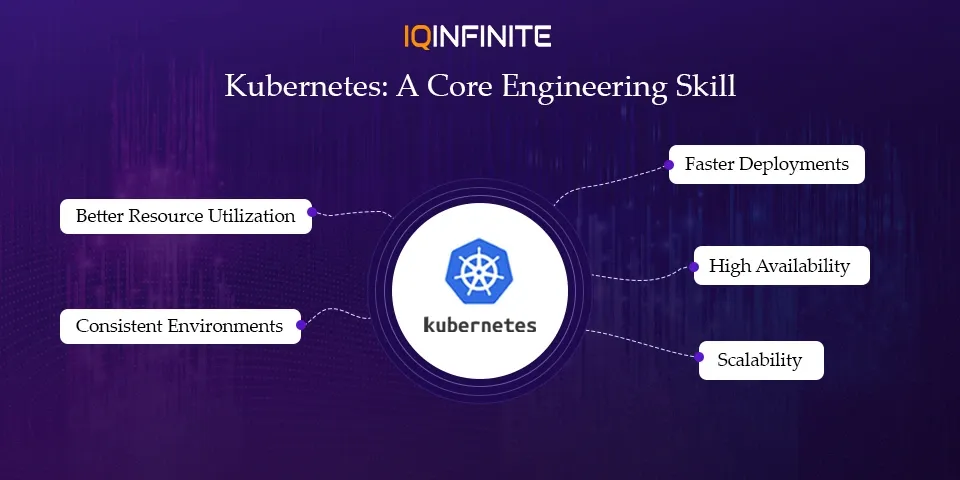
What Are the Benefits of Kubernetes?
Let’s look at the practical benefits engineers experience every day.
Scalability
Kubernetes automatically scales applications based on traffic and load, without manual intervention.
Kubernetes automatically scales applications based on traffic and load, without manual intervention.
High Availability
If a container or node fails, Kubernetes reschedules workloads automatically.
If a container or node fails, Kubernetes reschedules workloads automatically.
Faster Deployments
With rolling updates and automated rollbacks, deployments become safer and faster.
With rolling updates and automated rollbacks, deployments become safer and faster.
Better Resource Utilization
Kubernetes optimizes CPU and memory usage across workloads, reducing infrastructure costs.
Kubernetes optimizes CPU and memory usage across workloads, reducing infrastructure costs.
Consistent Environments
The same Kubernetes deployment works across development, staging and production.
The same Kubernetes deployment works across development, staging and production.
These are the core benefits of Kubernetes that make it essential in modern engineering teams.
Career Impact: Why Engineers Must Learn Kubernetes
From a career perspective, Kubernetes knowledge:
- Opens doors to DevOps and Cloud roles
- Increases salary potential
- Makes engineers relevant in cloud-native teams
- Aligns skills with industry demand
Many job descriptions now list Kubernetes as a required or preferred skill, not a nice-to-have.
Is Kubernetes Hard to Learn?
Kubernetes has a learning curve no sugarcoating that.
However:
However:
- You don’t need to master everything at once
- Understanding core concepts (pods, services, deployments) goes a long way
- Hands-on practice makes it click faster than theory
For modern engineers, the learning effort is worth the long-term payoff.
Conclusion
Kubernetes has become the backbone of modern application infrastructure. It simplifies container management, enables scalable systems and sets a standard for cloud-native development.
Understanding why Kubernetes is important, how kubernetes orchestration works and how kubernetes deployment fits into modern workflows is no longer optional for engineers who want to stay relevant.
In today’s tech landscape, Kubernetes isn’t just a tool, it’s a must-know skill for modern engineers.
Understanding why Kubernetes is important, how kubernetes orchestration works and how kubernetes deployment fits into modern workflows is no longer optional for engineers who want to stay relevant.
In today’s tech landscape, Kubernetes isn’t just a tool, it’s a must-know skill for modern engineers.