
Why Kubernetes and Terraform are dominating cloud infrastructure in 2026
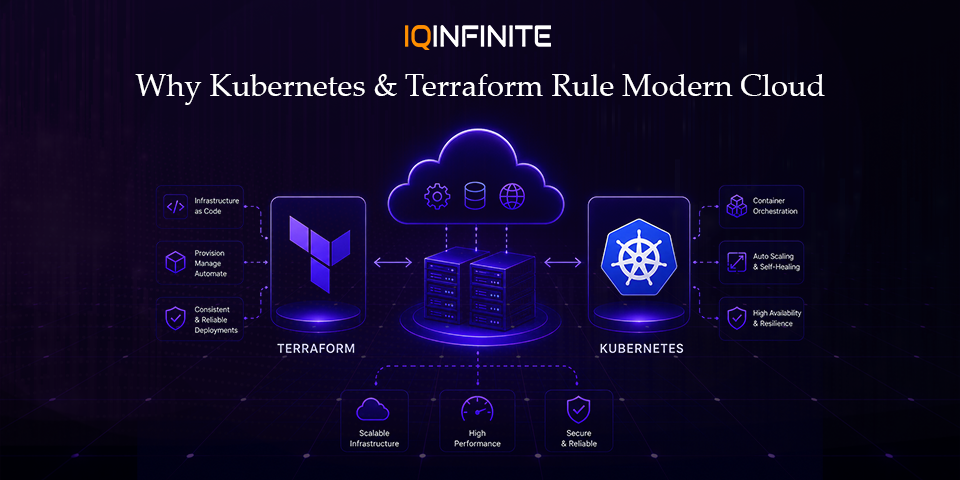
Cloud infrastructure has evolved rapidly over the last few years. Modern applications now demand scalability, automation, high availability and faster deployment cycles. To meet these requirements, companies are increasingly adopting Kubernetes and Terraform as the foundation of modern cloud-native infrastructure.
From startups building SaaS products to enterprises managing large distributed systems, Kubernetes and Terraform have become essential technologies for infrastructure automation and scalable application deployment.
The reason is simple: together, they enable consistent, automated and highly scalable infrastructure management. This is exactly why Kubernetes and Terraform continue dominating cloud infrastructure in 2026.
The Rise of Cloud-Native Infrastructure
Traditional infrastructure management relied heavily on manual server configuration and static deployment processes. These approaches created problems such as:
- Slow deployments
- Infrastructure inconsistencies
- Scaling limitations
- High operational overhead
- Difficult environment management
Modern cloud-native development requires infrastructure that can scale automatically, recover quickly and support continuous deployment workflows.
This is where Kubernetes and Terraform work together extremely effectively.
This is where Kubernetes and Terraform work together extremely effectively.
What Is Kubernetes?
Kubernetes is an open-source container orchestration platform used to manage, deploy and scale containerized applications.
Modern organizations use Kubernetes for:
Modern organizations use Kubernetes for:
- Container orchestration
- Auto-scaling workloads
- Service discovery
- High availability
- Self-healing infrastructure
- Microservices management
Today, Kubernetes has become the standard for managing modern distributed applications and Kubernetes cluster management across cloud environments.
What Is Terraform?
Terraform is an Infrastructure as Code (IaC) tool that allows developers and DevOps teams to provision infrastructure using configuration files instead of manual setup.
Terraform supports:
Terraform supports:
- AWS
- Azure
- Google Cloud
- Kubernetes
- Docker
- Networking infrastructure
By using Terraform, teams can automate cloud infrastructure deployment consistently and securely.
This makes Terraform one of the most important tools in modern cloud engineering.
This makes Terraform one of the most important tools in modern cloud engineering.
How Kubernetes and Terraform Work Together
Understanding how Kubernetes and Terraform work together explains why they dominate modern infrastructure.
Terraform handles infrastructure provisioning, while Kubernetes manages application orchestration.
A typical workflow looks like this:
Terraform handles infrastructure provisioning, while Kubernetes manages application orchestration.
A typical workflow looks like this:
Terraform Provisions Infrastructure
Terraform creates:
- Cloud networks
- Virtual machines
- Load balancers
- Databases
- Kubernetes clusters
Kubernetes Manages Applications
Once infrastructure is ready, Kubernetes handles:
- Container deployment
- Scaling
- Service discovery
- Load balancing
- Health monitoring
This combination creates a fully automated and scalable cloud-native environment.
Cloud Infrastructure Kubernetes Engine Adoption
Major cloud providers now heavily support Kubernetes services.
Examples include:
Examples include:
- Amazon EKS
- Azure AKS
- Google Kubernetes Engine (GKE)
These managed platforms simplify cloud infrastructure kubernetes engine deployment by reducing operational complexity.
Businesses can focus more on applications instead of manually managing cluster infrastructure.
This has accelerated enterprise adoption of Kubernetes globally.
Businesses can focus more on applications instead of manually managing cluster infrastructure.
This has accelerated enterprise adoption of Kubernetes globally.
Kubernetes Cluster Management in Modern Infrastructure
Modern Kubernetes cluster management involves far more than simply running containers.
Organizations now manage:
Organizations now manage:
- Multi-cluster environments
- Hybrid cloud infrastructure
- Auto-scaling systems
- Service meshes
- Distributed workloads
Kubernetes helps engineering teams maintain high availability while scaling applications dynamically based on traffic demand.
This makes Kubernetes ideal for:
This makes Kubernetes ideal for:
- SaaS applications
- FinTech systems
- Enterprise platforms
- AI-powered applications
- Real-time services
Bootstrapping Microservices with Docker Kubernetes and Terraform
Modern microservices architectures increasingly rely on:
- Docker for containerization
- Kubernetes for orchestration
- Terraform for infrastructure provisioning
This workflow is commonly described as bootstrapping microservices with docker kubernetes and terraform.
The process usually involves:
The process usually involves:
- Containerizing services using Docker
- Provisioning cloud infrastructure with Terraform
- Deploying services into Kubernetes clusters
- Managing scaling and orchestration automatically
This approach allows teams to build scalable and resilient distributed systems much faster.
Terraform Kubernetes Deployment Example
A simple terraform kubernetes deployment example typically includes:
- Creating cloud infrastructure
- Provisioning Kubernetes clusters
- Deploying Kubernetes resources automatically
Example Terraform Configuration
Example Terraform configuration:
resource "aws_eks_cluster" "main" {
  name = "production-cluster"
}
Kubernetes Deployment Example
Kubernetes deployment example:
apiVersion: apps/v1
kind: Deployment
metadata:
  name: app
spec:
  replicas: 3
Together, Terraform and Kubernetes create repeatable infrastructure workflows that reduce manual configuration errors significantly.
Why Enterprises Prefer Kubernetes and Terraform
Large organizations increasingly rely on Kubernetes and Terraform because they provide:
- Infrastructure consistency
- Faster deployments
- Automated scaling
- Cloud portability
- Improved DevOps workflows
- Better disaster recovery
This combination supports modern engineering practices such as:
- GitOps
- CI/CD automation
- Infrastructure as Code
- Microservices architecture
These capabilities are critical for modern cloud-native businesses.
The Future of Cloud Infrastructure
Cloud infrastructure is continuing to evolve rapidly.
Emerging trends include:
Emerging trends include:
- AI-powered infrastructure automation
- Serverless Kubernetes
- Edge-native deployments
- Multi-cloud orchestration
- Autonomous infrastructure management
As distributed systems become more complex, how Kubernetes and Terraform work together will become even more important for scalable cloud operations.
Conclusion
Kubernetes and Terraform continue dominating cloud infrastructure in 2026 because they provide scalability, automation and operational consistency for modern applications. From Kubernetes cluster management to bootstrapping microservices with docker kubernetes and terraform, these technologies have become essential for cloud-native engineering.
With growing adoption of managed cloud infrastructure kubernetes engine platforms and automated infrastructure workflows, businesses increasingly rely on Kubernetes and Terraform to build resilient digital systems. Whether teams are implementing a terraform kubernetes deployment example or learning how Kubernetes and Terraform work together, this combination remains one of the strongest foundations for scalable cloud infrastructure today.
With growing adoption of managed cloud infrastructure kubernetes engine platforms and automated infrastructure workflows, businesses increasingly rely on Kubernetes and Terraform to build resilient digital systems. Whether teams are implementing a terraform kubernetes deployment example or learning how Kubernetes and Terraform work together, this combination remains one of the strongest foundations for scalable cloud infrastructure today.