
WebAssembly vs Containers: Is WASM the Next Runtime for Cloud-Native DevOps?
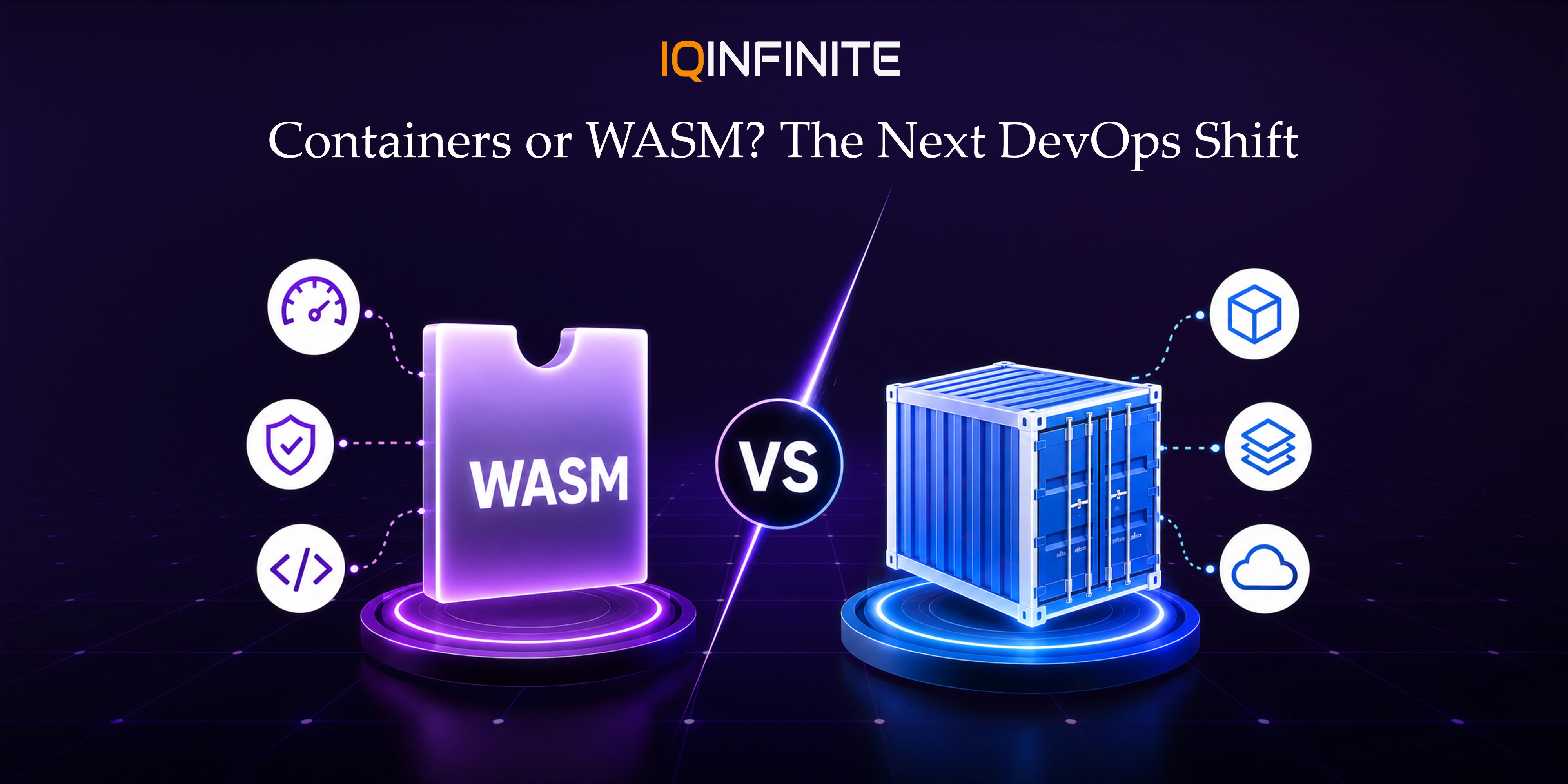
Cloud-native development is evolving beyond traditional container-based deployments. Containers and Kubernetes remain the foundation of modern infrastructure, but WebAssembly (WASM) is emerging as a lightweight runtime for serverless applications, edge computing, microservices and other cloud-native workloads.
The WebAssembly vs Containers debate is not necessarily about replacing one technology with another. Instead, it is about choosing the right runtime for the right workload. Containers remain strong for complex Linux applications, while WASM offers fast startup, portability, lightweight execution and sandboxed isolation.
What Is WebAssembly?
WebAssembly, commonly known as WASM, is a portable binary instruction format designed to run applications efficiently inside a secure sandbox.
Originally created for browser applications, WebAssembly has expanded into server-side and cloud-native environments through technologies such as WASI and the WebAssembly Component Model.
Developers can compile applications written in languages including:
Originally created for browser applications, WebAssembly has expanded into server-side and cloud-native environments through technologies such as WASI and the WebAssembly Component Model.
Developers can compile applications written in languages including:
- Rust
- C and C++
- Go
- AssemblyScript
- JavaScript and TypeScript
For cloud-native workloads, WASM is particularly attractive because it combines portability, fast startup, low resource consumption and isolation.
How Are Containers Different?
Containers package applications together with their dependencies, libraries and configuration so they can run consistently across environments.
Docker, containerd and Kubernetes have created a mature ecosystem around containers, making them suitable for a wide range of applications.
Containers are particularly effective for:
Docker, containerd and Kubernetes have created a mature ecosystem around containers, making them suitable for a wide range of applications.
Containers are particularly effective for:
- Complex Linux applications
- Native libraries
- Persistent services
- Advanced networking
- Databases and stateful workloads
- GPU-intensive applications
- Legacy systems
The key difference in the WASM vs Containers discussion is their isolation model. Containers provide operating-system-level process isolation, while WebAssembly executes applications inside a runtime-based sandbox.
Why Is WebAssembly Becoming Important for DevOps?
Modern applications increasingly operate across cloud platforms, Kubernetes clusters, serverless environments and edge locations. This creates demand for runtimes that are portable, lightweight, secure and easy to automate.
WebAssembly fits several of these requirements, making it increasingly relevant to WebAssembly DevOps.
Organizations can use WASM for workloads that need:
WebAssembly fits several of these requirements, making it increasingly relevant to WebAssembly DevOps.
Organizations can use WASM for workloads that need:
- Fast deployment
- Rapid scaling
- Lightweight execution
- Secure isolation
- Portability between environments
- Automated CI/CD deployment
- Edge execution
Faster Startup and Scaling
Startup time matters for workloads that are frequently created and destroyed.
Examples include:
Examples include:
- Serverless functions
- Event-driven applications
- Edge functions
- Short-lived jobs
- Lightweight APIs
Because WASM modules are lightweight, suitable workloads can start quickly without requiring a complete traditional operating-system userspace.
This makes WebAssembly Serverless particularly interesting for applications where rapid scaling and low startup overhead are important.
This makes WebAssembly Serverless particularly interesting for applications where rapid scaling and low startup overhead are important.
Lower Resource Consumption
Cloud infrastructure costs are closely connected to CPU and memory utilization.
When organizations run thousands of small workloads, reducing resource overhead can improve infrastructure efficiency.
WASM can be useful for workloads requiring:
When organizations run thousands of small workloads, reducing resource overhead can improve infrastructure efficiency.
WASM can be useful for workloads requiring:
- High workload density
- Lightweight processing
- Short-lived execution
- Rapid horizontal scaling
- Efficient edge deployment
However, performance should always be validated through application-specific benchmarks because results vary depending on the runtime, language and workload.
Strong Application Isolation
Security is another reason organizations are evaluating WebAssembly.
A WASM module runs inside a sandbox where access to system capabilities can be controlled by the runtime and host environment.
This can be useful for:
A WASM module runs inside a sandbox where access to system capabilities can be controlled by the runtime and host environment.
This can be useful for:
- SaaS plugin systems
- Multi-tenant applications
- Customer-defined business rules
- Third-party integrations
- Edge functions
- Extensible enterprise platforms
WebAssembly does not eliminate security risks, but sandboxed execution can provide an additional security boundary when implemented correctly.
WebAssembly and Kubernetes
WebAssembly does not have to compete directly with Kubernetes.
Instead, Kubernetes can remain the orchestration layer while WASM becomes another runtime for selected workloads.
A simplified architecture can look like:
Developer → CI/CD → Registry → Kubernetes → Runtime Selection → Container or WASM → Application
This approach allows organizations to run both containerized and WASM workloads within the same broader cloud-native environment.
For example:
Containers
Instead, Kubernetes can remain the orchestration layer while WASM becomes another runtime for selected workloads.
A simplified architecture can look like:
Developer → CI/CD → Registry → Kubernetes → Runtime Selection → Container or WASM → Application
This approach allows organizations to run both containerized and WASM workloads within the same broader cloud-native environment.
For example:
Containers
- Databases
- Complex backend services
- Legacy applications
- GPU workloads
- Linux-dependent applications
WebAssembly
- Lightweight APIs
- Serverless functions
- Edge workloads
- Plugin execution
- Short-lived services
- Multi-tenant application logic
For most organizations, this hybrid model is more practical than trying to replace every container with WASM.
WebAssembly for Edge Computing
Edge computing is one of the strongest use cases for WebAssembly.
Instead of sending every request to a centralized cloud environment, selected workloads can execute closer to users, devices and data sources.
WASM can support lightweight edge workloads such as:
Instead of sending every request to a centralized cloud environment, selected workloads can execute closer to users, devices and data sources.
WASM can support lightweight edge workloads such as:
- Authentication
- API processing
- Data transformation
- IoT processing
- Content personalization
- Real-time applications
Because edge environments can have limited resources, lightweight runtimes can provide a useful advantage.
Where Containers Still Make More Sense
Despite the growth of WebAssembly, containers remain the better option for many workloads.
Containers are generally more appropriate for:
Containers are generally more appropriate for:
- Complex Linux applications
- Stateful services
- Persistent storage
- Native libraries
- Advanced networking
- GPU-intensive applications
- Legacy applications
- Existing enterprise container platforms
The container ecosystem also has mature tooling for networking, security, storage, monitoring, deployment and Kubernetes operations.
Therefore, replacing containers simply because WASM is newer is rarely the right approach.
Therefore, replacing containers simply because WASM is newer is rarely the right approach.
Where WebAssembly Can Be the Better Choice
WASM becomes particularly attractive when applications need lightweight, portable and isolated execution.
Consider WebAssembly when you need:
Consider WebAssembly when you need:
- Fast startup
- Low resource consumption
- Strong sandboxing
- Portable execution
- Serverless deployment
- Edge computing
- Multi-tenant execution
- Plugin-based architecture
- Short-lived workloads
For example, a SaaS platform could use WebAssembly to execute customer-specific business rules inside a controlled environment without giving those rules unrestricted infrastructure access.
WebAssembly and CI/CD
Adopting WebAssembly does not require completely redesigning existing DevOps workflows.
A traditional container pipeline might look like:
Source Code → Build → Container Image → Security Scan → Registry → Kubernetes → Deployment
A WASM pipeline can follow a similar structure:
Source Code → Compile to WASM → Test → Security Scan → OCI Registry → Runtime → Deployment
Existing practices such as CI/CD, GitOps, Infrastructure as Code, automated testing, security scanning and observability can continue to be used.
This makes WebAssembly DevOps an extension of existing cloud-native practices rather than a completely different development model.
A traditional container pipeline might look like:
Source Code → Build → Container Image → Security Scan → Registry → Kubernetes → Deployment
A WASM pipeline can follow a similar structure:
Source Code → Compile to WASM → Test → Security Scan → OCI Registry → Runtime → Deployment
Existing practices such as CI/CD, GitOps, Infrastructure as Code, automated testing, security scanning and observability can continue to be used.
This makes WebAssembly DevOps an extension of existing cloud-native practices rather than a completely different development model.
WebAssembly Serverless Applications
Serverless environments are another area where WASM can provide advantages.
Traditional serverless workloads can experience startup delays and resource overhead depending on the runtime and deployment model.
Lightweight WASM modules can be suitable for short-lived functions that need:
Traditional serverless workloads can experience startup delays and resource overhead depending on the runtime and deployment model.
Lightweight WASM modules can be suitable for short-lived functions that need:
- Fast execution
- Rapid scaling
- Low resource overhead
- Strong isolation
This makes WebAssembly Serverless particularly relevant for APIs, event processing, edge functions and other short-lived workloads.
WebAssembly vs Containers: Which Should You Choose?
There is no universal winner.
Choose containers when your application depends heavily on Linux capabilities, native libraries, persistent infrastructure or mature container tooling.
Choose WASM when your workload benefits from fast startup, portability, sandboxing, lightweight execution or edge and serverless deployment.
For many organizations, the most practical architecture will use both.
Choose containers when your application depends heavily on Linux capabilities, native libraries, persistent infrastructure or mature container tooling.
Choose WASM when your workload benefits from fast startup, portability, sandboxing, lightweight execution or edge and serverless deployment.
For many organizations, the most practical architecture will use both.
Containers + WASM + Kubernetes + Serverless + Edge
This allows engineering teams to match the runtime to the application's requirements instead of forcing every workload into one technology.
The Future of Cloud-Native DevOps
WebAssembly is still developing, but its potential is becoming clearer. Improvements around WASI, the WebAssembly Component Model, Kubernetes integrations and cloud-native runtimes are making WASM increasingly relevant to modern infrastructure.
The technology is unlikely to eliminate containers. Instead, it can become another runtime in the cloud-native toolbox.
The future of WebAssembly DevOps will likely involve selecting between containers and WASM based on workload characteristics, security requirements, performance needs and deployment environments.
The technology is unlikely to eliminate containers. Instead, it can become another runtime in the cloud-native toolbox.
The future of WebAssembly DevOps will likely involve selecting between containers and WASM based on workload characteristics, security requirements, performance needs and deployment environments.
Conclusion
The WebAssembly vs Containers discussion is not really about deciding which technology wins. Containers remain essential for complex enterprise applications, databases, legacy systems and infrastructure-heavy workloads, while WASM offers an attractive alternative for lightweight, portable, isolated, serverless and edge applications.
As cloud-native environments become more diverse organizations will increasingly use multiple runtimes instead of relying on one deployment model. WASM vs Containers will therefore become a workload-specific decision, with WebAssembly Serverless and WebAssembly DevOps playing an increasingly important role in the next generation of cloud-native application infrastructure.
As cloud-native environments become more diverse organizations will increasingly use multiple runtimes instead of relying on one deployment model. WASM vs Containers will therefore become a workload-specific decision, with WebAssembly Serverless and WebAssembly DevOps playing an increasingly important role in the next generation of cloud-native application infrastructure.