
10 UX Principles Behind Great Design
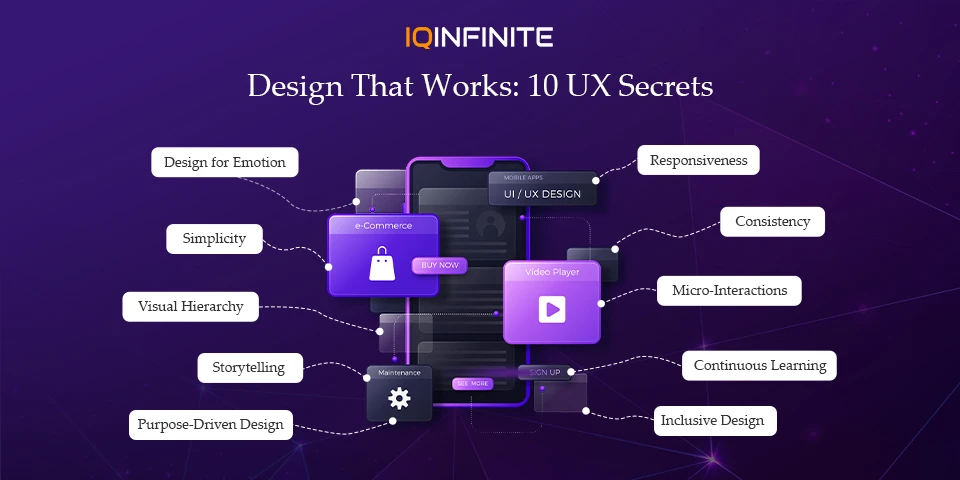
In a digital world where users expect the same level of seamlessness, they get from devices like the PS5 Pro backed by Cloudflare-level speed and reliability great UX design isn’t just about visuals it’s about intuitive flow, AI chat–level responsiveness and meaningful scalability.
Here are ten “secrets” that top UX practitioners are putting into practice in 2025 complete with why they matter, how they’re evolving and how you can apply them.
1. Design for Emotion, Not Just Function
Why it matters: Users remember how a product makes them feel, not just what it does. Usable but soulless UIs are easily replaced.
2025 trend: UX is shifting from efficiency to delight and meaning. Motion, tone, micro-interactions and accessibility choices now evoke trust and connection. Design systems are increasingly built for empathy over clicks.
How to apply:
2025 trend: UX is shifting from efficiency to delight and meaning. Motion, tone, micro-interactions and accessibility choices now evoke trust and connection. Design systems are increasingly built for empathy over clicks.
How to apply:
- Add micro-interactions with friendly feedback (animations, personalization).
- Align microcopy and tone with your brand personality.
- Include small “delight” moments thoughtful transitions or surprises.
- Test for emotional response, not just task completion.
2. Simplicity Is (Still) the Ultimate Sophistication
Why: Cluttered interfaces overload users, clarity lets them focus on what matters.
2025 nuance: “Simple” no longer means “bare” but “purposeful minimalism”. The latest trends talk about “minimalism with meaning” each element must have a reason to be there.
How to apply:
2025 nuance: “Simple” no longer means “bare” but “purposeful minimalism”. The latest trends talk about “minimalism with meaning” each element must have a reason to be there.
How to apply:
- Remove unnecessary UI elements.
- Guide focus with typography, spacing and colour.
- Use clean layouts with subtle motion or shadows.
- Keep patterns consistent across screens.
3. Speed, Performance & Responsiveness
Why: Slow or laggy interfaces erode trust and engagement.
2025 update: With more channels (mobile, AR/VR, foldables) and heavier interactions, performance is now a core UX challenge.
How to apply:
2025 update: With more channels (mobile, AR/VR, foldables) and heavier interactions, performance is now a core UX challenge.
How to apply:
- Optimize images and scripts, use lazy loading.
- Test on all devices, including low-end and slow networks.
- Improve perceived performance with skeleton screens and responsive animations.
- Monitor load times, time-to-interactive and real-user metrics.
4. Accessibility & Inclusive Design as a Foundation, not an Afterthought
Why: Excluding users by ability, age, device or context is bad design and harms brand trust.
2025 perspective: Accessibility is mandatory, linking to ethical design, legal compliance and brand integrity.
How to apply:
2025 perspective: Accessibility is mandatory, linking to ethical design, legal compliance and brand integrity.
How to apply:
- Use proper contrast, alt text, keyboard navigation and screen-reader-friendly markup.
- Include accessibility from day one in design briefs and QA.
- Design for diverse contexts: low vision, hearing, cognitive load.
- Use inclusive language, culturally sensitive visuals and device-agnostic interactions.
5. Personalisation & Contextual Design
Why: Users expect tailored experiences, one-size-fits-all is no longer enough.
2025 update: AI and data enable dynamic layouts, content and flows based on behaviour and context, beyond simple greetings.
How to apply:
2025 update: AI and data enable dynamic layouts, content and flows based on behaviour and context, beyond simple greetings.
How to apply:
- Adapt UI using behavioural data (respecting privacy).
- Test versions based on user profile, device or environment.
- Be transparent users should know why content appears.
- Balance personalization with consistency to avoid confusion.
6. Micro-Interactions & Motion Design as UX Tool
Why: Small animations and transitions make interfaces feel alive and help users understand actions.
2025 update: Motion is now functional providing feedback, guidance and inclusivity, not just aesthetics.
How to apply:
2025 update: Motion is now functional providing feedback, guidance and inclusivity, not just aesthetics.
How to apply:
- Use purposeful transitions for buttons, loading and state changes.
- Avoid distracting or excessive motion.
- Respect accessibility (e.g., reduced/no-motion options).
- Coordinate motion with micro copy and layout for cohesion.
7. Visual Hierarchy, Typographic Purpose & Dept
Why: Clear hierarchy guides users’ focus, poor hierarchy causes confusion.
2025 emphasis: Beyond flat design, “post-neumorphism” and subtle 3D/immersive elements add depth and clarity.
How to apply:
2025 emphasis: Beyond flat design, “post-neumorphism” and subtle 3D/immersive elements add depth and clarity.
How to apply:
- Prioritise content with size, weight, colour and spacing.
- Add subtle depth: layering, shadows, card effects.
- Use expressive typography for key information.
- Test readability across devices and contexts.
8. Consistency (Design Systems) Builds Confidence
Why: Inconsistent screens create uncertainty, consistency builds trust and reduces cognitive load.
2025 update: With more design systems, shared libraries and cross-platform patterns, consistency is more important than ever balancing flexibility and uniformity.
How to apply:
2025 update: With more design systems, shared libraries and cross-platform patterns, consistency is more important than ever balancing flexibility and uniformity.
How to apply:
- Develop and maintain a design system (components, motion, accessibility, typography, colour).
- Ensure cross-platform consistency (web, mobile, tablet, AR/VR).
- Use pattern libraries to align design and dev teams.
- Monitor deviations to keep innovation aligned with system goals.
9. Data-Driven Iteration & Continuous Learning
Why: UX isn’t “set and forget.” Regular updates based on real user behavior improve retention and conversion.
2025 nuance: With advanced analytics and tools, UX now blends research, data science and business strategy, emphasizing deeper insights.
How to apply:
2025 nuance: With advanced analytics and tools, UX now blends research, data science and business strategy, emphasizing deeper insights.
How to apply:
- Use quantitative (clicks, scrolls, drop-offs) and qualitative data (user tests, interviews).
- Run A/B tests carefully; preserve human-centred insight.
- Iterate quickly: shorter cycles, faster feedback, smaller deployments.
- Link UX metrics to business outcomes (engagement, retention, conversion).
10. Storytelling Through Flow & Purpose-Driven Design
Why: Users engage more when journeys feel coherent, meaningful and aligned with a clear 'why'.
2025 evolution: Designers focus on experience arcs, context-awareness, ethical design, sustainability and value-driven experiences.
How to apply:
2025 evolution: Designers focus on experience arcs, context-awareness, ethical design, sustainability and value-driven experiences.
How to apply:
- Map user journeys: entry → decision → outcome, noting emotions and pain points.
- Connect features to benefits, not just actions.
- Set ethical guardrails: consider privacy, diversity and sustainability.
- Make UX purposeful: ask why a feature exists and its impact on users.
Conclusion
The best UX design in 2025 doesn’t demand attention it works quietly, seamlessly and meaningfully, making every click, swipe and scroll feel effortless and human. The products that stand out will be those that:
- Put people first: Prioritize real human needs over mere business metrics.
- Blend craft with intelligence: Combine thoughtful visual design, motion and feedback with data-driven iteration.
- Scale across contexts: Deliver consistent, delightful experiences across devices, platforms and emerging technologies like AR/VR, adaptive interfaces and Claude-powered AI assistants.
- Champion ethics and inclusivity: Design sustainably and inclusively, with empathy at the core.
- Treat UX as strategy: Move beyond interface decoration to make UX a central driver of business and user value.
Applied thoughtfully, these principles won’t just serve users they will create experiences that truly resonate and endure.