
Spatial Computing and Mobile Apps: Preparing for the Next Digital Experience
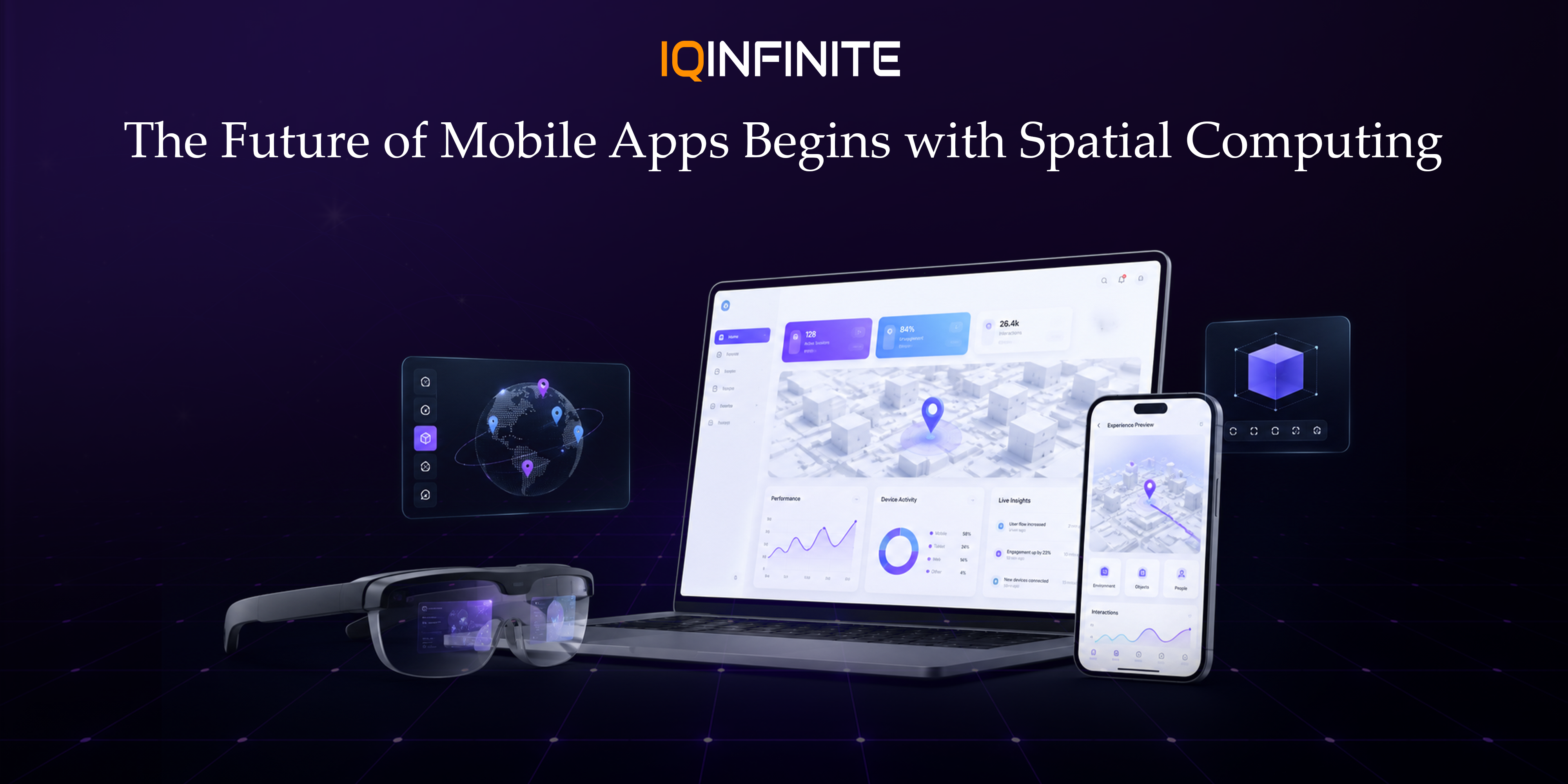
The way people interact with digital technology is evolving rapidly. Smartphones are no longer the only gateway to digital experiences. With the rise of Spatial Computing, businesses are entering a new era where digital content seamlessly blends with the physical world through Augmented Reality (AR), Virtual Reality (VR), Mixed Reality (MR), Artificial Intelligence (AI) and advanced sensors.
From retail and healthcare to manufacturing, education, gaming and real estate, spatial computing is transforming how users engage with applications. As devices like Apple Vision Pro, Meta Quest, Android XR and AI-powered smart glasses continue to gain traction, businesses must rethink how they approach AI Mobile App Development, Enterprise Mobile App Development and next-generation digital experiences.
What is Spatial Computing?
Unlike traditional mobile applications that rely on touchscreens, spatial computing allows users to interact naturally using:
- Hand gestures
- Eye tracking
- Voice commands
- Body movements
- 3D object recognition
- Environmental mapping
Why Spatial Computing is Becoming the Next Big Technology Trend
AI-Powered Environment Understanding:Modern AI models can recognize rooms, furniture, people, objects and surroundings in real time, making AR experiences far more intelligent and interactive. This evolution is also driving innovation in AI App Development by enabling context-aware mobile experiences.
Advanced AR and VR Hardware:Devices are becoming lighter, more powerful and more affordable, enabling businesses to create enterprise-grade immersive applications through modern Mobile App Development Services.
Faster 5G and Edge Computing:Ultra-low latency networks allow real-time rendering of 3D environments, cloud processing and seamless collaboration across locations. The rise of Edge Computing Mobile Apps enables faster processing, reduced latency and enhanced user experiences.
Powerful Mobile Devices:Today's smartphones are equipped with LiDAR sensors, advanced cameras, AI chips and high-performance GPUs capable of supporting complex spatial applications across Android App Development and iOS ecosystems.
Growing Enterprise Adoption:Organizations are investing in spatial technologies to improve training, remote collaboration, product visualization and customer engagement.
Key Technologies Behind Spatial Computing
Augmented Reality (AR):AR overlays digital content onto the real world through smartphones, tablets or smart glasses. It is widely used for virtual product previews, interactive shopping, indoor navigation and maintenance support.
Virtual Reality (VR):VR creates fully immersive digital environments using specialized headsets. Common applications include employee training, gaming, virtual tourism and medical simulations.
Mixed Reality (MR):Mixed Reality merges physical and digital environments, allowing virtual objects to interact with the real world. It is commonly used for collaborative workspaces, industrial maintenance and 3D design visualization.
Artificial Intelligence (AI):AI powers intelligent spatial experiences through object detection, scene understanding, gesture recognition, voice interaction and personalized user recommendations.
Computer Vision:Computer vision enables devices to analyze and understand images and videos, allowing accurate recognition of objects, faces, environments and user movements.
IoT Integration:IoT connects smart devices to share real-time data, enabling spatial applications to deliver intelligent experiences across homes, healthcare, manufacturing and smart workplaces.
How Mobile Apps are Evolving with Spatial Computing
Instead of clicking menus and buttons, users can:
- Walk through virtual stores
- Visualize furniture inside their homes
- Attend immersive meetings
- Interact with 3D product models
- Navigate indoor environments using AR
- Receive contextual information based on location
Benefits of Spatial Computing for Businesses
Enhanced Customer Engagement:Immersive experiences capture attention and increase user interaction compared to traditional mobile interfaces.
Better Decision Making:Interactive 3D visualization helps customers and employees make faster, more informed decisions.
Improved Productivity:Hands-free interfaces, guided workflows and AI-assisted operations streamline complex tasks.
Reduced Training Costs:Virtual simulations allow employees to practice safely without requiring physical equipment.
Higher Conversion Rates:Virtual product experiences increase purchase confidence and reduce abandoned shopping carts.
Competitive Differentiation:Early adoption helps businesses stand out by offering innovative, engaging digital experiences.
Challenges in Spatial Computing Development
Hardware Adoption:Advanced AR and VR devices are still gaining mainstream adoption, though smartphones continue to provide an accessible entry point.
Development Complexity:Building high-quality spatial applications requires expertise in 3D design, computer vision, AI and cross-platform development.
Privacy and Security:Spatial applications often process camera feeds, location data and environmental information, making strong privacy protections and secure data handling essential.
Performance Optimization:Rendering 3D environments and AI processing demands optimized applications to maintain smooth performance and battery efficiency.
Best Practices for Building Spatial Mobile Applications
- Design intuitive, gesture-based interactions.
- Optimize 3D assets for smooth performance.
- Use AI for personalized and context-aware experiences.
- Ensure compatibility across Android, iOS and emerging XR devices.
- Prioritize user privacy with transparent data collection practices.
- Integrate cloud services and edge computing for scalable performance.
- Conduct extensive real-world testing in different environments.
- Build modular architectures that support future hardware advancements.
Future Trends in Spatial Computing
AI-Native Spatial Interfaces:Applications will understand user intent, context and surroundings to deliver highly personalized interactions.
Smart Glasses Becoming Mainstream:Lightweight AI-powered glasses will gradually replace many smartphone interactions for navigation, communication and productivity.
Digital Twins:Businesses will increasingly create real-time digital replicas of factories, buildings and infrastructure for monitoring, simulation and predictive maintenance.
Enterprise Collaboration:Remote teams will collaborate in immersive 3D workspaces with shared virtual content, improving productivity across distributed organizations.
Spatial Commerce:Online shopping will evolve into immersive experiences where customers explore virtual stores, compare products in 3D and make purchases within spatial environments.
AI-Powered Personal Assistants:Context-aware assistants will use spatial awareness to provide real-time guidance, recommendations and automation based on the user's environment.
Conclusion
Organizations that begin investing in spatial-ready mobile applications today will be better positioned to meet evolving customer expectations, improve operational efficiency and stay competitive in the next generation of digital innovation. The future of mobile apps is no longer confined to screens it is expanding into the spaces where we live, work and connect.