
Why the Software Market Still Has Plenty of Runway in 2025-2030
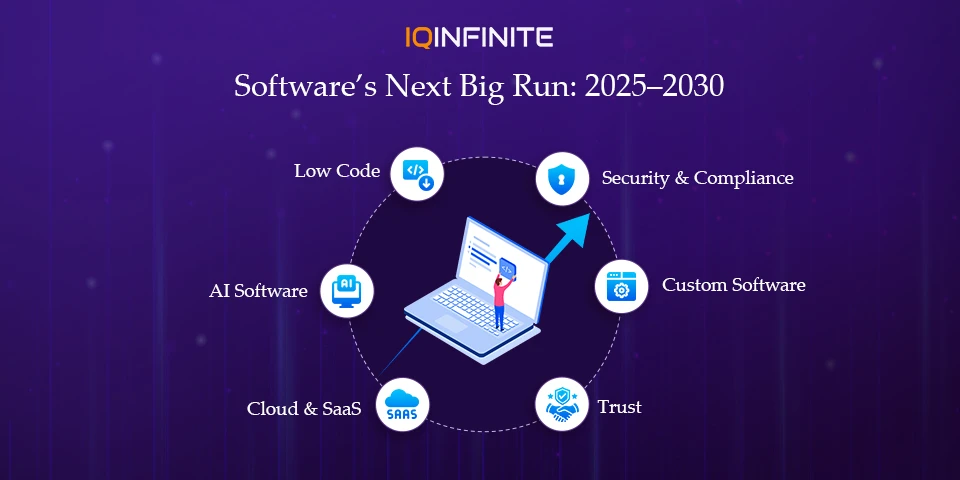
The software industry has never been bigger but it’s also nowhere near its peak.
From AI-powered enterprise tools to low-code development platforms, we’re entering a new growth phase where software isn’t just supporting business it’s becoming the business itself.
According to Precedence Research, the global software market is set to grow from $823.9 billion in 2025 to nearly $2.25 trillion by 2034, expanding at an impressive 11.8% CAGR. That’s proof the runway is long and the engines are still firing.
Let’s break down what’s fueling this next wave of growth.
1. AI Is Powering a New Software Economy
Generative AI and intelligent automation have moved from hype to tangible ROI. Today, over 78% of organizations leverage AI in at least one business function spanning chatbots, analytics, design, coding and customer service.
We’re witnessing the rise of AI-native software applications built around intelligence rather than just features. These tools learn, adapt and make autonomous decisions, transforming functions across finance, marketing, HR and logistics.
For software vendors, this shift means:
We’re witnessing the rise of AI-native software applications built around intelligence rather than just features. These tools learn, adapt and make autonomous decisions, transforming functions across finance, marketing, HR and logistics.
For software vendors, this shift means:
- From static to dynamic: Software is evolving into adaptive, self-learning systems.
- AI as baseline, not bonus: Integration of intelligence is now an expectation, not a differentiator.
2. Cloud & SaaS Are Redefining the Business Model
The global shift to SaaS and cloud-native platforms isn’t slowing it’s accelerating.
We’ve entered what experts call “SaaS 3.0”, an era where software is:
We’ve entered what experts call “SaaS 3.0”, an era where software is:
- Smarter: AI-powered personalization drives better insights and user experiences.
- More flexible: Usage-based and outcome-driven pricing models replace rigid licensing.
- Easier to scale: Hybrid and multi-cloud architectures enable rapid growth and global reach.
Enterprises aren’t just adopting software they’re rebuilding business processes around it. This ongoing digital transformation ensures SaaS will remain the backbone of enterprise growth for the decade ahead.
3. The Rise of Low-Code, No-Code & Custom Development
By 2030, Gartner predicts 70% of new enterprise applications will be built with low-code or no-code platforms.
This shift empowers non-developer's operations, marketers and analysts to create solutions on demand, while demand for custom software continues to soar, growing nearly twice as fast as the overall market.
The message is clear: companies no longer adapt their workflows to software they expect software that adapts to their workflows.
This shift empowers non-developer's operations, marketers and analysts to create solutions on demand, while demand for custom software continues to soar, growing nearly twice as fast as the overall market.
The message is clear: companies no longer adapt their workflows to software they expect software that adapts to their workflows.
4. Global Expansion: The APAC Advantage
The fastest-growing software markets are no longer centered in Silicon Valley they’re in Asia-Pacific.
India, Southeast Asia and the Middle East are emerging as software innovation hubs, not just outsourcing centers. India’s software products market is booming, fueled by Agile, DevOps and AI adoption.
Startups across APAC are building industry-specific solutions in fintech, healthtech and edtech, intensifying global competition.
This regional momentum is adding billions to global software revenues and reshaping where the next wave of innovation comes from.
India, Southeast Asia and the Middle East are emerging as software innovation hubs, not just outsourcing centers. India’s software products market is booming, fueled by Agile, DevOps and AI adoption.
Startups across APAC are building industry-specific solutions in fintech, healthtech and edtech, intensifying global competition.
This regional momentum is adding billions to global software revenues and reshaping where the next wave of innovation comes from.
5. Trust, Security & Compliance Are the New Value Drivers
As AI, cloud and data-sharing accelerate, security is no longer optional it’s foundational.
Enterprises are prioritizing investments in:
Enterprises are prioritizing investments in:
- Zero-trust frameworks to safeguard access
- AI-driven threat detection for proactive protection
- Data governance & privacy-by-design to ensure compliance
Vendors that embed trust, transparency and compliance into their products don’t just protect customers they earn loyalty and long-term market share.
6. What’s Next: The Software Supercycle
Between 2025 and 2030, the software market is poised for a supercycle of innovation:
- AI everywhere: 100% of enterprise-grade solutions will integrate intelligent capabilities.
- Converged technologies: AI, cloud and edge computing will operate seamlessly together.
- Vertical expansion: Industry-specific platforms will dominate, tailored to unique business needs.
- Evolved monetization: Subscription- and usage-based models will continue to redefine value creation.
The future isn’t just more software it’s smarter, faster and adaptive, continuously learning and evolving alongside the businesses it powers.
Conclusion
The last decade was defined by digitization. The next one will be defined by intelligence, adaptability and scale. The software market still has immense runway innovation isn’t slowing, it’s diversifying, decentralizing and democratizing.
In short: Software isn’t plateauing it’s powering the next era of global growth.
In short: Software isn’t plateauing it’s powering the next era of global growth.