
The Shift from Human-Centered Design to Human-Centered AI in UX Design
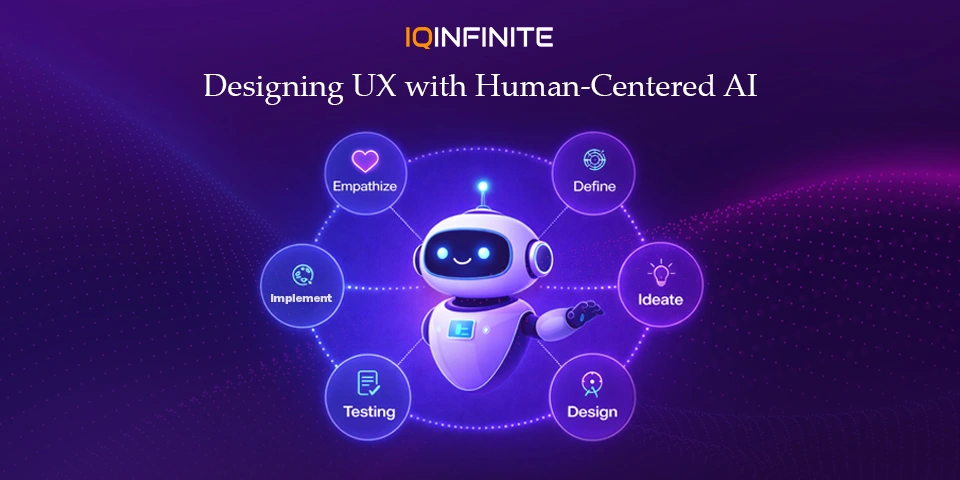
UX design has always been rooted in understanding people. For decades, designers have focused on creating products that are usable, accessible and meaningful. This philosophy, commonly known as human-centered design (HCD), has shaped how digital experiences are researched, designed and improved.
Today, however, UX design is evolving. Artificial intelligence is no longer just a backend technology; it actively influences decisions, recommendations and user interactions. This shift has introduced a new design responsibility: ensuring that intelligent systems remain aligned with human needs. As a result, UX is moving toward human-centered AI (HCAI), where AI systems are designed to support, not replace, human judgment.
This blog explores how UX design is transitioning from traditional human-centered design to human-centered AI and what this means for designers in 2026 and beyond.
Understanding Human-Centered Design in UX
At its core, human-centered design principles focus on:
- Understanding user needs and contexts
- Designing solutions through continuous feedback
- Prioritizing accessibility and inclusivity
- Aligning business goals with user value
The Role of Human-Centered Design Thinking
Human-centered design thinking encourages teams to:
- Explore problems before jumping to solutions
- Test ideas early and often
- Learn from failures and user feedback
- Continuously refine experiences
Why UX Design Is Shifting Toward Human-Centered AI
This is where human-centered AI (HCAI) becomes essential. Instead of designing AI purely for efficiency or automation, HCAI ensures that intelligent systems are built around human values.
Human-centered AI focuses on:
- Transparency in AI-driven decisions
- Maintaining user control and oversight
- Reducing bias and unintended outcomes
- Supporting human goals rather than replacing them
How Human-Centered Design Evolves in the AI Era
In AI-powered products, UX designers must consider:
- How AI decisions are explained to users
- How errors and uncertainty are communicated
- How users can intervene or correct outcomes
- How trust is built over time
Human-Centered Design Examples in Traditional UX
Common human-centered design examples include:
- Simplified onboarding experiences based on user testing
- Accessible interfaces for users with disabilities
- Navigation systems designed around real user behavior
- Continuous improvements based on usability feedback
Human-Centered AI Examples in Modern Products
Effective human-centered AI examples include:
- Recommendation systems that explain why content is suggested
- AI assistants that allow users to refine or reject outputs
- Predictive tools that show confidence levels or uncertainty
- Automated systems that keep humans in control of final decisions
The UX Designer’s Role in Human-Centered AI
Designers working with AI systems are responsible for:
- Designing trust and explainability into experiences
- Anticipating ethical and social impacts
- Ensuring inclusivity across diverse user groups
- Collaborating closely with engineers and data teams
Challenges in Designing Human-Centered AI
Common challenges include:
- Limited visibility into AI decision-making
- Difficulty explaining complex models to users
- Balancing automation with user control
- Managing expectations around AI accuracy
Best Practices for UX Teams Adopting Human-Centered AI
Recommended practices include:
- Involving UX designers early in AI product planning
- Testing AI behavior, not just interfaces
- Designing clear feedback and correction mechanisms
- Documenting AI decisions in user-friendly language
The Future of UX Design in an AI-Driven World
As human-centered AI (HCAI) becomes more widespread:
- UX design will play a key role in ethical AI adoption
- Trust and transparency will become core UX metrics
- Human values will remain central to product success
Conclusion
Embracing human-centered AI (HCAI) ensures that as technology advances, human needs, trust and understanding remain at the heart of UX design.