
Self-Healing Infrastructure: The Next Evolution of DevOps Automation
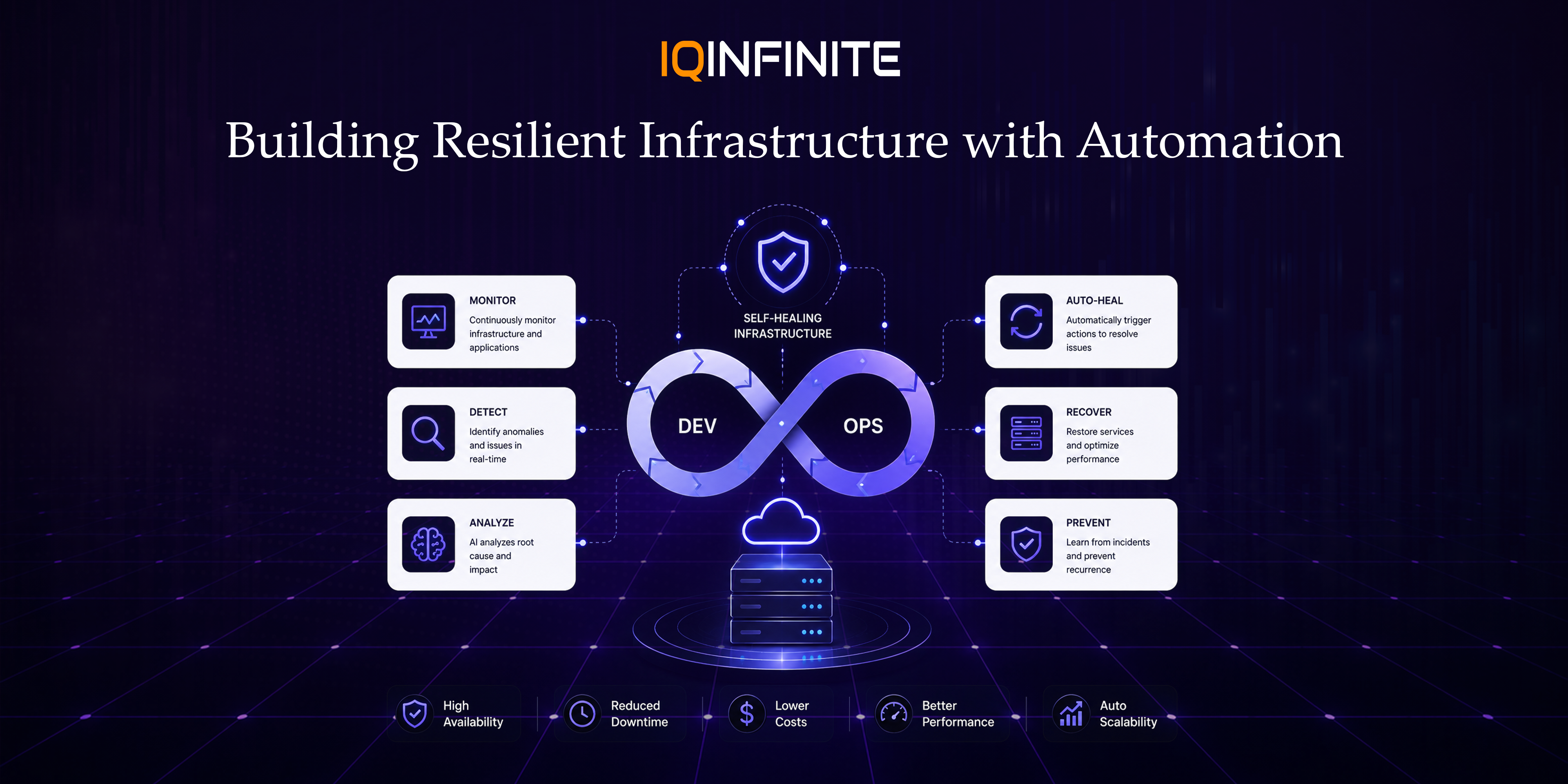
In today's cloud-native world, businesses expect applications to be available 24/7 with minimal downtime. Traditional DevOps practices have significantly improved software delivery through Continuous Integration (CI), Continuous Delivery (CD), Infrastructure as Code (IaC) and automated monitoring. However, modern distributed systems have become increasingly complex, making manual incident response slower and more expensive.
This is where Self-Healing Infrastructure is transforming the future of DevOps automation. By combining AI, observability and cloud infrastructure automation, organizations are building intelligent systems capable of managing failures with minimal human intervention.
As businesses continue adopting Kubernetes, serverless computing, microservices and multi-cloud environments, self-healing infrastructure is emerging as the next evolution of DevOps automation, enabling autonomous infrastructure that can monitor, repair and optimize itself in real time.
What is Self-Healing Infrastructure?
Unlike traditional monitoring systems that simply send alerts, self-healing infrastructure actively resolves problems before they impact users.
A typical self-healing workflow includes:
- Continuous health monitoring
- AI-powered anomaly detection
- Root cause analysis
- Automated remediation
- Validation after recovery
- Continuous learning and optimization
Reduce downtime, eliminate repetitive manual tasks, improve reliability and allow DevOps teams to focus on innovation rather than firefighting.
Why Traditional DevOps Automation Is No Longer Enough
- Thousands of microservices running simultaneously
- Multi-cloud and hybrid cloud deployments
- Kubernetes clusters across multiple regions
- Dynamic infrastructure scaling
- Increasing cybersecurity threats
- Millions of application logs and metrics generated every day
- Investigating alerts
- Identifying root causes
- Restarting failed services
- Scaling infrastructure manually
- Recovering workloads
Self-healing infrastructure addresses these challenges by enabling systems to recover automatically without waiting for human intervention.
Core Components of Self-Healing Infrastructure
1. Observability
This comprehensive visibility helps detect anomalies before they become critical incidents.
Key observability capabilities include:
- Distributed tracing
- Centralized logging
- Infrastructure monitoring
- Performance analytics
- User experience monitoring
2. AI-Powered Anomaly Detection
Rather than relying solely on static alert thresholds, AI identifies unusual patterns such as:
- Unexpected CPU spikes
- Memory leaks
- Network latency
- Error rate increases
- Database performance degradation
Examples include:
3. Automated Remediation
- Restarting failed containers
- Replacing unhealthy virtual machines
- Scaling Kubernetes pods
- Clearing cache
- Restarting services
- Rolling back failed deployments
- Switching traffic to healthy regions
4. Infrastructure as Code (IaC)
If a server becomes unhealthy, the infrastructure can simply replace it with a fresh instance.
Popular IaC tools include:
- Terraform
- OpenTofu
- Pulumi
- AWS CloudFormation
- Azure Bicep
5. Policy-Driven Automation
For example:
- Restart workloads after repeated failures
- Auto-scale during traffic spikes
- Replace unhealthy nodes
- Block suspicious network traffic
- Roll back unstable deployments
The Role of AI Agents in Self-Healing Infrastructure
Unlike traditional automation scripts, AI agents can:
- Analyse infrastructure health continuously
- Correlate multiple alerts
- Predict failures
- Recommend fixes
- Execute remediation actions
- Learn from previous incidents
Many organizations are integrating AI agents into their DevOps workflows to improve operational efficiency and reduce manual workloads.
Self-Healing Infrastructure in Kubernetes
These include:
- Automatic pod restarts
- Replica management
- Health checks
- Node replacement
- Self-scheduling workloads
- Auto-scaling
Benefits of Self-Healing Infrastructure
Faster Incident Response:Recovery actions begin immediately after detecting failures, eliminating delays caused by manual intervention.
Lower Operational Costs:Automation reduces repetitive maintenance tasks, allowing DevOps engineers to focus on higher-value initiatives.
Improved Customer Experience:Applications remain stable, responsive and available, leading to greater customer satisfaction and trust.
Increased Scalability:Self-healing systems can automatically adapt to growing workloads without requiring continuous manual management.
Enhanced Security:Automated policies can isolate compromised workloads, rotate credentials, enforce compliance and respond to suspicious activities in real time.
Real-World Use Cases
E-commerce Platforms:Automatically scale services during high-traffic shopping events and recover failed application instances without affecting customers.
Financial Services:Maintain high availability for payment systems while automatically responding to infrastructure failures and security threats.
SaaS Platforms:Detect application slowdowns, restart unhealthy services and optimize resource allocation automatically.
Healthcare Systems:Ensure uninterrupted access to critical applications through automated failover and continuous infrastructure monitoring.
Manufacturing & IoT:Recover edge devices, restart data pipelines and maintain uninterrupted communication across connected systems.
Best Practices for Building Self-Healing Infrastructure
- Adopt Infrastructure as Code for consistent and repeatable deployments.
- Implement comprehensive observability using logs, metrics and distributed tracing.
- Define automated remediation workflows for common operational issues.
- Use AI-powered anomaly detection instead of relying solely on static alert thresholds.
- Regularly test recovery scenarios through chaos engineering and disaster recovery exercises.
- Secure automation workflows with role-based access control and policy enforcement.
- Continuously review and optimize automation rules based on production insights.
Future Trends in Self-Healing DevOps
Key trends shaping the future include:
- AI-driven Platform Engineering
- Autonomous cloud operations
- Predictive infrastructure maintenance
- Agentic AI for DevOps
- Intelligent GitOps workflows
- Autonomous Kubernetes management
- Generative AI-assisted incident response
- FinOps automation for cloud cost optimization
- Digital twins for infrastructure simulation
- Unified observability powered by AI
Conclusion
As cloud-native applications continue to grow in complexity, businesses that invest in self-healing infrastructure will benefit from improved reliability, faster incident resolution, reduced operational costs and enhanced customer experiences. In 2026 and beyond, autonomous infrastructure is no longer a futuristic concept it is becoming a practical strategy for building resilient, scalable and always-on digital platforms.