
Saas Product Designs that converts from first click to long term Loyalty
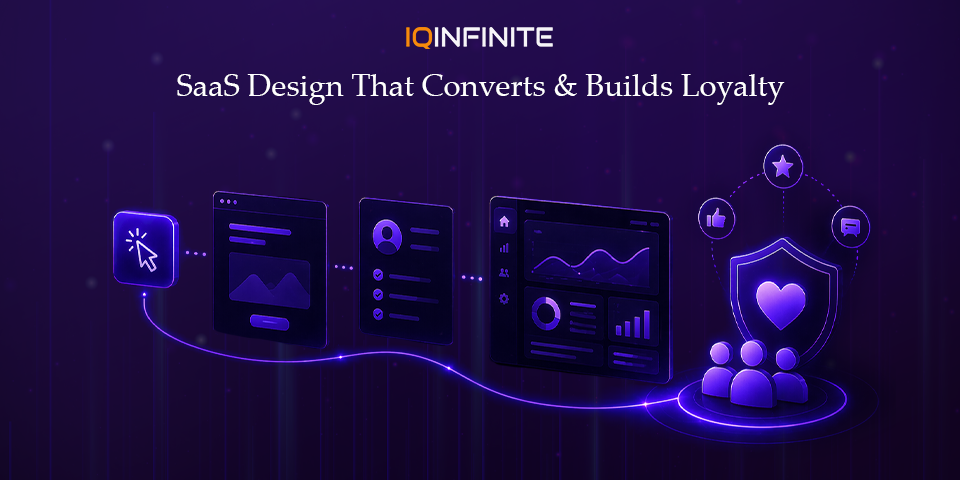
In today’s hyper-competitive SaaS landscape, great features are no longer enough. Users decide within seconds whether your product is worth their time and if the experience feels confusing, slow or irrelevant, they leave just as quickly.
The real differentiator? Conversion-focused SaaS design that guides users effortlessly from first interaction to long-term engagement.
This blog explores how modern SaaS product design powered by AI, behavioural UX and workflow-first thinking drives conversion, retention and loyalty through high-converting SaaS UI UX strategies and stronger SaaS conversion rate optimization.
1. First Impressions: Designing for Instant Clarity
Users don’t explore they scan. Within seconds, they ask:
“Does this solve my problem?”
If your UI fails to answer that immediately, conversion drops.
What works today:
“Does this solve my problem?”
If your UI fails to answer that immediately, conversion drops.
What works today:
- Clear value proposition above the fold
- Minimal cognitive load (no clutter, no confusion)
- Strong visual hierarchy guiding attention
Modern SaaS design emphasizes speed of understanding over visual beauty. Users prioritize clarity and ease over aesthetics.
Insight: A clean interface isn’t enough it must communicate value instantly.
Insight: A clean interface isn’t enough it must communicate value instantly.
2. Frictionless Onboarding = Higher Activation
The biggest drop-off happens during onboarding. If users feel lost, they abandon.
A strong SaaS onboarding experience design ensures users reach value quickly without confusion.
High-converting onboarding patterns:
A strong SaaS onboarding experience design ensures users reach value quickly without confusion.
High-converting onboarding patterns:
- Progressive disclosure (one step at a time)
- Interactive walkthroughs instead of static tutorials
- “Next best action” guidance inside UI
SaaS products that simplify onboarding can reduce time-to-value dramatically and improve retention early in the lifecycle.
Insight: Don’t “teach” your product guide users through doing.
Insight: Don’t “teach” your product guide users through doing.
3. AI-Driven Personalization: The New Standard
Modern SaaS products are no longer static they adapt in real time.
How AI improves conversion:
How AI improves conversion:
- Personalized dashboards based on behaviour
- Smart recommendations and automation
- Context-aware UI elements
AI-driven personalization increases engagement and retention by making the product feel tailored to each user.
Insight: Users don’t want features they want relevance.
Insight: Users don’t want features they want relevance.
4. Workflow-First Design (Not Feature-First)
A major shift in SaaS is happening:
From feature-heavy tools → to workflow-driven experiences
Products that integrate seamlessly into users’ daily workflows outperform those that simply offer more features.
What this means:
From feature-heavy tools → to workflow-driven experiences
Products that integrate seamlessly into users’ daily workflows outperform those that simply offer more features.
What this means:
- Design around user goals, not features
- Reduce steps between intention → outcome
- Align UI with real-world tasks
Insight: The best SaaS products don’t feel like tools they feel like part of the user’s workflow.
5. Adaptive & Role-Based Interfaces
Not all users are the same so why show them the same UI?
Modern SaaS platforms now deliver:
Modern SaaS platforms now deliver:
- Role-based dashboards (e.g., admin vs user views)
- Behaviour-based customization
- Context-aware navigation
Adaptive interfaces improve usability and reduce overwhelm by showing only what matters to each user.
Insight: Personalization isn’t optional it’s expected.
Insight: Personalization isn’t optional it’s expected.
6. Micro-Interactions & Feedback Loops
Small design details create big engagement.
Examples:
Examples:
- Button animations
- Real-time feedback (loading, success states)
- Interactive dashboards
These micro-interactions:
- Improve usability
- Build emotional connection
- Encourage continued usage
Modern SaaS design uses these subtle cues to create delight and confidence.
Insight: Users stay longer when the product feels responsive and alive.
Insight: Users stay longer when the product feels responsive and alive.
7. Performance & Speed = Retention
Even the best design fails if performance is slow.
Critical factors:
Critical factors:
- Fast load times
- Smooth transitions
- Real-time responsiveness
Users associate speed with quality. A slow interface increases churn even if the product is powerful.
Insight: Performance is not engineering it’s UX.
Insight: Performance is not engineering it’s UX.
8. Building Trust Through Design
Conversion doesn’t stop at signup trust drives long-term loyalty.
Trust-building elements:
Trust-building elements:
- Transparent pricing
- Clear error messages
- Data security indicators
- Social proof (testimonials, logos)
Users need confidence at every step before committing long-term.
Insight: Trust is designed not assumed.
Insight: Trust is designed not assumed.
9. Gamification & Engagement Mechanics
Retention is driven by engagement not just utility.
Modern techniques:
Modern techniques:
- Progress tracking
- Rewards and achievements
- Usage streaks
Gamification increases interaction frequency and builds habit loops within SaaS products.
Insight: The more users engage, the harder it is to leave.
Insight: The more users engage, the harder it is to leave.
10. Continuous Optimization Through Data
Top SaaS companies don’t guess they test.
Data-driven design includes:
Data-driven design includes:
- A/B testing onboarding flows
- Heatmaps and session recordings
- Feature usage tracking
Small UX changes can significantly improve:
- Conversion rates
- Feature adoption
- Retention
Insight: Great SaaS design is never finished it evolves.
Conclusion
SaaS success today isn’t defined by how many features you ship it’s defined by how little friction users feel.
The products that win don’t overwhelm users they guide them with precision.
They don’t stay static they adapt in real time.
They don’t interrupt workflows they become part of them.
And they don’t settle they continuously evolve through data and feedback.
From the very first click to long-term loyalty, every interaction compounds into either trust or drop-off.
The products that win don’t overwhelm users they guide them with precision.
They don’t stay static they adapt in real time.
They don’t interrupt workflows they become part of them.
And they don’t settle they continuously evolve through data and feedback.
From the very first click to long-term loyalty, every interaction compounds into either trust or drop-off.