
Design Without Limits: Responsive and Adaptive Solutions for Modern Users
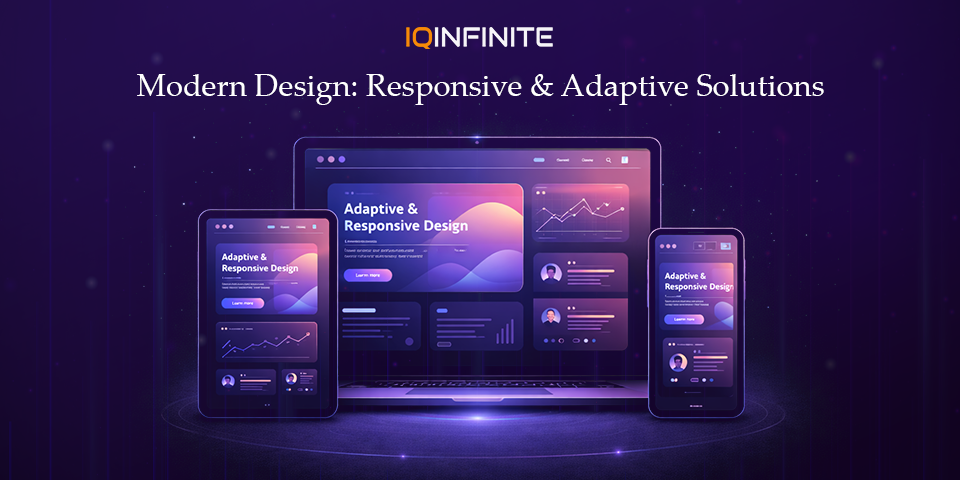
In today’s fast-evolving digital ecosystem, design is no longer confined to static layouts or device-specific interfaces. Modern users expect seamless, intuitive and personalized experiences regardless of device, context or environment.
This shift has led to the rise of responsive and adaptive design for modern users, enabling businesses to improve user experience across devices while maintaining consistency and performance.
By 2026, design has evolved beyond aesthetics into a context-aware, data-driven discipline where systems respond intelligently to user behaviour in real time.
Understanding Responsive vs Adaptive Design
Responsive Design
Responsive design focuses on fluid layouts that automatically adjust to different screen sizes using flexible grids, images and CSS media queries. It ensures:
- Seamless experience across devices (mobile, tablet, desktop)
- Consistent UI/UX
- Cost-effective development
Modern responsive approaches now rely heavily on fluid responsive design systems to ensure layouts adapt smoothly across an ever-growing range of devices.
Adaptive Design
Adaptive design goes a step further by creating multiple layouts tailored to specific devices or user contexts. It leverages data such as user behaviour, location, device type and preferences to create a seamless responsive user experience design that adapts dynamically rather than simply resizing content.
Why “Design Without Limits” Matters Today
Modern users interact with digital products across multiple touchpoints smartphones, wearables, smart TVs and even voice interfaces. As a result:
- Users expect frictionless, fast and intuitive experiences
- Businesses must design for scalability and flexibility
- Interfaces must adapt to real-world usage conditions
Studies show adaptive interfaces can significantly improve engagement and task completion, highlighting their business impact.
Key Trends Shaping Modern Responsive & Adaptive Design
1. AI-Powered Personalization
Artificial Intelligence has evolved from a supporting tool into the backbone of modern design systems. Today’s interfaces are no longer static they are intelligent and adaptive.
AI enables systems to:
AI enables systems to:
- Learn user behaviour patterns
- Predict user needs in real time
- Dynamically adjust UI elements
This results in hyper-personalized dashboards, tailored recommendations and highly efficient user workflows, significantly enhancing user satisfaction and engagement.
2. Context-Aware Interfaces
Modern applications are increasingly designed to respond to user context rather than just device specifications.
Interfaces now adapt based on:
Interfaces now adapt based on:
- Time of day
- User location and environment
- Device type and usage behaviour
This creates experiences that feel intuitive, relevant and seamlessly integrated into users’ daily routines.
3. Fluid & Flexible Layout Systems
Responsive design in 2026 goes beyond traditional breakpoints. It embraces fluidity and adaptability at every level.
Key components include:
Key components include:
- Fluid grid systems
- Dynamic and content-driven breakpoints
- Card-based and modular UI architectures
These approaches ensure consistent and seamless experiences across a wide range of devices and screen sizes.
4. Minimalism with Intelligent Interactions
Minimalist design continues to dominate, but it is now enhanced with purposeful interactivity.
Modern interfaces incorporate:
Modern interfaces incorporate:
- Micro-interactions for user guidance
- Subtle animations for visual feedback
- Real-time system responses
This balance improves usability while maintaining a clean and distraction-free interface.
5. Voice & Conversational Interfaces
User interaction is shifting beyond traditional touch and click-based navigation.
Emerging interaction methods include:
Emerging interaction methods include:
- Voice assistants
- AI-powered chatbots
- Natural language interfaces
These technologies reduce friction, improve accessibility and create more human-centric digital experiences.
6. Accessibility & Inclusive Design
Accessibility is no longer a secondary consideration it is a fundamental design principle.
Design strategies now focus on:
Design strategies now focus on:
- Inclusive experiences for diverse user groups
- Adaptive interfaces for varying abilities
- Compliance with global accessibility standards
Prioritizing accessibility ensures broader reach, better usability and stronger brand credibility.
7. Immersive & Multi-Device Experiences
With the rise of AR, VR and spatial computing, digital experiences are expanding beyond traditional screens.
Key advancements include:
Key advancements include:
- Immersive 3D interfaces
- Cross-device continuity
- Real-world interaction layers
Users can now interact with digital products in more engaging and realistic environments.
Technologies Enabling Limitless Design
Modern responsive and adaptive design is powered by a robust technology ecosystem:
- AI & Machine Learning → Drive personalization and predictive user experiences
- 5G & Edge Computing → Enable ultra-fast, real-time responsiveness
- Progressive Web Apps (PWAs) → Deliver app-like performance on the web
- Design Systems & Component Libraries → Ensure scalability and consistency
- APIs & Microservices Architecture → Provide flexibility and seamless integration
These technologies empower businesses to build scalable, high-performance and future-ready digital products.
Best Practices for Modern Designers
To create truly adaptive and future-proof experiences:
1. Design for Context, Not Just Screens
Focus on complete user journeys rather than individual devices.
2. Prioritize Performance
Speed, responsiveness and load time directly influence user retention and satisfaction.
3. Build Modular Design Systems
Reusable components ensure consistency, faster development and scalability.
4. Embrace Data-Driven Design
Leverage analytics and user insights to continuously optimize experiences.
5. Test in Real-World Scenarios
Validate designs across environments, devices and user conditions to ensure adaptability.
1. Design for Context, Not Just Screens
Focus on complete user journeys rather than individual devices.
2. Prioritize Performance
Speed, responsiveness and load time directly influence user retention and satisfaction.
3. Build Modular Design Systems
Reusable components ensure consistency, faster development and scalability.
4. Embrace Data-Driven Design
Leverage analytics and user insights to continuously optimize experiences.
5. Test in Real-World Scenarios
Validate designs across environments, devices and user conditions to ensure adaptability.
Business Impact of Responsive & Adaptive Design
Organizations that adopt modern design strategies gain measurable advantages:
- Increased user engagement
- Higher conversion rates
- Improved customer retention
- Reduced long-term development costs
More importantly, they establish long-term user trust and deliver consistent, high-quality digital experiences critical factors in today’s competitive landscape.
Conclusion
“Design without limits” is not just a concept it’s a necessity in 2026. Responsive and adaptive design empower businesses to create experiences that are not only visually appealing but also intelligent, inclusive and future-ready.
As technology continues to evolve, the focus will shift even further toward predictive, autonomous and deeply personalized interfaces. Companies that embrace these innovations today will be the ones leading tomorrow’s digital experiences.
As technology continues to evolve, the focus will shift even further toward predictive, autonomous and deeply personalized interfaces. Companies that embrace these innovations today will be the ones leading tomorrow’s digital experiences.