
PHP Process Isolation vs True Parallelism: What You Need to Know
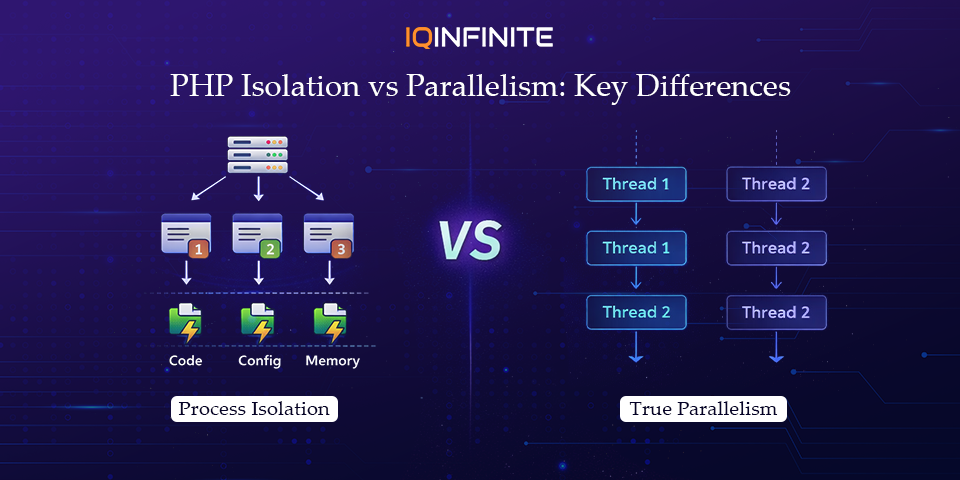
PHP has powered the web for decades, evolving from a simple scripting language into a robust backend ecosystem. However, one architectural characteristic still defines how PHP applications behave under load: process isolation.
At the same time, modern applications demand true parallelism, high concurrency and real-time responsiveness capabilities often associated with languages like Go, Node.js and Java.
So where does PHP stand today in 2026? And how should developers approach PHP parallel processing, PHP process management and how to run parallel tasks in PHP effectively?
What is Process Isolation in PHP?
Traditional PHP especially when powered by PHP-FPM operates on a multi-process architecture.
This means:
This means:
- Each incoming request is handled by a separate process
- There is no shared memory between requests
- Every execution runs in a clean, isolated environment
In simple terms, every request starts fresh, runs independently and then terminates leaving no trace behind.
Why This Matters
Advantages
- Strong Isolation by Default: Each request is sandboxed, eliminating shared-state issues and minimizing race conditions.
- Failure Containment: If one request crashes, it doesn’t affect others ensuring system stability.
- Effortless Horizontal Scaling: Stateless architecture makes it easy to scale across servers or containers.
- Clean Memory Lifecycle: Memory is reset after every request, preventing long-term memory leaks.
Trade-offs
- Higher Memory Consumption: Each process consumes its own memory, which can add up under heavy load.
- Slower Startup Time: Every request requires bootstrapping the application from scratch.
- Expensive Inter-Process Communication (IPC): Sharing data between processes is complex and resource intensive.
What is True Parallelism?
True parallelism refers to executing multiple tasks simultaneously, not just quickly switching between them.
It leverages advanced execution models such as:
It leverages advanced execution models such as:
- Threads (multiple execution paths within a process)
- Event loops (non-blocking task handling)
- Async I/O (handling I/O without waiting)
- Shared memory models (efficient data exchange between tasks)
These concepts form the foundation of PHP parallel processing when implemented through modern extensions and frameworks.
Where We See It in Action
Modern languages and runtimes are built with parallelism at their core:
- Node.js → Event-driven, non-blocking I/O
- Go → Lightweight goroutines for massive concurrency
- Java → Mature multi-threading ecosystem
Benefits of True Parallelism
- Maximized CPU Utilization: Multiple cores are actively used instead of sitting idle.
- High Throughput: Handles thousands of concurrent operations efficiently.
- Efficient Background Processing: Perfect for queues, workers and long-running tasks.
- Lower Latency for I/O-heavy Workloads: Non-blocking operations reduce wait times significantly.
Where PHP Traditionally Falls Short
PHP was originally designed for a request-response lifecycle, not continuous execution.
Key Limitations:
Key Limitations:
- No Native Threading (in most environments)
- Stateless Execution Model
- Blocking I/O Operations
- Limited Shared Memory Support
Result: Building real-time systems, streaming services or high-concurrency APIs becomes more complex compared to other ecosystems.
Modern PHP: Closing the Gap
The PHP ecosystem is evolving rapidly bringing in tools that challenge its traditional limitations.
1. Async PHP with ReactPHP & Amp
Libraries like ReactPHP and Amp introduce event-driven, non-blocking I/O.
Use Cases:
Use Cases:
- WebSockets
- Real-time APIs
- Concurrent HTTP requests
2. Laravel Octane (Swoole / RoadRunner)
Laravel Octane transforms PHP into a long-running application server using Swoole or RoadRunner.
Benefits:
Benefits:
- Eliminates repeated bootstrapping
- Massive performance gains
- Supports concurrent task execution
3. Parallel Extension
PHP’s parallel enables true multi-threading (CLI-based):
- Run tasks in parallel threads
- Share data via channels
Limitations:
- Not widely adopted in web environments
- Requires careful synchronization
4. Fibers (PHP 8.1+)
With PHP 8.1, Fibers introduced lightweight concurrency:
- Cooperative multitasking
- Foundation for async frameworks
Note: Fibers don’t provide true parallelism, but they significantly improve concurrency handling.
Process Isolation vs Parallelism: Key Differences
Execution Model
• Process Isolation → Uses separate processes for each task
• True Parallelism → Uses threads or async execution
• True Parallelism → Uses threads or async execution
Memory Handling
• Process Isolation → Fully isolated memory
• True Parallelism → Shared (but controlled) memory
• True Parallelism → Shared (but controlled) memory
Performance
• Process Isolation → Higher overhead
• True Parallelism → More efficient
• True Parallelism → More efficient
Safety
• Process Isolation → Very high (built-in isolation)
• True Parallelism → Requires careful synchronization
• True Parallelism → Requires careful synchronization
Scalability
• Process Isolation → Scales horizontally
• True Parallelism → Scales both vertically and horizontally
• True Parallelism → Scales both vertically and horizontally
Best Use Case
• Process Isolation → Web requests
• True Parallelism → Real-time systems and heavy computation
• True Parallelism → Real-time systems and heavy computation
When to Use What?
Use Process Isolation When:
- You are building traditional web applications
- You want reliability with minimal complexity
- Your system works well with stateless APIs
Use Parallelism / Async When:
- You are building real-time features (chat, notifications)
- You need to process large datasets
- You are making multiple API calls at once
- You are building high-performance systems
Best Way to Run Background Jobs in PHP
When it comes to the best way to run background jobs in PHP, modern architectures rely on a combination of tools:
- Queue systems like Redis, RabbitMQ or Beanstalkd
- Worker processes for asynchronous execution
- Supervisor tools for process monitoring
- Laravel queues or Symfony Messenger for abstraction
This approach ensures scalable and efficient PHP process management while enabling parallel execution where needed.
Real-World Architecture (2026)
Modern PHP applications usually combine both approaches:
- PHP-FPM handles incoming requests
- Queues like Redis or RabbitMQ handle background jobs
- Async workers manage concurrency
- Octane / Swoole improve performance for critical parts
The goal is not to replace process isolation, but to enhance it with concurrency tools.
Conclusion
Process isolation is one of PHP’s biggest strengths it brings stability, simplicity and reliability.
But modern applications demand more.
The future of PHP is moving toward:
But modern applications demand more.
The future of PHP is moving toward:
- Hybrid architectures
- Async capabilities
- Long-running processes
If you understand when to use isolation and when to use parallelism, you can build systems that are both reliable and extremely fast.