
On-Device AI vs Cloud AI: Choosing the Right Architecture for Modern Mobile Apps
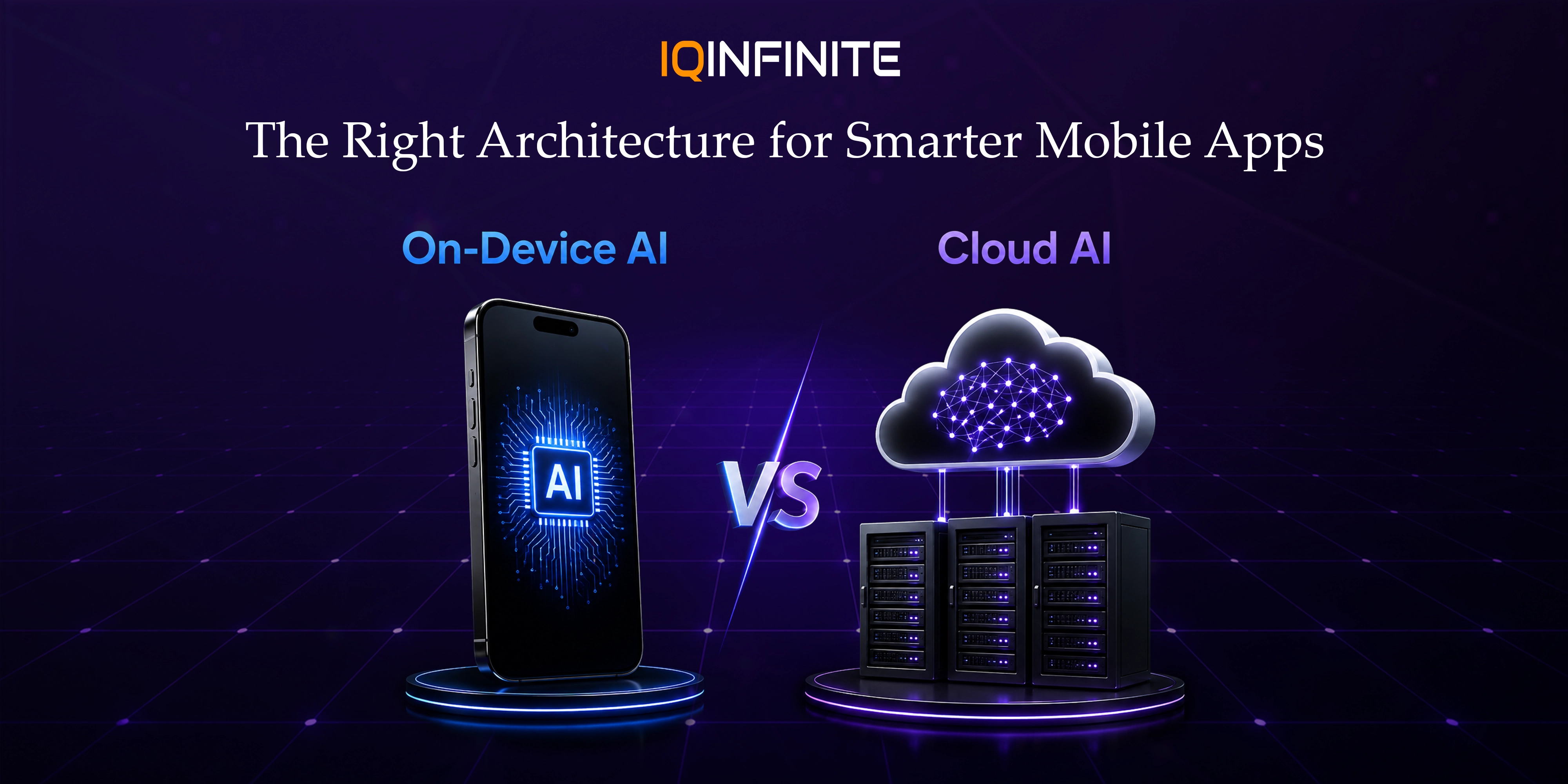
Artificial intelligence is becoming a core capability of modern mobile applications. From AI-powered search and voice assistants to personalized recommendations, computer vision, generative AI and intelligent automation, users increasingly expect mobile apps to deliver smarter and faster experiences.
The key architectural question is no longer simply where AI should run. Modern Mobile AI development is increasingly moving toward hybrid architectures, where privacy-sensitive and latency-critical tasks run locally while complex workloads are handled by cloud or edge infrastructure.
What Is On-Device AI?
On-device AI processes data and runs AI models directly on smartphones, tablets, wearables or other edge devices. Instead of sending every request to a remote server, the application uses local CPU, GPU, NPU or other AI acceleration hardware.
This approach is particularly useful when applications require:
This approach is particularly useful when applications require:
- Low latency
- Offline functionality
- Data privacy
- Real-time processing
- Reduced network dependency
Common examples include:
- Face and image recognition
- Speech-to-text
- Smart camera features
- Document scanning and OCR
- Predictive typing
- Real-time translation
- Personal recommendations
As mobile hardware becomes more capable, on-device inference is becoming increasingly practical for modern AI app development.
What Is Cloud AI?
Cloud AI moves AI inference from the mobile device to remote infrastructure operated by cloud platforms or AI model providers.
The mobile application sends data to an API or backend, the cloud processes it using powerful GPUs or other accelerators and the result is returned to the application.
Cloud AI is particularly useful for:
The mobile application sends data to an API or backend, the cloud processes it using powerful GPUs or other accelerators and the result is returned to the application.
Cloud AI is particularly useful for:
- Large language models
- Complex reasoning
- Long-context processing
- Multimodal AI
- Retrieval-augmented generation
- AI agents
- Enterprise data processing
- Centralized model management
This makes Cloud AI development a strong choice when AI workloads require more computing power than a smartphone can practically provide.
Why On-Device AI Is Becoming More Important
Mobile devices now contain increasingly powerful AI accelerators, while smaller models can be optimized for limited hardware.
Modern Mobile AI development is also expanding beyond traditional machine learning toward generative AI, small language models, multimodal AI and AI agents.
This creates an important architectural shift: instead of forcing all AI processing into the cloud, developers can distribute intelligence across the device, edge and cloud depending on the task.
Modern Mobile AI development is also expanding beyond traditional machine learning toward generative AI, small language models, multimodal AI and AI agents.
This creates an important architectural shift: instead of forcing all AI processing into the cloud, developers can distribute intelligence across the device, edge and cloud depending on the task.
Benefits of On-Device AI
Faster Experiences
Because data does not need to travel to a remote server, local inference can reduce network-related delays. This is particularly valuable for voice interactions, camera features, translation, gesture recognition and offline assistants.
Better Privacy
Sensitive information such as conversations, photos, recordings, documents and personal preferences can potentially be processed locally instead of being transmitted to external infrastructure.
For privacy-focused products, this can become an important part of the overall Mobile AI architecture.
For privacy-focused products, this can become an important part of the overall Mobile AI architecture.
Offline Functionality
On-device AI can continue working without an active internet connection, making it useful for applications operating in remote locations, poor connectivity or limited-bandwidth environments.
Reduced Cloud Costs
Processing some AI requests locally can reduce the number of calls made to cloud AI APIs. For applications with millions of users, this can potentially reduce recurring inference costs.
When Cloud AI Is the Better Choice
On-device AI has limitations. Smartphones have restricted memory, processing power, battery capacity and storage compared with cloud infrastructure.
Cloud AI development is generally more suitable when an application requires:
Cloud AI development is generally more suitable when an application requires:
- Large AI models
- Advanced reasoning
- Long context windows
- Complex multimodal processing
- Large-scale RAG
- AI agents and tool calling
- Enterprise-scale processing
- Frequent model updates
Cloud infrastructure provides significantly more computational resources, making it suitable for advanced workloads that would be impractical to run entirely on a mobile device.
Small Language Models on Mobile Devices
One of the most important trends in Mobile AI development is the growth of Small Language Models (SLMs).
Instead of running massive models directly on smartphones, developers can use smaller models optimized for specific tasks.
These models can be:
Instead of running massive models directly on smartphones, developers can use smaller models optimized for specific tasks.
These models can be:
- Quantized
- Pruned
- Distilled
- Hardware-optimized
- Task-specific
The practical principle is simple: use the smallest model capable of delivering the required result.
Hybrid AI: The Best of Both Worlds
The most practical approach for many modern applications is a hybrid Mobile AI architecture.
A hybrid system can keep simple and privacy-sensitive tasks on the device while sending complex workloads to cloud infrastructure.
For example:
A hybrid system can keep simple and privacy-sensitive tasks on the device while sending complex workloads to cloud infrastructure.
For example:
Mobile Device → Edge Infrastructure → Cloud AI → AI Agents
The device can handle voice recognition or basic personalization, while the cloud handles complex reasoning, large models, RAG or agent-based workflows.
This approach allows developers to balance:
This approach allows developers to balance:
- Performance
- Privacy
- Cost
- Scalability
- Model complexity
- User experience
For sophisticated mobile applications, hybrid architecture can provide greater flexibility than relying entirely on either on-device or cloud inference.
How to Choose the Right AI Architecture
The right architecture depends on the application's requirements.
Choose On-Device AI When:
Choose On-Device AI When:
- Low latency is critical
- Offline functionality is required
- User data is highly sensitive
- The AI task is focused
- The model fits device limitations
- You want to reduce cloud inference costs
Choose Cloud AI When:
- Advanced reasoning is required
- Large models are needed
- Workloads are computationally intensive
- Centralized model management is important
- Frequent model updates are required
- Enterprise-scale processing is necessary
Choose Hybrid AI When:
- Some operations require instant local processing
- Other tasks need powerful cloud models
- Privacy is important
- The application needs advanced AI capabilities
- The product is expected to scale significantly
Security Considerations
Moving AI inference to the device does not automatically make an application secure.
Developers still need to consider:
Developers still need to consider:
- Model extraction
- Reverse engineering
- Prompt injection
- Malicious inputs
- Data leakage
- Insecure APIs
- Model tampering
- Authentication and authorization
- Secure model updates
Cloud AI introduces different risks around API security, data transmission, third-party model providers and centralized data processing.
A strong Mobile AI architecture should therefore protect both device and cloud layers.
A strong Mobile AI architecture should therefore protect both device and cloud layers.
The Future of AI-Powered Mobile Apps
The future of mobile AI is moving toward distributed intelligence.
Instead of treating smartphones as simple interfaces for cloud AI, mobile devices are increasingly becoming intelligent computing environments themselves.
The emerging model can be represented as:
Instead of treating smartphones as simple interfaces for cloud AI, mobile devices are increasingly becoming intelligent computing environments themselves.
The emerging model can be represented as:
Device AI → Edge AI → Cloud AI → AI Agents
Each layer performs the tasks it is best suited for. Simple and privacy-sensitive operations can stay on the device, latency-sensitive workloads can move to the edge and complex reasoning can use cloud infrastructure.
This approach is particularly important as AI app development moves toward AI-native applications capable of understanding context, processing multimodal inputs, making recommendations and executing actions.
This approach is particularly important as AI app development moves toward AI-native applications capable of understanding context, processing multimodal inputs, making recommendations and executing actions.
Conclusion
The choice between on-device AI and cloud AI is no longer about selecting a single technology. Modern AI app development requires developers to distribute AI workloads based on performance, privacy, cost, device capabilities and application complexity.
On-device AI is ideal for fast, private, offline and focused intelligence. Cloud AI development remains the stronger option for large models, complex reasoning and computationally demanding workloads.
For many modern products, the most effective Mobile AI architecture will combine both approaches, creating mobile experiences that are responsive, scalable, privacy-conscious and capable of supporting increasingly sophisticated AI features.
On-device AI is ideal for fast, private, offline and focused intelligence. Cloud AI development remains the stronger option for large models, complex reasoning and computationally demanding workloads.
For many modern products, the most effective Mobile AI architecture will combine both approaches, creating mobile experiences that are responsive, scalable, privacy-conscious and capable of supporting increasingly sophisticated AI features.