
Compose Update Introduces On-Device AI for Notifications and XR
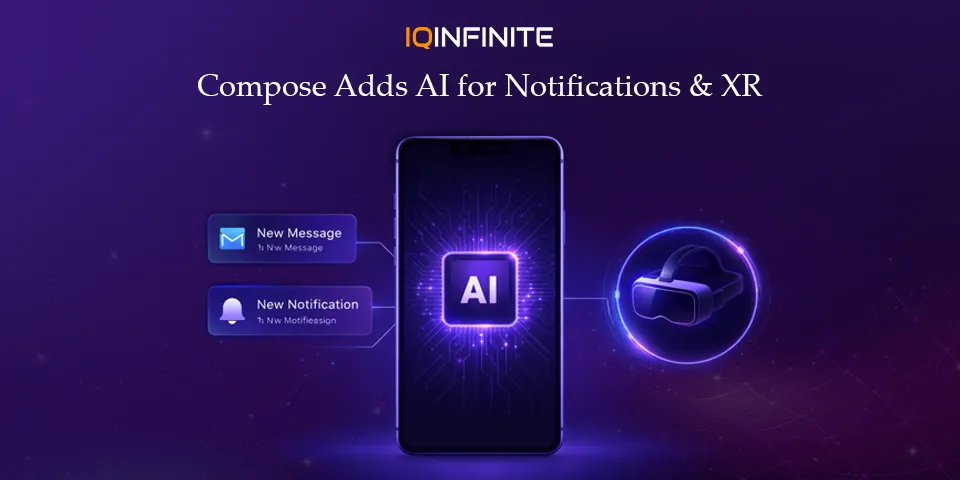
In 2026, technology updates are no longer just about visual polish or incremental improvements they’re reshaping how devices think, respond and interact with us. The latest wave of software and platform innovation places AI for Notifications and XR at the center of user experience, embedding intelligence directly into smartphones, smart glasses and mixed-reality devices.
Devices like the iPhone 18 now leverage advanced on-device AI to deliver smarter notifications, immersive extended reality (XR) environments and faster, privacy-first processing without depending entirely on cloud infrastructure.
This marks a pivotal shift toward the future of on-device AI in XR and mobile, where intelligence lives directly on the device, enabling real-time responsiveness and stronger privacy protections.
Smarter Notifications: AI That Understands Context
Traditional alerts were simple banners informative yet often overwhelming. Today, on-device AI analyzes and summarizes notifications locally, generating concise, context-aware summaries without sending personal data to remote servers.
Modern systems now:
- Group related notifications automatically
- Prioritize urgent updates
- Suppress low-value interruptions
- Summarize long message threads
- Highlight action-required alerts
On Android ecosystems, developers are increasingly implementing on-device AI in Android apps using lightweight AI models optimized for mobile chips. These models process alerts directly on the device, reducing latency and enhancing privacy.
Key advantages include:
- No cloud dependency
- Faster notification summarization
- Customizable app-level filtering
- Secure processing for sensitive data
XR Gets Smarter: AI-Powered Immersive Experiences
Smart glasses and mixed-reality headsets are integrating AI engines capable of real-time interpretation, spatial mapping and predictive assistance. Central to this evolution is the rise of the ai voice engine for xr headsets, enabling seamless hands-free control through natural language commands.
Instead of tapping screens or controllers, users can:
- Ask for contextual overlays
- Request real-time translations
- Receive meeting summaries mid-session
- Navigate environments with voice-guided prompts
AI systems in XR environments can also:
- Classify notification urgency
- Detect environmental changes
- Adapt overlays based on activity
- Learn user preferences over time
Why On-Device AI Matters Now
Here’s why it matters:
1. Performance & Responsiveness
Local AI processing delivers instant results without waiting for cloud round-trips.
2. Stronger Privacy
Sensitive information health alerts, financial updates, enterprise communications stays on the device.
3. Offline Functionality
Even in low-connectivity environments, AI-powered features continue working.
4. Context-Aware Adaptation
AI learns behavioral patterns and adjusts notifications or XR stimuli accordingly.
This convergence signals the broader future of on-device AI in XR and mobile, where privacy, personalization and performance coexist seamlessly.
Real-World Use Cases: Everyday Benefits
1. Smarter Workday Management
- Summarizes long discussions
- Groups related messages
- Highlights deadlines
- Silences non-urgent alerts
2. Intelligent Context Awareness in XR
- Detect whether you’re working, commuting or exercising
- Display navigation overlays when traveling
- Suppress social notifications during meetings
3. Enhanced Privacy for Sensitive Interactions
- Financial transactions remain secure
- Health data stays private
- Enterprise communications are processed on-device
4. Offline Intelligence
- Notifications remain organized
- Voice assistants respond instantly
- XR assistants continue functioning
5. Entertainment & Personalized Ecosystems
Gaming ecosystems now use localized AI to generate curated PS Plus games recommendations based on player behavior and play history. Instead of waiting for cloud analytics, recommendations adapt in real time, delivering faster and more private personalization.
This same principle applies across streaming, shopping and content platforms.
Developer & Business Opportunities
- Building intelligent notification frameworks
- Creating adaptive XR applications
- Designing AI-first mobile architectures
- Enhancing privacy-centric app experiences
On-device AI is no longer optional it is becoming a competitive differentiator.
Conclusion
The integration of AI agents, intelligent voice engines, contextual awareness and personalized ecosystems signals a powerful shift toward the future of on-device AI in XR and mobile.
This isn’t just about smarter devices it’s about more intuitive, private and responsive computing that adapts seamlessly to human behavior.
Expect even deeper integrations as manufacturers, OS developers and platform partners continue advancing local AI performance and privacy-first architectures.