
Beyond Chatbots: Designing Natural Conversations Between Users and AI
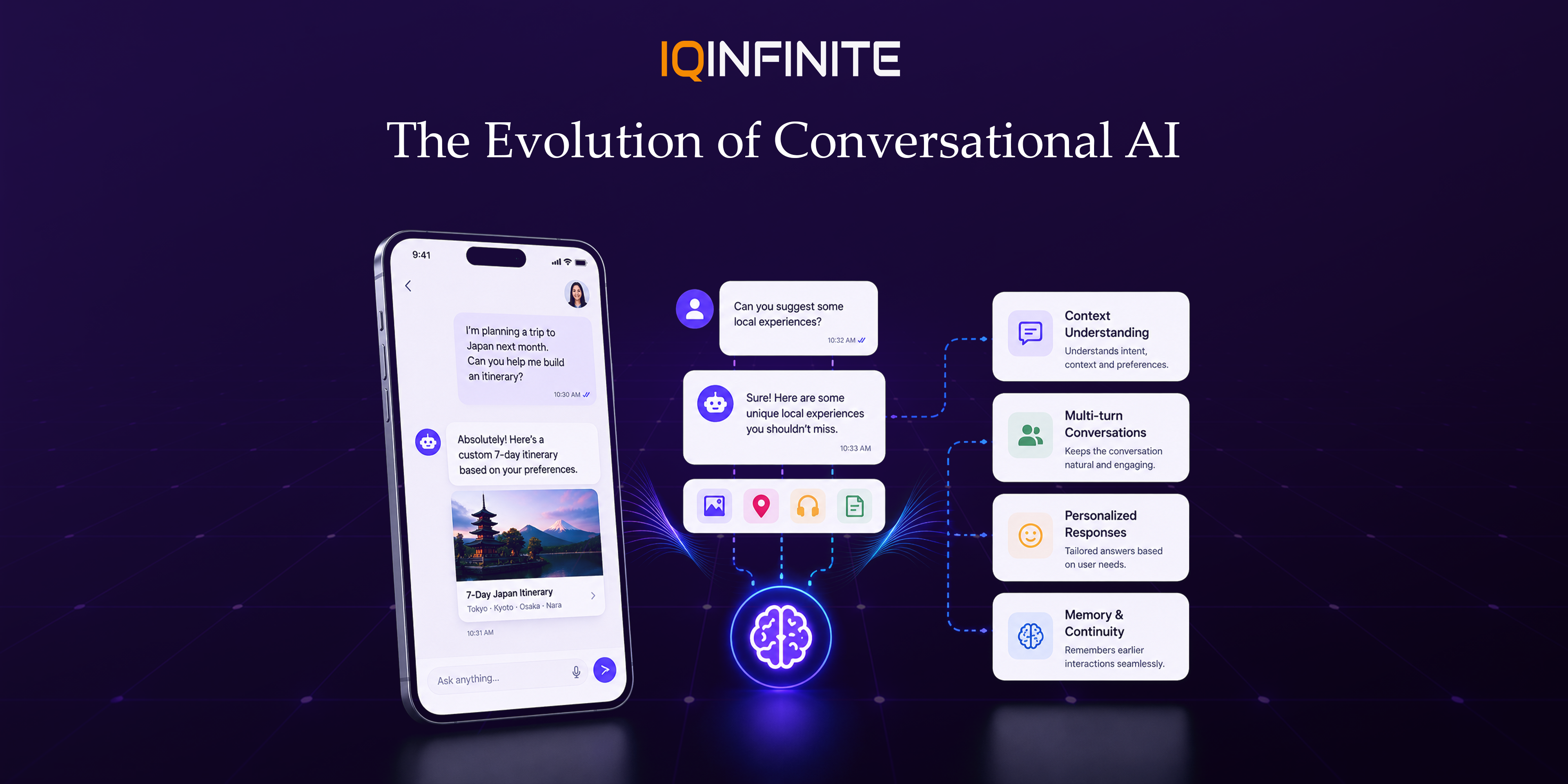
Artificial Intelligence has evolved far beyond answering simple customer support questions. Today's users expect AI to understand context, remember previous interactions, respond naturally and help them complete tasks rather than simply providing information. From AI-powered assistants and autonomous agents to voice interfaces and multimodal experiences, conversational AI is transforming how people interact with technology.
The future is no longer about building better chatbots it's about designing intelligent conversations that feel natural, personalized and human-like through an intuitive conversational interface.
Businesses across healthcare, finance, retail, education, logistics and enterprise software are now investing in conversational experiences that increase productivity, improve customer satisfaction and create seamless digital interactions.
Why Traditional Chatbots Are No Longer Enough
Modern users expect AI to:
- Understand natural language instead of fixed commands.
- Remember previous conversations.
- Personalize responses based on user preferences.
- Handle multiple requests within a single conversation.
- Perform real actions like booking appointments, creating reports or scheduling meetings.
- Communicate naturally across text, voice and visual interfaces.
What Makes Conversations Feel Natural?
1. Context Awareness
Example:
User: "Book a dentist appointment next week."
Later: "Actually, make it Thursday afternoon."
The AI understands the reference and updates the appointment without asking the user to repeat the original request.
2. Memory and Personalization
It can remember:
- Preferred language and communication style
- Favourite products or services
- Previous interactions
- Personalized recommendations
3. Understanding Intent
Example:
User: "I'm planning a family vacation."
The AI can proactively suggest:
- Flights and hotels
- Local attractions
- Budget planning
- Weather updates
- Travel insurance
4. Multi-Step Task Completion
Example:
User: "Schedule a project review with my team next Monday."
The AI can:
- Check team availability
- Create the meeting
- Send invitations
- Prepare an agenda
- Share relevant documents
The Rise of Multimodal Conversations
Modern AI understands and combines multiple forms of input, including:
- Text
- Voice
- Images
- Documents
- Audio
- Video
- Screenshots
"Can I claim this under warranty?"
The AI analyses the image, reviews warranty policies, identifies the product and guides the customer through the claim process all within one conversation.
This multimodal capability creates richer and more intuitive user experiences.
AI Agents Are Changing Conversations
Unlike traditional assistants, AI agents can reason, plan, make decisions and interact with external tools to complete complex tasks.
For example, an AI travel assistant can:
- Compare airline prices
- Monitor fare changes
- Recommend the best itinerary
- Reserve hotels
- Book transportation
- Generate a complete travel schedule
Designing Conversations That Feel Human
Key design principles include:
Keep Language Simple: Avoid technical jargon and communicate in a friendly, conversational tone.
Maintain Context: Allow users to continue conversations naturally without repeating previous information.
Ask Clarifying Questions: When a request is ambiguous, AI should seek clarification instead of making incorrect assumptions.
Be Transparent: Clearly indicate when AI is uncertain and explain why additional information is needed.
Enable Smooth Human Handoffs: For sensitive or complex situations, users should be able to transition seamlessly to a human representative without losing conversation history.
Learn Continuously: Use user feedback and interaction data to refine AI responses, improve accuracy and enhance future conversations.
Industry Applications of Natural Conversational AI
Retail & E-commerce: AI helps customers discover products, compare options, answer questions, provide personalized recommendations, track orders, process returns and deliver post-purchase support.
Banking & Financial Services: Conversational AI assists users with account management, expense tracking, investment insights, fraud alerts, loan applications and secure financial guidance.
Education: Students receive personalized tutoring, course recommendations, assignment support, progress tracking and instant answers tailored to their learning pace.
Enterprise Productivity: Employees use AI assistants to search company knowledge, summarize meetings, automate repetitive tasks, draft documents, generate reports and coordinate across teams.
Technologies Powering Modern Conversational AI
- Large Language Models (LLMs) for understanding and generating natural language.
- Retrieval-Augmented Generation (RAG) to provide accurate, up-to-date and organization-specific information.
- Context Engineering to maintain relevant conversation history and improve response quality.
- AI Agents capable of planning, reasoning and completing multi-step tasks autonomously.
- Voice AI for natural spoken interactions with users.
- Multimodal AI for processing text, images, audio, documents and video within a single conversation.
- Vector Databases for semantic search and efficient knowledge retrieval.
- ModelOps to monitor, govern and optimize AI models in production environments.
Business Benefits of Natural AI Conversations
Some key benefits include:
- Higher customer satisfaction through personalized experiences.
- Faster issue resolution with intelligent automation.
- Reduced operational costs by automating repetitive tasks.
- Increased employee productivity through AI-assisted workflows.
- Greater customer engagement and retention.
- Improved accessibility with voice and multilingual support.
- Consistent service available 24/7 across digital channels.
- Scalable interactions without compromising quality.
The Future of Human-AI Conversations
Future interactions will include persistent memory, real-time collaboration, multilingual communication and seamless integration with business systems. Instead of opening multiple applications to complete a task, users will simply express their goals in natural language and AI will orchestrate the necessary actions behind the scenes.
This evolution marks a shift from software that requires users to adapt, to intelligent systems that adapt to users.
Conclusion
As conversational AI continues to advance, the question is no longer whether businesses should adopt it, but how effectively they can design conversations that are intuitive, trustworthy and genuinely helpful. Companies that embrace this shift today will shape the next generation of digital experiences.