
How Multimodal UI Is Revolutionizing User Experience in Mobile and Web Apps
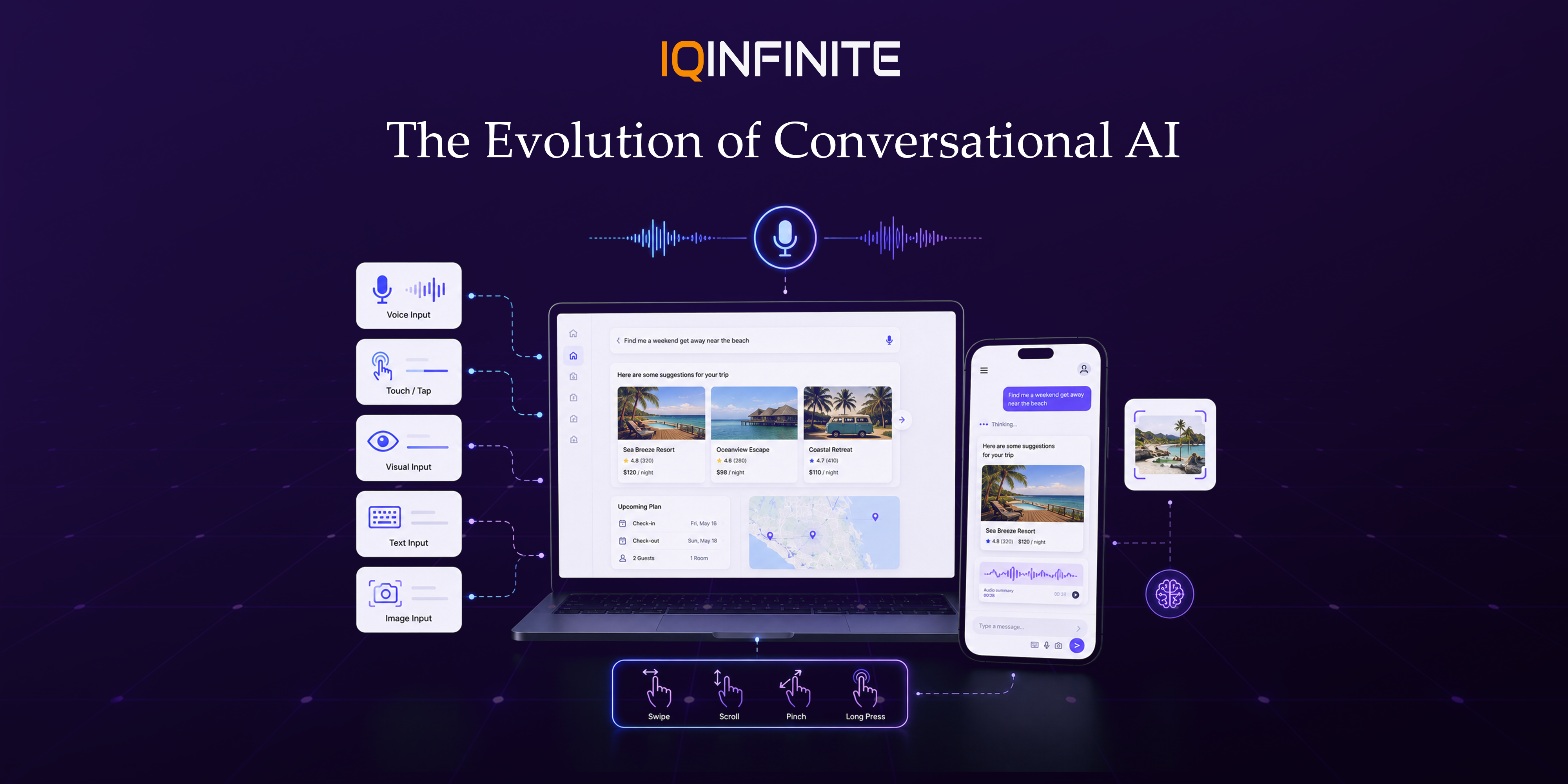
The way users interact with digital applications is changing faster than ever. Traditional interfaces based solely on clicks, taps and text inputs are being replaced by Multimodal User Interfaces (Multimodal UI) that support multimodal interaction through voice, touch, images, text, gesture recognition, camera input, handwriting and AI-powered contextual understanding. This shift is revolutionizing user experience, enabling applications to understand users naturally rather than forcing users to adapt to technology.
With the rapid growth of Generative AI, AI Agents, Large Language Models (LLMs), Edge AI, Spatial Computing and Agentic AI, businesses are building applications that understand users naturally instead of forcing users to adapt to technology.
Whether it's asking an AI assistant to book an appointment, uploading an image for product search, speaking to a banking app or controlling a smart device with gestures, multimodal experiences are becoming the new standard for modern mobile and web applications.
What Is Multimodal UI?
These interaction methods include:
- Voice Commands
- Touch & Gestures
- Text Conversations
- Image Uploads
- Camera Recognition
- Facial Recognition
- Handwriting
- Eye Tracking
- AR/VR Interactions
- Haptic Feedback
- AI Chat Interfaces
For example:
A user can:
- Speak a command
- Upload a product image
- Tap suggestions
- Receive voice responses
- Continue the conversation through text
This seamless experience significantly improves usability and customer satisfaction.
Why Multimodal UI Is Becoming the Future of Digital Experiences
1. Generative AI Is Redefining User Interactions
- Voice commands
- Images
- Documents
- Videos
- Natural language
- Contextual information
2. Powerful Mobile Hardware Enables Real-Time AI
- Neural Processing Units (NPUs) for AI acceleration
- LiDAR sensors for spatial awareness
- High-resolution AI-powered cameras
- Facial recognition technology
- Multiple noise-canceling microphones
- On-device AI processing for faster, privacy-focused experiences
3. Users Expect Conversational, Natural Experiences
"Find my last invoice."
"Book a meeting with Sarah next Tuesday."
Powered by conversational AI and Large Language Models (LLMs), modern applications can instantly understand user intent, retrieve relevant information and perform complex tasks through simple, human-like interactions. This shift significantly improves user convenience, efficiency and overall customer satisfaction.
4. Enhanced Accessibility for Every User
- Voice navigation
- Screen reader compatibility
- Gesture-based controls
- Text alternatives for multimedia content
- AI-powered visual recognition
- Adaptive and personalized user interactions
Core Components of a Multimodal User Interface
Voice Interaction
Common examples include:
- Voice search
- AI assistants
- Smart home controls
- Customer support bots
- Voice-enabled shopping
Image Recognition
Popular use cases:
- Visual product search
- OCR document scanning
- Plant identification
- Medical image analysis
- Barcode scanning
Natural Language Processing (NLP)
Capabilities include:
- Intent recognition
- Context awareness
- AI chat
- Personalized recommendations
- Automated workflows
Gesture Recognition
- Hand tracking
- Motion sensors
- Camera-based controls
- Air gestures
Touch + Voice Combination
- Touch navigation
- AI chat
- Voice commands
- Visual responses
Latest Multimodal UI Trends in 2026
1. AI Agents as the New User Interface
Common use cases include:
- CRM platforms
- ERP systems
- Customer support
- Healthcare portals
- Productivity tools
- Enterprise software
2. Camera-First Experiences
Popular applications include:
- Visual shopping
- Identity verification (eKYC)
- QR code payments
- Object detection
- Inventory management
- AR navigation
3. Voice-First Applications
Benefits include:
- Faster task completion
- Reduced manual input
- Improved workplace efficiency
4. On-Device AI
Key advantages:
- Faster response times
- Better privacy
- Offline functionality
- Lower latency
- Enhanced security
5. Context-Aware Interfaces
- Location
- User behaviour
- Device type
- Time
- Previous interactions
- Preferences
Benefits of Multimodal UI for Businesses
1. Improved User Engagement:Natural interactions through voice, touch, text, images and gestures make applications more intuitive and enjoyable, encouraging users to spend more time engaging with your platform.
2. Higher Conversion Rates: By simplifying user journeys and reducing friction, multimodal interfaces help users complete actions faster whether it's making a purchase, booking a service or submitting a form leading to increased conversions.
3. Enhanced Customer Satisfaction: AI-powered, personalized interactions provide faster and more relevant responses, creating seamless experiences that improve customer satisfaction, loyalty and long-term retention.
4. Better Accessibility and Inclusivity: Supporting multiple interaction methods such as voice commands, screen readers, gesture controls and visual recognition makes applications accessible to a wider audience while helping businesses meet modern accessibility standards.
5. Future-Ready Digital ProductsMultimodal UI provides a strong foundation for integrating emerging technologies like Generative AI, AI Agents, Augmented Reality (AR), wearable devices and spatial computing, ensuring your applications remain competitive as digital experiences continue to evolve.
Best Practices for Building Multimodal Applications
- Design with accessibility as a priority.
- Ensure seamless transitions between voice, touch and text inputs.
- Optimize AI models for speed and accuracy.
- Implement privacy-first architectures with secure data handling.
- Use on-device AI whenever feasible to reduce latency.
- Continuously test interactions across different devices and user scenarios.
- Provide clear visual and audio feedback for every interaction.
- Monitor user behaviour and refine AI experiences based on analytics.
The Future of Multimodal UI
Rather than navigating menus, users will simply describe what they want and intelligent systems will handle the execution. This shift toward natural, conversational experiences will make applications faster, more accessible and deeply personalized.
Businesses that embrace multimodal UI today will be well-positioned to deliver next-generation digital experiences that meet rising customer expectations and stand out in competitive markets.