
Modern PHP 2026: Cleaner Code with Property Hooks, Asymmetric Visibility & Native URIs
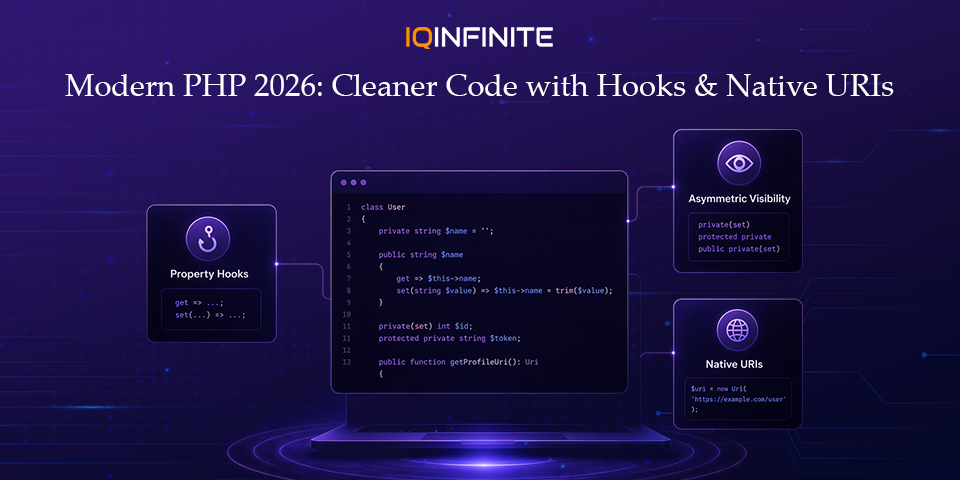
PHP is changing faster than most developers realize. While everyone debates frameworks, the PHP core team has quietly shipped three features in PHP 8.4 and 8.5 that change how you write code every single day. These are not small tweaks. They are architectural shifts that remove years of boilerplate, improve data safety and close a long-standing security gap in URL handling.
If you are still writing the same PHP you wrote in 2020, this article is your wake-up call.
Let’s explore the three features that define Modern PHP in 2026 and understand why developers are searching for terms like asymmetric visibility PHP explained, modern PHP clean architecture, PHP language evolution 2026 and PHP property hooks tutorial.
1. Property Hooks - Goodbye to Getters and Setters Forever
For over two decades, PHP developers have written the same repetitive pattern:
class User {
    private string $email;

    public function getEmail(): string {
        return $this->email;
    }

    public function setEmail(string $email): void {
        if (!filter_var($email, FILTER_VALIDATE_EMAIL)) {
            throw new InvalidArgumentException('Invalid email.');
        }
        $this->email = strtolower($email);
    }
}
This is called a getter/setter pattern and it has been the standard way to control how class properties are read or written. It works, but it is verbose, repetitive and adds hundreds of unnecessary lines to any large codebase.
PHP 8.4 introduced Property Hooks, which lets you write that same logic directly inside the property definition:
PHP 8.4 introduced Property Hooks, which lets you write that same logic directly inside the property definition:
class User {
    public string $email {
        set(string $value) {
            if (!filter_var($value, FILTER_VALIDATE_EMAIL)) {
                throw new InvalidArgumentException('Invalid email.');
            }
            $this->email = strtolower($value);
        }
    }
}
That is all. No separate method. No extra function call overhead. The validation and formatting logic lives exactly where the property is defined.
Why this matters for 2026:
Why this matters for 2026:
- It reduces class file sizes by 30-50% in real-world applications
- It improves readability because behaviour and definition are co-located
- It reduces function call overhead since no method dispatch happens
- It brings PHP syntax closer to modern languages like Kotlin and Swift
Property Hooks are not just a convenience feature. They are a signal that PHP is maturing toward a 'concise by default' philosophy.
2. Asymmetric Visibility - Immutable by Default, Flexible by Design
Here is a common problem. You want a property to be readable from anywhere in your application but only writable from within the class itself. Before PHP 8.4, your options were limited.
You could make it private and provide a public getter method. But then you are back to writing boilerplate. You could make it public but then anything in your codebase could accidentally overwrite it.
PHP 8.4 introduced Asymmetric Visibility to solve this cleanly:
You could make it private and provide a public getter method. But then you are back to writing boilerplate. You could make it public but then anything in your codebase could accidentally overwrite it.
PHP 8.4 introduced Asymmetric Visibility to solve this cleanly:
class Order {
    public private(set) string $status = 'pending';

    public function approve(): void {
        $this->status = 'approved'; // Only works inside the class
    }
}

$order = new Order();
echo $order->status;        // Works fine - public read
$order->status = 'cancelled'; // Fatal Error - private write
The syntax 'public private(set)' means anyone can read this property, but only this class can change it.
Why this is a breakthrough:
Why this is a breakthrough:
- Immutability by default without creating read-only objects that cannot be updated internally
- It replaces an entire pattern of private properties plus public getters
- It makes your data contracts explicit and visible directly in the class definition
- It is the most significant improvement to PHP's Object-Oriented system in five years
For developers building clean architecture, domain-driven design or any system where data integrity matters, Asymmetric Visibility is now the standard approach.
3. The Native URI Extension - The End of parse_url()
If you have ever worked with URLs in PHP, you know the frustration. The built-in parse_url() function is old, inconsistent and dangerously permissive. It accepts malformed URLs without throwing errors and returns results that vary depending on which parts of the URL are present or missing.
Developers have worked around this for years using third-party libraries like the League URI package. That is a dependency you now no longer need.
HP 8.5 introduces a Native URI Extension with a proper object-oriented API:
Developers have worked around this for years using third-party libraries like the League URI package. That is a dependency you now no longer need.
HP 8.5 introduces a Native URI Extension with a proper object-oriented API:
$uri = Uri::new('https://www.example.com/products?category=php&sort=asc');

echo $uri->getHost();   // www.example.com
echo $uri->getPath();   // /products
echo $uri->getQuery();  // category=php&sort=asc

// Modify and rebuild safely
$newUri = $uri->withQuery('category=laravel&sort=desc');
echo $newUri; // https://www.example.com/products?category=laravel&sort=desc
The URI extension parses, validates and builds URLs in a predictable, strict way. It throws proper exceptions on invalid input rather than silently returning broken arrays.
Why this is a security gamechanger:
Why this is a security gamechanger:
- URL Spoofing attacks caused by inconsistent parsing of malformed URLs
- Eliminates an entire class of redirect vulnerabilities common in PHP applications
- Removes the need for third-party URL libraries, reducing your dependency surface
- Provides a consistent, testable API that works the same way every time
For developers building APIs, handling redirects, processing webhooks or working with any user-supplied URLs, the Native URI Extension is now the only safe choice.
How These Three Features Connect: The “Concise PHP” Revolution
These three features are not isolated improvements. Together, they represent a clear and unified direction for PHP in 2026: reduce boilerplate, enforce correctness at the language level and eliminate the need for third-party workarounds to solve core problems.
Key Transformations
Getter + Setter Methods → Property Hooks
Simplifies property access by removing repetitive method definitions.
Private Property + Public Getter → Asymmetric Visibility
Provides more precise control over read/write access without extra code.
parse_url() + League URI Library → Native URI Extension
Replaces fragmented URL handling with a standardized, built-in solution.
Simplifies property access by removing repetitive method definitions.
Private Property + Public Getter → Asymmetric Visibility
Provides more precise control over read/write access without extra code.
parse_url() + League URI Library → Native URI Extension
Replaces fragmented URL handling with a standardized, built-in solution.
What This Means for Developers
Each of these changes removes an unnecessary layer of abstraction that PHP developers have been manually implementing for years. The result is:
- Less code to write and maintain
- Improved readability and consistency
- Stronger guarantees of correctness directly from the language
In essence, PHP is evolving toward a more expressive and efficient development model where common patterns are handled natively rather than rebuilt in every project.
What This Means for PHP's Future
PHP 9.0 is on the horizon with an even stricter type of system. The JIT compiler introduced in PHP 8.0 continues to improve performance. Worker-mode runtimes like FrankenPHP are eliminating the overhead of traditional PHP-FPM deployments.
The language is not dying. It is becoming more disciplined, more expressive and more competitive with languages like Go, Rust and Kotlin that have dominated the 'modern language' conversation for years.
Developers who adopt these features today are not just writing cleaner code. They are positioning themselves for a version of PHP where strictness, safety and simplicity are built into the language itself not patched in through frameworks or third-party packages.
The language is not dying. It is becoming more disciplined, more expressive and more competitive with languages like Go, Rust and Kotlin that have dominated the 'modern language' conversation for years.
Developers who adopt these features today are not just writing cleaner code. They are positioning themselves for a version of PHP where strictness, safety and simplicity are built into the language itself not patched in through frameworks or third-party packages.
Conclusion
PHP 8.4 and 8.5 are not minor version bumps. They represent a fundamental shift in how PHP code is written, structured and secured.
Property Hooks eliminate getter/setter boilerplate that has cluttered PHP classes for twenty years.
Asymmetric Visibility brings true encapsulation to class design without sacrificing usability.
The Native URI Extension closes a security gap that has existed in the language since the beginning.
If you are a PHP developer, these features deserve your attention right now. If you are a business building on PHP, understanding this evolution helps you make better decisions about architecture, code quality and long-term maintainability.
Modern PHP is not the PHP of the past. And in 2026, that is very good news.
Property Hooks eliminate getter/setter boilerplate that has cluttered PHP classes for twenty years.
Asymmetric Visibility brings true encapsulation to class design without sacrificing usability.
The Native URI Extension closes a security gap that has existed in the language since the beginning.
If you are a PHP developer, these features deserve your attention right now. If you are a business building on PHP, understanding this evolution helps you make better decisions about architecture, code quality and long-term maintainability.
Modern PHP is not the PHP of the past. And in 2026, that is very good news.