
The Rise of ModelOps 2.0: Managing Foundation Models at Enterprise Scale
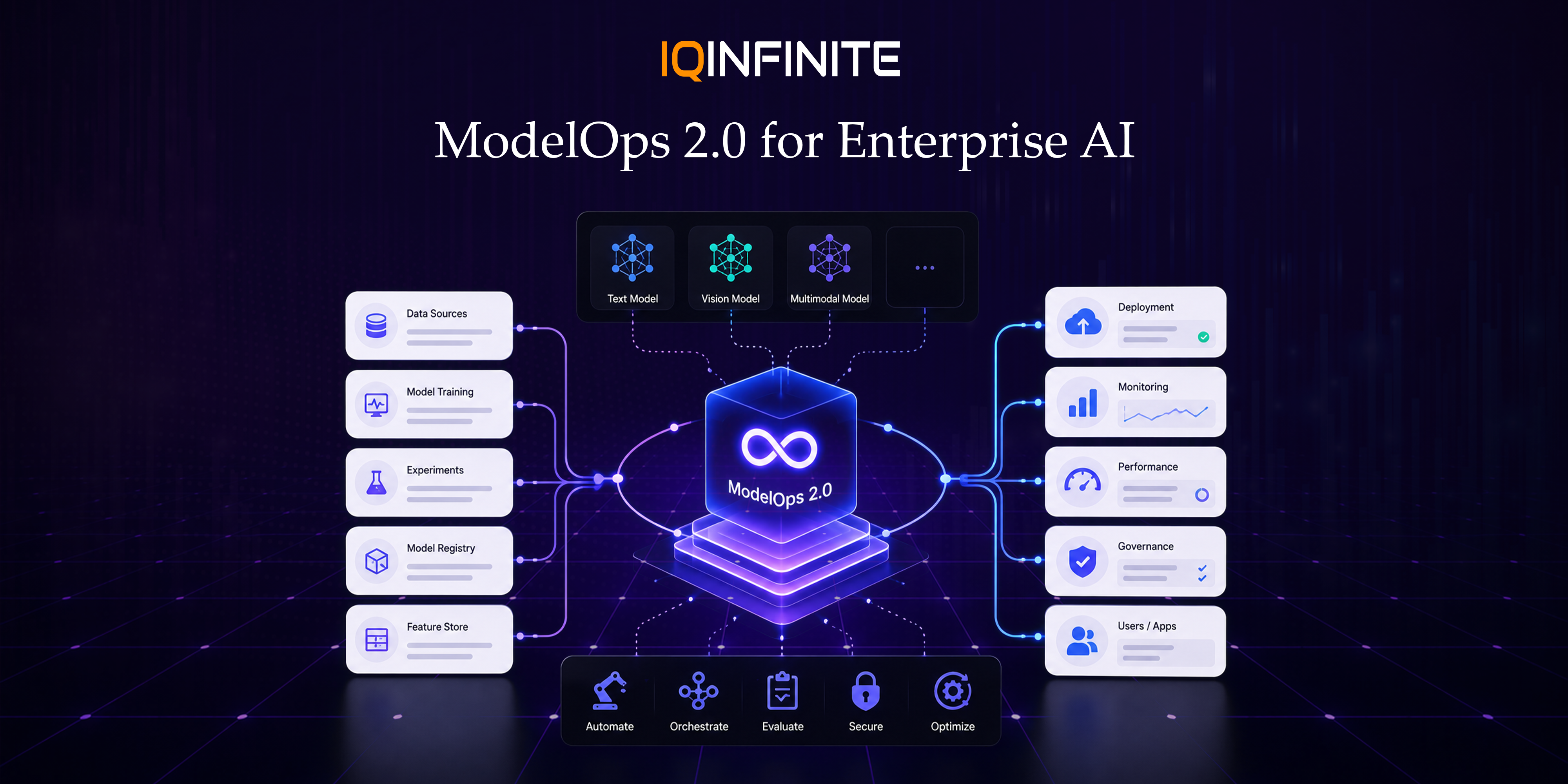
Artificial Intelligence has entered a new era. Organizations are no longer experimenting with a single machine learning model they are managing multiple foundation models, AI agents, Retrieval-Augmented Generation (RAG) systems, multimodal AI and domain-specific Large Language Models (LLMs) across departments.
As AI adoption accelerates, businesses face a critical challenge:
How do you securely manage hundreds of AI models while maintaining governance, compliance, performance and cost efficiency?
This challenge has led to the evolution of ModelOps 2.0 the next generation of AI lifecycle management designed specifically for foundation models and enterprise-scale AI systems.
Unlike traditional MLOps, which primarily focused on training and deploying predictive machine learning models, ModelOps 2.0 is built for an AI-first world where organizations must continuously monitor, optimize, secure and govern large language models and intelligent AI agents.
What is ModelOps 2.0?
It extends beyond deployment by providing continuous governance, monitoring, automation, security and optimization for AI systems operating in production.
A modern ModelOps platform manages:
- Foundation Models (GPT, Claude, Gemini, Llama, Mistral)
- Fine-tuned enterprise models
- RAG pipelines
- AI agents
- Vector databases
- Prompt management
- AI workflows
- Model routing
- Continuous evaluation
- Compliance monitoring
Why Traditional MLOps Is No Longer Enough
Supporting enterprise generative AI requires capabilities such as intelligent model serving, automated governance, continuous evaluation and scalable infrastructure that traditional MLOps platforms were never designed to provide. They need continuous monitoring for response quality, hallucinations, safety, compliance and operational costs. Traditional MLOps mainly focuses on model deployment and accuracy, making it insufficient for managing these advanced AI workloads.
ModelOps 2.0 addresses these challenges by enabling organizations to:
- Manage foundation models, LLMs and AI agents from a single platform.
- Continuously monitor AI quality, safety and performance.
- Enforce governance, security and regulatory compliance.
- Optimize AI costs and resource utilization.
- Orchestrate multiple AI models and workflows efficiently.
Why Enterprises Are Investing in ModelOps 2.0
However, scaling AI introduces several challenges:
- Rising infrastructure and inference costs
- AI hallucinations affecting business decisions
- Regulatory compliance requirements
- Security risks involving sensitive enterprise data
- Model version management
- Prompt consistency across applications
- Performance degradation over time
- Vendor lock-in concerns
Core Components of a Modern ModelOps 2.0 Platform
1. Foundation Model Lifecycle Management
- Register and version foundation models
- Compare model performance
- Track fine-tuned model variants
- Roll back underperforming models
- Automate deployment pipelines
- Manage model dependencies
2. Intelligent Model Routing
For example:
- GPT for reasoning-intensive tasks
- Claude for long-document analysis
- Gemini for multimodal processing
- Open-source Llama models for private deployments
- Lightweight models for cost-sensitive workloads
This approach improves both performance and operational efficiency.
3. AI Governance and Compliance
ModelOps 2.0 introduces centralized governance capabilities, including:
- AI usage policies
- Access control
- Model approval workflows
- Audit trails
- Prompt version tracking
- Explainability reports
- Responsible AI monitoring
- Regulatory compliance documentation
4. Continuous AI Evaluation
Key evaluation metrics include:
- Response quality
- Hallucination rate
- Factual accuracy
- Groundedness
- Toxicity detection
- Bias monitoring
- User satisfaction
- Task completion rate
- Latency
- Cost per inference
5. Prompt and Context Management
ModelOps 2.0 enables organizations to manage:
- Prompt templates
- System instructions
- Business rules
- Retrieval pipelines
- Context windows
- Memory configurations
- AI agent workflows
6. Cost Optimization
Modern ModelOps platforms optimize costs through:
- Intelligent model selection
- Token usage monitoring
- Response caching
- Load balancing
- Smaller model fallback strategies
- GPU utilization optimization
- Inference cost analytics
How ModelOps 2.0 Powers AI Agents
ModelOps 2.0 provides the operational backbone that enables AI agents to function reliably by:
- Managing agent versions and configurations
- Monitoring autonomous decision-making
- Evaluating tool usage and workflow success rates
- Controlling access to enterprise data
- Maintaining execution logs for auditing
- Ensuring compliance with organizational policies
Real-World Enterprise Use Cases
Financial Services: Banks leverage ModelOps to monitor fraud detection systems, automate customer support, manage credit risk analysis and ensure regulatory compliance across AI-driven operations.
Retail and E-commerce: Retail businesses optimize recommendation engines, personalized shopping assistants, inventory forecasting, dynamic pricing and customer engagement through centralized AI management.
Manufacturing: Manufacturers use ModelOps to support predictive maintenance, quality inspections, digital twins and supply chain optimization across global production environments.
Software Development: Development teams integrate ModelOps into AI-powered coding assistants, automated testing, documentation generation, code reviews and DevOps workflows to ensure consistent and secure AI performance.
Emerging Trends Shaping ModelOps in 2026
Multi-Model AI Architectures: Organizations are moving away from dependence on a single AI provider by combining proprietary, open-source and specialized models for greater flexibility and resilience.
AgentOps Integration: As autonomous AI agents become more common, AgentOps is emerging as a complementary discipline focused on monitoring, orchestrating and governing AI agent behaviour alongside ModelOps.
AI Observability Platforms: Enterprises are adopting AI observability tools that provide deep insights into model performance, latency, token usage, hallucination rates and user interactions.
Context Engineering: Organizations are shifting focus from prompt engineering to context engineering, ensuring AI systems receive the right business data, retrieval context and memory for more accurate responses.
Small Language Models (SLMs): Businesses are increasingly deploying compact language models for internal workflows, edge computing and industry-specific applications to reduce inference costs and improve data privacy.
Responsible AI by Design: Ethics, transparency, explainability, fairness and human oversight are becoming integral components of enterprise AI strategies rather than afterthoughts.
Infrastructure Automation: Modern ModelOps platforms are increasingly adopting infrastructure automation to provision AI environments, manage GPU resources, deploy models and scale workloads automatically. This reduces manual operations while improving consistency, reliability and deployment speed.
Best Practices for Implementing ModelOps 2.0
- Establish centralized AI governance policies.
- Standardize model registration and version control.
- Continuously evaluate model quality and business outcomes.
- Implement role-based access control for AI systems.
- Automate deployment and rollback processes.
- Optimize inference costs through intelligent model routing.
- Integrate AI observability into production environments.
- Secure sensitive enterprise data with encryption and access controls.
- Maintain comprehensive audit logs for regulatory compliance.
- Regularly update foundation models to leverage the latest capabilities while validating performance and safety.
The Future of Enterprise AI Operations
ModelOps 2.0 is no longer simply about deploying AI it is about managing intelligent ecosystems where foundation models, AI agents, retrieval systems, workflows and governance operate together seamlessly.
Organizations that invest in robust ModelOps capabilities today will be better positioned to scale AI responsibly, reduce operational risk, optimize costs and accelerate innovation in the years ahead.
Conclusion
ModelOps 2.0 provides the framework needed to manage AI at enterprise scale, enabling businesses to deploy multiple models confidently, monitor performance in real time, ensure regulatory compliance and control operational costs.
As AI becomes deeply embedded across industries, organizations that embrace ModelOps 2.0 will gain a significant competitive advantage by building AI systems that are not only powerful but also secure, scalable and trustworthy.