
From CRUD to AI Agents: How Laravel Applications Are Evolving in 2026
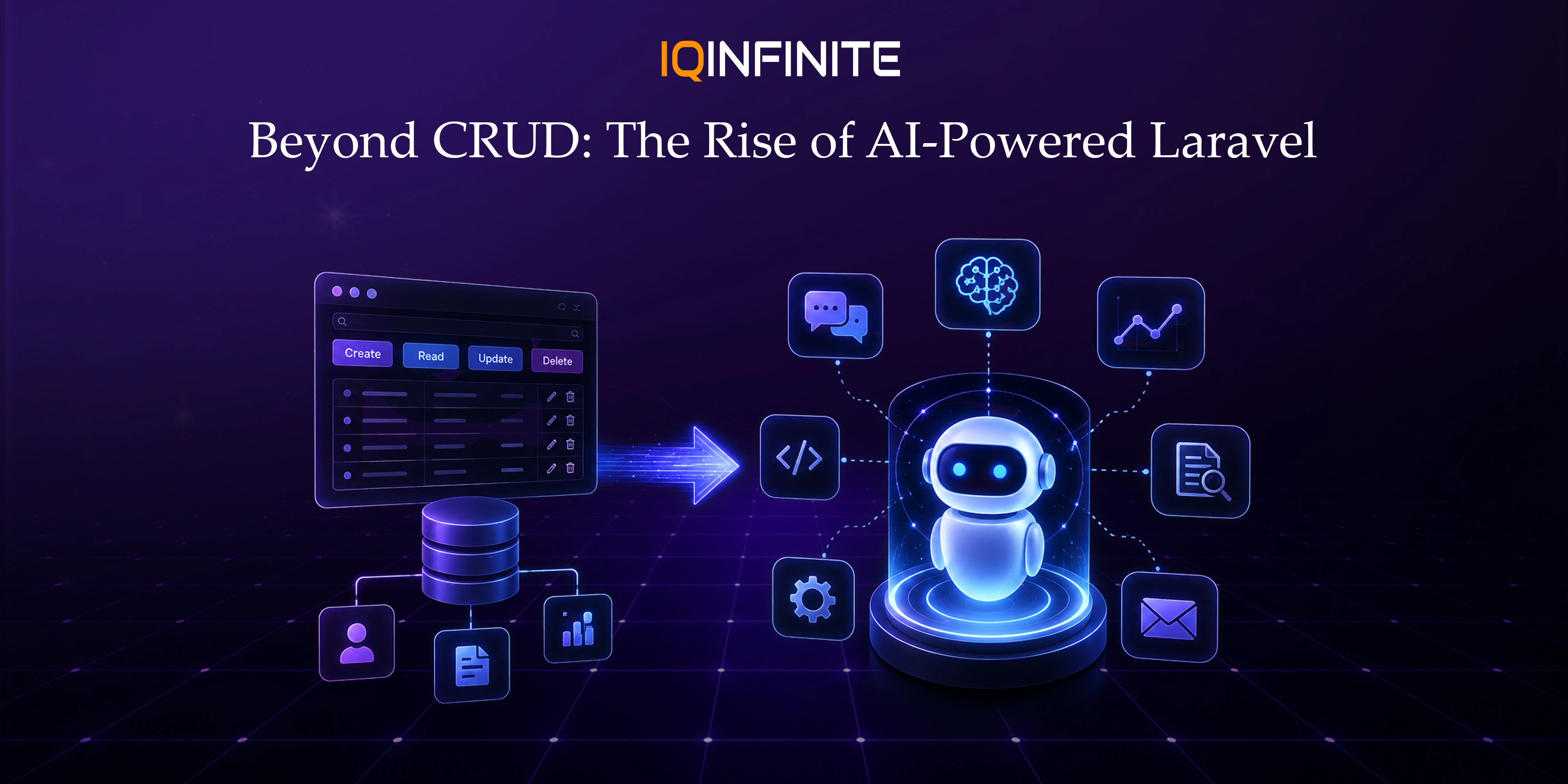
Laravel has traditionally been a popular choice for building business applications, dashboards, e-commerce platforms, SaaS products and API-driven systems. Much of this work has been based around CRUD operations creating, reading, updating and deleting data.
That model is still important, but modern applications are becoming more intelligent. In 2026, developers are increasingly combining traditional Laravel architecture with AI, automation, APIs, queues and intelligent agents. This shift is driving new opportunities for Laravel AI development, allowing applications to not only store and process information but also understand tasks, use tools and automate parts of a workflow.
From Traditional CRUD to Intelligent Applications
A typical Laravel application might allow users to:
- Create customer records
- Update orders
- Manage products
- Generate reports
- View dashboards
These are essential business functions, but they generally require users to initiate every action.
AI-powered applications introduce another layer of capability. Instead of simply responding to user input, an AI agent can interpret a request, decide which action is required, use available tools and return a result.
For example, instead of manually searching customer records and generating a report, a user could ask:
"Show me this month's highest-value customers and summarize their purchasing behavior."
The application could retrieve the relevant data, process it and generate a useful response.
AI-powered applications introduce another layer of capability. Instead of simply responding to user input, an AI agent can interpret a request, decide which action is required, use available tools and return a result.
For example, instead of manually searching customer records and generating a report, a user could ask:
"Show me this month's highest-value customers and summarize their purchasing behavior."
The application could retrieve the relevant data, process it and generate a useful response.
What Are AI Agents?
AI agents are software systems that can perform tasks using AI models, tools, APIs and application data.
Unlike a basic chatbot that only generates responses, an AI agent can potentially:
Unlike a basic chatbot that only generates responses, an AI agent can potentially:
- Understand a user's objective
- Break a task into multiple steps
- Retrieve application data
- Call APIs
- Execute predefined actions
- Analyze information
- Return the result
This makes AI agent development particularly useful for business applications where users already work with structured data and established workflows.
Why Laravel Is a Strong Foundation for AI Applications
Laravel provides many of the building blocks required to connect AI capabilities with existing business systems.
Developers can combine Laravel with:
Developers can combine Laravel with:
- REST APIs
- Queues and background jobs
- Events and listeners
- Database models
- Authentication
- Caching
- External AI APIs
- Third-party integrations
This means businesses do not necessarily need to rebuild an existing Laravel application to introduce AI functionality.
Instead, AI capabilities can be added gradually around existing workflows.
Instead, AI capabilities can be added gradually around existing workflows.
Laravel AI SDK and Modern AI Integration
One of the important developments in the Laravel ecosystem is the growing use of tools such as the Laravel AI SDK to simplify integration between Laravel applications and modern AI capabilities.
These tools can help developers work with AI models, structured outputs, agents, tool calling and other AI-powered functionality while keeping the application aligned with Laravel development practices.
For businesses, this can make AI application development more practical by allowing AI features to be introduced without replacing the application's existing database, authentication, APIs or business logic.
These tools can help developers work with AI models, structured outputs, agents, tool calling and other AI-powered functionality while keeping the application aligned with Laravel development practices.
For businesses, this can make AI application development more practical by allowing AI features to be introduced without replacing the application's existing database, authentication, APIs or business logic.
Laravel + AI: A Practical Architecture
A modern Laravel application can act as the central application layer while an AI model handles reasoning and natural-language interaction.
A simplified architecture could look like:
A simplified architecture could look like:
User
↓
Laravel Application
↓
AI Agent
↓
Tools / APIs / Database
↓
Action or Response
For example, a customer support platform could allow an AI agent to search customer information, review previous interactions, check order status and prepare a response.
Laravel remains responsible for authentication, business rules, data access and application logic, while the AI layer provides intelligent interaction and automation.
Laravel remains responsible for authentication, business rules, data access and application logic, while the AI layer provides intelligent interaction and automation.
Laravel MCP Integration
Another emerging area for Laravel MCP integration is connecting Laravel applications with AI agents through standardized access to tools and application capabilities.
Model Context Protocol (MCP) can provide a structured way for AI systems to interact with external tools and data sources. For Laravel applications, this creates opportunities to expose selected business functionality to AI agents while maintaining application-level controls.
For example, an AI agent could potentially access approved tools for:
Model Context Protocol (MCP) can provide a structured way for AI systems to interact with external tools and data sources. For Laravel applications, this creates opportunities to expose selected business functionality to AI agents while maintaining application-level controls.
For example, an AI agent could potentially access approved tools for:
- Searching customer information
- Checking order status
- Retrieving product information
- Generating reports
- Triggering approved workflows
The important point is that AI should not receive unrestricted access to the entire application. Laravel's existing authentication, authorization, validation and business rules should remain part of the control layer.
AI Agents for Business Workflows
The biggest opportunity is not simply adding an AI chatbot to an application. It is connecting AI to real business workflows.
Consider an order management platform.
A traditional workflow might require an employee to:
Consider an order management platform.
A traditional workflow might require an employee to:
- Find the customer's order
- Check payment status
- Review shipping information
- Contact the delivery service
- Update the customer
An AI-enabled Laravel application could assist with several of these steps through connected tools and APIs.
This approach can reduce repetitive work while keeping important business rules under application control.
This approach can reduce repetitive work while keeping important business rules under application control.
Background Jobs and AI Workloads
AI operations can sometimes take longer than a normal web request. Laravel queues and background jobs are useful for handling these workloads w
ithout making users wait.
Tasks such as:
ithout making users wait.
Tasks such as:
- Document processing
- Data analysis
- Report generation
- Content summarization
- Large-scale data processing
can be moved to background workers.
This allows the main application to remain responsive while AI-related tasks are processed asynchronously.
This allows the main application to remain responsive while AI-related tasks are processed asynchronously.
From Chatbots to AI-Powered Applications
There is an important difference between adding a chatbot and building an AI-powered application.
A chatbot primarily communicates with users.
An AI-powered application can connect that conversation to actual application functionality.
For example:
Basic chatbot:
"Your order is currently being processed."
AI-powered application:
"Your order #4821 is being processed and is expected to arrive tomorrow. The shipping provider has received the package."
The second experience becomes possible when AI is connected to application data and controlled tools.
A chatbot primarily communicates with users.
An AI-powered application can connect that conversation to actual application functionality.
For example:
Basic chatbot:
"Your order is currently being processed."
AI-powered application:
"Your order #4821 is being processed and is expected to arrive tomorrow. The shipping provider has received the package."
The second experience becomes possible when AI is connected to application data and controlled tools.
Security Still Comes First
Giving AI access to application data and actions introduces new security considerations.
Developers should carefully control:
Developers should carefully control:
- Which data an AI agent can access
- Which actions it can perform
- User permissions
- API credentials
- Sensitive information
- Actions requiring human approval
AI should not automatically bypass existing application authorization.
Laravel's authentication and authorization systems can remain an important control layer between users, AI agents and business data.
Laravel's authentication and authorization systems can remain an important control layer between users, AI agents and business data.
Where Laravel AI Applications Can Be Used
The combination of Laravel and AI agents can support many business scenarios
Customer Support:AI can retrieve customer information, summarize conversations and assist support teams
Finance:AI can analyze transactions, generate reports and assist with financial workflows while respecting access controls.
Healthcare:Applications can assist with administrative workflows, document processing and information retrieval.
E-Commerce:AI can help with product discovery, order assistance, recommendations and customer support.
Enterprise Applications:AI agents can interact with internal systems to automate repetitive workflows and improve employee productivity.
Customer Support:AI can retrieve customer information, summarize conversations and assist support teams
Finance:AI can analyze transactions, generate reports and assist with financial workflows while respecting access controls.
Healthcare:Applications can assist with administrative workflows, document processing and information retrieval.
E-Commerce:AI can help with product discovery, order assistance, recommendations and customer support.
Enterprise Applications:AI agents can interact with internal systems to automate repetitive workflows and improve employee productivity.
The Future of Laravel Development
Laravel is not moving away from its traditional strengths. CRUD operations, APIs, databases, authentication and business logic remain fundamental to modern applications.
What is changing is how these capabilities are accessed.
Instead of users interacting with every feature manually, AI can become an additional interface to the application.
The future Laravel application may therefore combine:
What is changing is how these capabilities are accessed.
Instead of users interacting with every feature manually, AI can become an additional interface to the application.
The future Laravel application may therefore combine:
- Traditional web interfaces
- Mobile applications
- APIs
- AI assistants
- AI agents
- Automated workflows
- Background processing
This creates a more flexible application architecture where users can interact with business systems through both conventional interfaces and intelligent agents.
Conclusion
Laravel applications are evolving from traditional CRUD systems into intelligent, connected platforms. The framework's existing strengths in APIs, databases, authentication, queues, events and application architecture make it a practical foundation for introducing AI capabilities without abandoning established development patterns.
The real opportunity in 2026 is not simply putting a chatbot inside a Laravel application. It is connecting AI agents to meaningful business workflows while keeping security, permissions and business logic under control. As AI becomes more capable, Laravel developers can build applications that do more than store and display information they can help users understand data, automate repetitive work and complete complex tasks more efficiently.
The real opportunity in 2026 is not simply putting a chatbot inside a Laravel application. It is connecting AI agents to meaningful business workflows while keeping security, permissions and business logic under control. As AI becomes more capable, Laravel developers can build applications that do more than store and display information they can help users understand data, automate repetitive work and complete complex tasks more efficiently.
Ready to Build with Laravel?
Looking to hire experienced Laravel developers for your next project?
Hire us: Laravel Developers | IQ Infinite Technologies
Hire us today and let our Laravel experts build secure, scalable and high-performing web applications tailored to your unique business goals.
Hire us: Laravel Developers | IQ Infinite Technologies
Hire us today and let our Laravel experts build secure, scalable and high-performing web applications tailored to your unique business goals.