
Can Laravel Power Autonomous Business Workflows? Building Agentic AI Applications in 2026
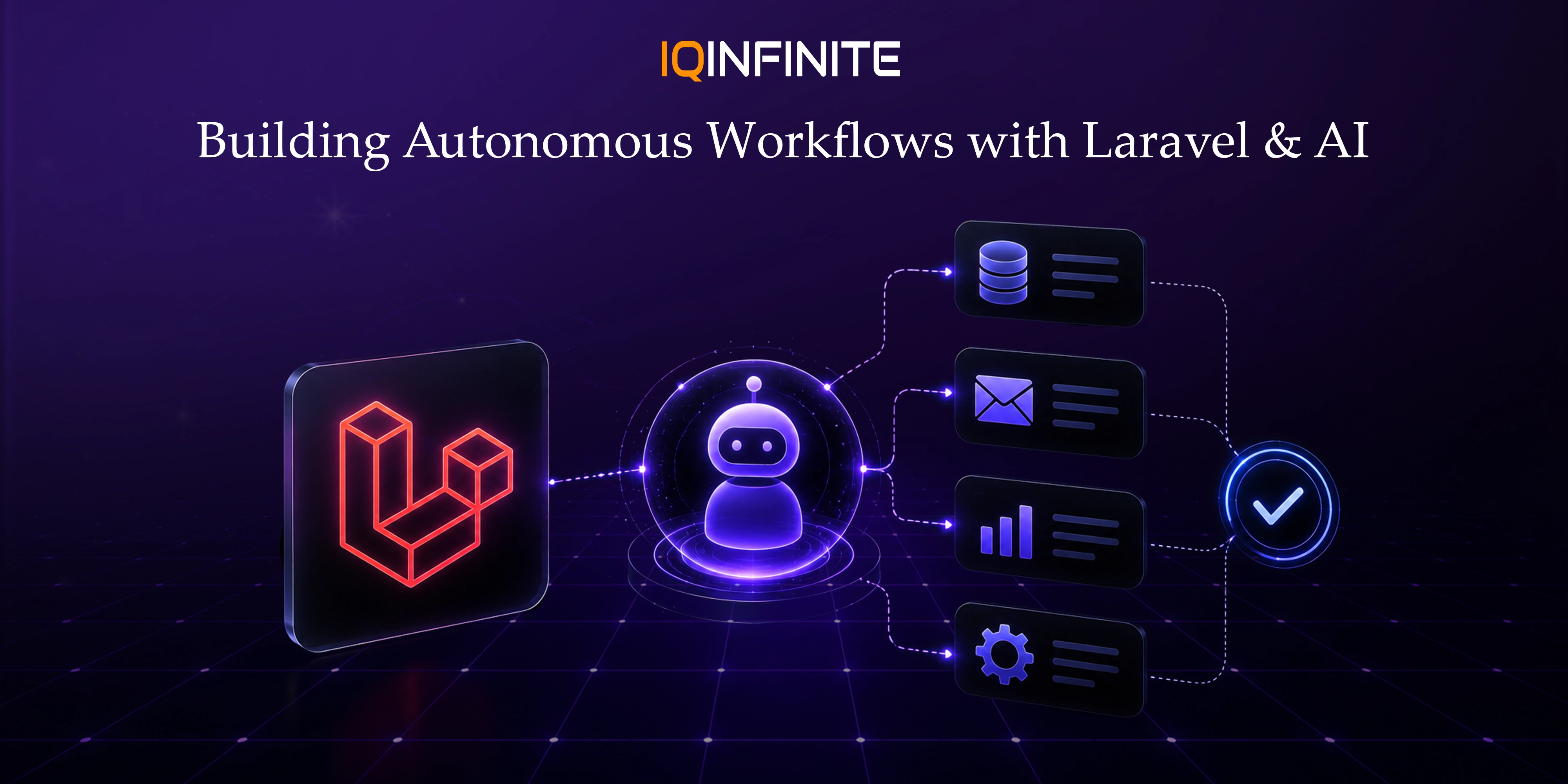
Businesses are moving beyond traditional chatbots and AI-powered features toward agentic AI applications that can understand goals, make decisions, use tools and complete multi-step tasks with limited human intervention.
In 2026, this shift is creating a new generation of autonomous business workflows. Instead of simply generating a response, an AI agent can analyze information, retrieve business data, call APIs, update records, trigger workflows and escalate important decisions to humans.
Laravel is increasingly well positioned for this transformation. With the Laravel AI SDK, developers can build AI agents, connect tools, manage structured outputs and memory, work with embeddings and orchestrate multi-agent workflows using familiar PHP and Laravel patterns.
What Is Agentic AI?
User Input → AI Response
Goal → Reasoning → Tool Selection → Action → Evaluation → Next Action
For example, an e-commerce agent could:
- Identify a high-priority customer issue
- Retrieve the customer's order history
- Check inventory and delivery status
- Generate an appropriate response
- Issue an approved refund
- Update the CRM
- Notify the support team when human intervention is required
Why Laravel Is Becoming Relevant for Agentic AI
The Laravel AI SDK provides a unified interface for AI providers including OpenAI, Anthropic, Gemini and others, while supporting agents, tools, structured output, embeddings and additional AI capabilities.
This means developers can keep important application logic inside the Laravel ecosystem instead of creating an entirely separate AI backend.
Key Laravel capabilities for agentic applications include:
- AI Agents: Create dedicated agents with specific responsibilities and instructions.
- Tool Calling: Allow agents to interact with databases, APIs and application services.
- Structured Output: Generate predictable data that applications can safely process.
- Memory & Context: Maintain relevant information across conversations and workflows.
- Vector Search: Retrieve semantically relevant business information.
- Multi-Agent Workflows: Divide complex processes between specialized AI agents.
- MCP Integration: Connect Laravel applications and their tools with external AI clients.
From AI Assistants to Autonomous Business Workflows
A conventional customer-support chatbot might answer:
"Your order is currently in transit."
An agentic customer-support system could go further:
Customer Request → Retrieve Order → Check Delivery API → Analyze Status → Decide Response → Update CRM → Notify Customer
Modern agentic systems are increasingly designed to handle longer-running tasks, coordinate tools and iterate toward a desired outcome rather than responding to a single prompt.
How Laravel Can Power Autonomous Workflows
1. Connect AI Agents With Business Data
For example, a sales agent could securely retrieve:
- Customer profiles
- Previous purchases
- Lead information
- Product availability
- Subscription status
2. Automate Multi-Step Processes
For example:
Lead Generation Workflow
- Lead Research Agent identifies relevant prospects.
- Qualification Agent evaluates lead quality.
- Personalization Agent prepares messaging.
- Review Agent validates the content.
- CRM Tool updates the lead.
- Human approval is requested when required.
This creates opportunities for Enterprise AI automation, where organizations can automate repetitive processes while maintaining business rules, approval systems and operational controls.
3. Connect Agents to External Tools
Laravel agents can be connected to tools and services such as:
- CRM platforms
- Payment systems
- Email services
- Inventory APIs
- Analytics platforms
- Internal databases
- Project management systems
- Document repositories
MCP is also becoming an important part of this ecosystem because it provides a standardized way for AI clients to interact with application tools and resources. Laravel now provides dedicated MCP capabilities for this purpose.
Real-World Laravel Agentic AI Use Cases
Customer Support Automation:AI agents can classify support requests, retrieve customer information, suggest solutions, update tickets and escalate complex issues.
Sales & Lead Qualification:Agents can analyse incoming leads, enrich customer information, score opportunities and prepare personalized outreach.
Finance & Operations:AI-powered workflows can assist with invoice processing, payment verification, expense analysis and financial reporting while keeping approval controls in place.
E-Commerce Automation:Agents can monitor inventory, analyse customer behaviour, recommend products and coordinate order-related workflows.
HR & Recruitment:Recruitment agents can help screen applications, organize candidate information, schedule interviews and generate hiring insights.
Internal Knowledge Assistants:With embeddings and vector search, Laravel applications can transform company documentation into intelligent knowledge systems capable of retrieving relevant information based on meaning rather than exact keywords.
This is where Retrieval-augmented generation becomes especially valuable. By combining AI models with business documents, vector databases and semantic search, agents can generate responses based on relevant, up-to-date organizational knowledge.
Agentic AI Needs More Than an LLM
Production-ready agentic AI development requires several layers:
AI Model + Tools + Business Logic + Data + Memory + Guardrails + Observability + Human Approval
For example, an AI agent might be allowed to:
- Read customer information automatically
- Generate a refund recommendation
- Request approval for high-value refunds
- Execute only approved transactions
Laravel + AI + MCP: A More Connected Architecture
For Laravel applications, this creates opportunities to expose controlled application capabilities to AI clients without rebuilding every integration from scratch.
A modern architecture could look like:
User / AI Client
↓
AI Agent
↓
MCP / Tool Layer
↓
Laravel Application
↓
Database + APIs + Business Services
Key Trends Shaping Laravel Agentic AI in 2026
AI Agents Instead of Simple Chatbots:Businesses are moving from question-and-answer interfaces toward agents capable of completing tasks and workflows.
Multi-Agent Systems:Instead of creating one large agent, organizations can use specialized agents for research, analysis, execution and validation.
Tool-Using AI:The value of AI increases when agents can safely interact with real business systems
Retrieval-Augmented Generation:RAG and vector search help agents work with private business knowledge instead of relying only on model training data.
Human-in-the-Loop AI:Human approval remains essential for sensitive operations such as financial transactions, account changes and high-impact decisions.
AI Governance and Observability:As AI agents become more autonomous, organizations need better monitoring, permissions, audit trails and evaluation systems.
AI-Native Development:Laravel itself is adapting to AI-assisted development through tools such as Laravel Boost, which provides AI coding agents with Laravel-specific context, tools and guidelines.
Can Laravel Really Power Autonomous Business Workflows?
Laravel provides a strong application foundation for building agentic systems because it combines mature backend capabilities with modern AI tooling.
The real advantage is the ability to connect AI reasoning with existing business logic.
Instead of rebuilding an entire platform around AI, organizations can progressively introduce intelligence into existing Laravel applications:
Existing Laravel App → AI Features → AI Agents → Tool Calling → Automated Workflows → Multi-Agent Systems
This incremental approach can make AI transformation more practical and manageable for businesses.
The Future of Laravel Agentic AI
Laravel is already moving in this direction with first-party AI capabilities, agent workflows, MCP support and AI-assisted development tools.
For businesses, the opportunity is significant: repetitive processes can become intelligent workflows, employees can delegate multi-step tasks to AI agents and applications can evolve from passive systems into proactive digital assistants.
Conclusion
The future is not simply Laravel + AI chatbot.
It is:
Laravel + AI Agents + Tools + MCP + Automation + Business Intelligence