
Infrastructure as Code in 2026: Terraform, OpenTofu and Beyond
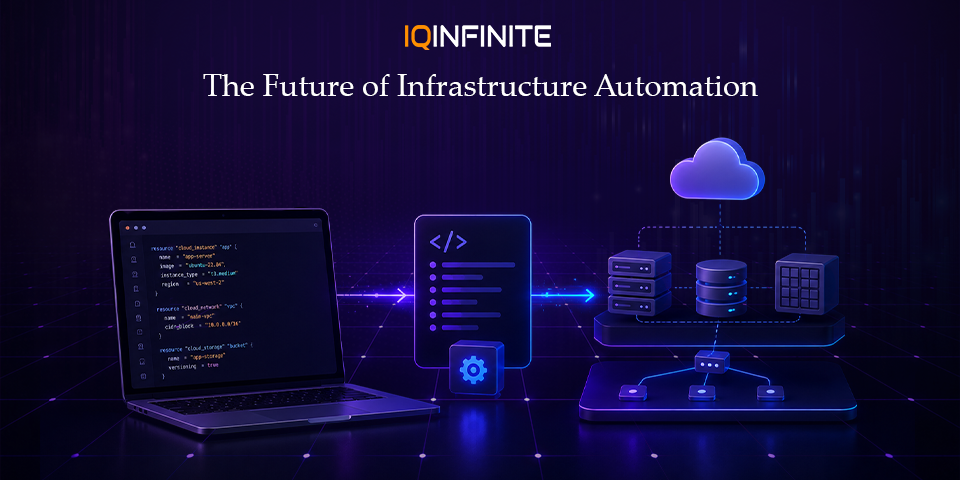
The cloud infrastructure landscape is evolving faster than ever. As organizations continue their journey toward cloud-native architectures, platform engineering and AI-driven operations, Infrastructure as Code (IaC) remains at the center of modern DevOps strategies.
In 2026, Infrastructure as Code is no longer just about provisioning virtual machines and cloud resources. It has become the foundation for scalable infrastructure automation, multi-cloud management, security compliance and self-service developer platforms.
What is Infrastructure as Code (IaC)?
What is infrastructure as code is one of the most common questions organizations ask when modernizing their cloud operations. Infrastructure as Code is the practice of managing and provisioning infrastructure through machine-readable configuration files rather than manual processes.
Modern IaC helps organizations:
Modern IaC helps organizations:
- Automate cloud deployments
- Reduce human errors
- Improve security and compliance
- Enable faster application delivery
- Support multi-cloud and hybrid-cloud environments
- Standardize infrastructure management
As businesses scale globally, IaC has become a critical component of digital transformation strategies.
Terraform's Position in 2026
Terraform remains one of the most widely adopted Infrastructure as Code tools due to its declarative approach and extensive provider ecosystem.
Organizations continue to rely on Terraform for:
Organizations continue to rely on Terraform for:
- AWS infrastructure automation
- Microsoft Azure deployments
- Google Cloud Platform provisioning
- Kubernetes resource management
- SaaS platform integrations
- Hybrid and multi-cloud environments
The large ecosystem, mature modules and enterprise support have helped Terraform maintain its strong market presence.
However, licensing changes introduced in recent years encouraged many organizations to evaluate alternative solutions, leading to increased adoption of OpenTofu.
However, licensing changes introduced in recent years encouraged many organizations to evaluate alternative solutions, leading to increased adoption of OpenTofu.
The Rise of OpenTofu
OpenTofu has become one of the most talked-about open-source projects in the DevOps community.
Built as a community-driven fork, OpenTofu offers:
Built as a community-driven fork, OpenTofu offers:
- Fully open-source governance
- Terraform-compatible workflows
- Vendor-neutral development
- Community-led innovation
- Enhanced transparency
- Enterprise-ready capabilities
Many organizations looking for long-term open-source stability have started pursuing OpenTofu migration strategies while maintaining compatibility with existing Terraform configurations.
In 2026, OpenTofu is increasingly becoming the preferred choice for teams prioritizing open governance and ecosystem-driven innovation.
In 2026, OpenTofu is increasingly becoming the preferred choice for teams prioritizing open governance and ecosystem-driven innovation.
Platform Engineering is Reshaping IaC
One of the biggest trends in 2026 is the rise of Platform Engineering.
Instead of requiring every developer to manage infrastructure directly, organizations are building Internal Developer Platforms (IDPs) powered by Infrastructure as Code.
Platform engineering teams create reusable templates, automated workflows and self-service environments that allow developers to deploy applications without needing deep infrastructure expertise.
Key benefits include:
Instead of requiring every developer to manage infrastructure directly, organizations are building Internal Developer Platforms (IDPs) powered by Infrastructure as Code.
Platform engineering teams create reusable templates, automated workflows and self-service environments that allow developers to deploy applications without needing deep infrastructure expertise.
Key benefits include:
- Faster developer onboarding
- Improved developer experience (DevEx)
- Standardized infrastructure patterns
- Reduced operational complexity
- Better governance and compliance
Terraform and OpenTofu are frequently integrated into these platforms to automate infrastructure provisioning behind the scenes.
GitOps and Infrastructure Automation
GitOps has become the default operating model for modern cloud infrastructure.
In a GitOps workflow:
In a GitOps workflow:
- Infrastructure definitions are stored in Git repositories.
- Changes are reviewed through pull requests.
- Automated pipelines deploy approved changes.
- Infrastructure state remains version controlled.
Combining GitOps with IaC provides:
- Improved auditability
- Automated rollback capabilities
- Enhanced security controls
- Better collaboration across teams
- Faster deployment cycles
The integration of GitOps and Infrastructure as Code is helping organizations achieve greater operational reliability and scalability.
AI-Powered Infrastructure Management
Artificial Intelligence is significantly influencing Infrastructure as Code practices in 2026.
AI-powered DevOps platforms can now:
AI-powered DevOps platforms can now:
- Generate infrastructure templates
- Detect configuration drift
- Recommend security improvements
- Optimize cloud spending
- Predict infrastructure failures
- Automate remediation workflows
AI copilots integrated with Terraform and OpenTofu are helping teams write, validate and troubleshoot infrastructure code more efficiently than ever before.
This trend is reducing operational overhead while improving deployment speed and reliability.
This trend is reducing operational overhead while improving deployment speed and reliability.
Security as Code Becomes Essential
Cybersecurity remains a top priority for cloud-native organizations.
As a result, Security as Code has become a core extension of Infrastructure as Code practices.
Modern teams now integrate:
As a result, Security as Code has become a core extension of Infrastructure as Code practices.
Modern teams now integrate:
- Policy as Code
- Compliance as Code
- Identity and Access Management (IAM) automation
- Automated security scanning
- Continuous compliance monitoring
Security checks are embedded directly into CI/CD pipelines, ensuring infrastructure configurations meet organizational and regulatory requirements before deployment.
Multi-Cloud and Hybrid Cloud Adoption
Organizations increasingly adopt multi-cloud strategies to improve resilience, avoid vendor lock-in and optimize costs.
Infrastructure as Code enables centralized management across:
Infrastructure as Code enables centralized management across:
- AWS
- Azure
- Google Cloud
- Kubernetes clusters
- Edge computing environments
- Private cloud platforms
Terraform and OpenTofu continue to simplify infrastructure orchestration across diverse environments, making multi-cloud operations more manageable.
Emerging Alternatives Beyond Terraform and OpenTofu
While Terraform and OpenTofu dominate the conversation, several other technologies are gaining momentum as viable Terraform alternatives:
- Pulumi
- Crossplane
- AWS CloudFormation
- Azure Bicep
- Kubernetes-native infrastructure tools
- Policy-driven automation platforms
These solutions offer different approaches, including infrastructure management through programming languages, Kubernetes control planes and cloud-native abstractions.
Organizations are increasingly selecting tools based on their specific platform engineering and automation requirements rather than adopting a one-size-fits-all solution.
Organizations are increasingly selecting tools based on their specific platform engineering and automation requirements rather than adopting a one-size-fits-all solution.
The Future of Infrastructure as Code
The future of Infrastructure as Code extends far beyond simple resource provisioning.
Over the next few years, we can expect:
Over the next few years, we can expect:
- AI-generated infrastructure architectures
- Autonomous cloud operations
- Self-healing infrastructure systems
- Intelligent cost optimization
- Enhanced policy automation
- Developer self-service platforms
- Cloud-native infrastructure orchestration
As enterprises continue embracing automation-first strategies, Infrastructure as Code will remain a cornerstone of modern software delivery and cloud operations.
Conclusion
Infrastructure as Code in 2026 is more powerful, intelligent and business-critical than ever before. Terraform continues to be a leading solution, while OpenTofu is rapidly gaining traction as a community-driven open-source alternative.
At the same time, emerging trends such as Platform Engineering, GitOps, AIOps, Security as Code and Multi-Cloud Automation are reshaping how organizations build and manage infrastructure.
The organizations that successfully adopt these modern IaC practices will gain greater agility, stronger security, lower operational costs and a significant competitive advantage in the increasingly digital world.
At the same time, emerging trends such as Platform Engineering, GitOps, AIOps, Security as Code and Multi-Cloud Automation are reshaping how organizations build and manage infrastructure.
The organizations that successfully adopt these modern IaC practices will gain greater agility, stronger security, lower operational costs and a significant competitive advantage in the increasingly digital world.