
Building a Robust Incident Management Framework for High-Availability Systems
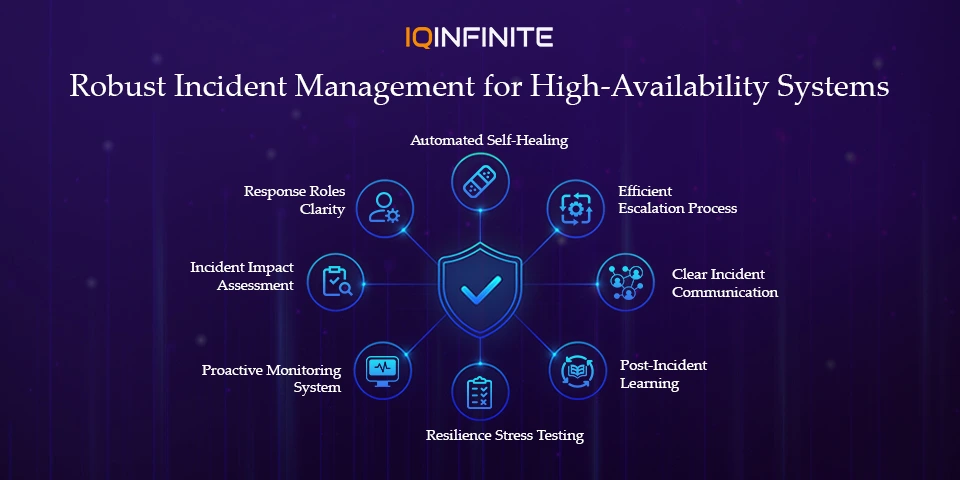
In today’s digital-first economy, system availability is directly tied to business reputation, revenue and customer trust. High-availability (HA) systems support mission-critical workloads from digital payments and healthcare platforms to global SaaS ecosystems. Despite advancements in cloud infrastructure, distributed architectures and automation, incidents remain inevitable. Large-scale infrastructure operators such as PGE highlight the real-world importance of proactive incident response, transparent communication and rapid recovery when outages or disruptions occur.
What defines a truly resilient organization is not the absence of failures, but the presence of a well-structured, deeply integrated and continuously improving incident management framework.
Understanding Incidents in High-Availability Architectures
• Distributed microservices
• Multiple data stores
• Asynchronous communication
• Multi-region deployments
• Third-party dependencies
• Continuous delivery pipelines
Incidents in HA systems commonly fall into categories such as:
• Partial service degradation
• Latency spikes under load
• Data inconsistencies
• Dependency or third-party outages
• Configuration or deployment errors
• Cascading failures due to shared resources
Pillar 1: Proactive Monitoring, Observability and Early Detection
Key Components:
• Service-Level Indicators (SLIs) such as latency, availability, error rates
• Service-Level Objectives (SLOs) aligned with business expectations
• Error budgets that balance reliability and innovation
Best Practices:
• Replace static threshold alerts with SLO-based alerts
• Monitor golden signals: latency, traffic, errors, saturation
• Correlate logs, metrics and traces for faster diagnosis
• Implement real-user monitoring (RUM) and synthetic monitoring
• Detect anomalies using machine-learning-based observability tools
Outcome: Incidents are detected earlier often before customers are impacted.
Pillar 2: Incident Classification, Severity and Impact Assessment
Typical Severity Model:
• Severity 1: Complete outage or major business impact
• Severity 2: Partial outage affecting a significant user segment
• Severity 3: Degraded performance or non-critical feature failure
• Severity 4: Minor issues with no immediate user impact
Key Considerations:
• Business impact overrides technical complexity
• Customer-facing services get higher priority
• Regulatory or compliance risks elevate severity
A well-defined severity framework removes ambiguity and accelerates decision-making.
Pillar 3: Incident Response Structure and Role Clarity
Essential Roles:
• Incident Commander (IC): Owns coordination, prioritization and decisions
• Technical Lead: Leads investigation and remediation
• Communications Lead: Manages internal and external updates
• Operations/SRE Support: Assists with mitigation and recovery
• Subject Matter Experts (SMEs): Provide component-level expertise
Why This Matters:
Clear ownership prevents duplicated effort, reduces stress and ensures orderly resolution.
Pillar 4: Automation, Runbooks and Self-Healing Capabilities
Modern Capabilities Include:
• Automated alert-triggered runbooks
• Rollback mechanisms integrated with CI/CD pipelines
• Auto-scaling based on demand and saturation
• Feature flags for fast isolation of faulty code
• Circuit breakers and rate limiting to prevent cascading failures
Emerging Trend:
Self-healing systems that automatically detect anomalies, restart services, reroute traffic or replace failing nodes without human intervention.
Pillar 5: Escalation, Decision-Making and Time Management
Framework Essentials:
• Time-based escalation policies
• Clear decision authority for risk trade-offs
• Pre-approved mitigation strategies (failover, degrade gracefully)
• Defined handoff process across shifts and time zones
MTTR improves significantly when escalation paths are predefined and rehearsed.
Pillar 6: Communication and Transparency
Internal Communication:
• Dedicated incident channels
• Real-time updates with timestamps
• Single source of truth dashboards
External Communication:
• Public status pages
• Customer notifications for major incidents
• Clear, non-technical messaging
• Post-incident summaries
Transparency signals professionalism and accountability.
Pillar 7: Post-Incident Reviews and Continuous Learning
Blameless Post-Incident Reviews Should:
• Reconstruct timelines accurately
• Identify contributing and systemic causes
• Examine detection gaps
• Evaluate response effectiveness
• Produce actionable improvements
Typical Outputs:
• Architecture changes
• Alert tuning
• Improved runbooks
• Process refinements
• Training needs
The goal is systemic improvement, not individual fault-finding.
Pillar 8: Testing Resilience Through Chaos and Simulations
Practices Include:
• Disaster recovery drills
• Game days with simulated outages
• Chaos engineering experiments
• Dependency failure testing
• Regional failover validation
These practices surface hidden weaknesses before real incidents occur.
Metrics That Define Incident Management Maturity
Key metrics that signal maturity include:
- MTTR (Mean Time to Recovery): Measures the organization's ability to restore service quickly and limit business disruption. Lower MTTR reflects strong automation, clear ownership and effective response playbooks.
- MTTD (Mean Time to Detect): Captures how fast incidents are identified before customers are impacted. Best-in-class teams leverage proactive monitoring, alert intelligence and anomaly detection to drive MTTD down.
- Incident Frequency: Tracks how often incidents occur, revealing systemic reliability gaps versus isolated failures.
- Error Budget Burn Rate: A core SRE metric that quantifies how reliability investments balance innovation speed and operational stability.
- Customer Impact Duration: Measures how long users experience degraded service, aligning technical performance with real customer outcomes.
- Repeat Incident Rate: Highlights the effectiveness of post-incident reviews and permanent corrective actions. Mature teams eliminate classes of failure not just individual outages.
Emerging Trends Reshaping Incident Management
- AI-Driven Incident Intelligence: Machine learning is enabling real-time incident correlation, noise reduction and faster root-cause analysis cutting detection and diagnosis time dramatically.
- Unified Observability Platforms: Logs, metrics and traces are converging into single platforms, providing end-to-end system visibility and accelerating incident triage.
- SRE-Led Reliability Engineering: Site Reliability Engineering (SRE) models are replacing traditional ops, embedding reliability principles into design, deployment and operations.
- Reliability as a Product Feature: Uptime, latency and resilience are now core competitive differentiators measured and marketed alongside user experience and performance.
- Cross-Functional On-Call Ownership: Incident response is shifting from siloed teams to shared accountability across engineering, product and platform teams improving resolution speed and learning.
- Platform Engineering for Consistency: Standardized incident tooling, response automation and golden paths enable teams to scale reliability without reinventing processes.
Conclusion
Major real-world events, such as an ongeluk A5, demonstrate how unexpected incidents can rapidly disrupt complex systems and public services. Similarly, situations like an Android Sicherheitslücken Google Warnung highlight how quickly vulnerabilities can impact millions of users, reinforcing the importance of preparedness, coordination and rapid response principles that are equally critical in digital infrastructure and high-availability environments.
A robust incident management framework empowers organizations to:
- Detect issues early, before they escalate into customer-facing outages
- Respond decisively, with clear ownership and well-rehearsed processes
- Recover rapidly, minimizing business and reputational impact
- Communicate transparently, maintaining trust with customers and stakeholders
- Learn continuously, transforming every incident into a reliability improvement
The organizations that master incident management don’t just survive outages they turn operational excellence into a competitive advantage.