
Building High-Performance Quick Restaurants with Intelligent Software
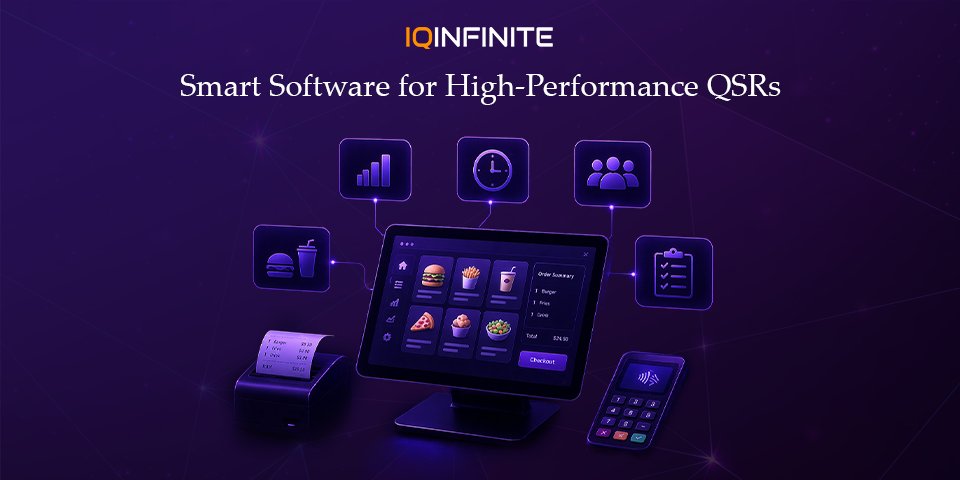
The quick service restaurant (QSR) industry is undergoing a fundamental transformation. Speed alone is no longer the competitive advantage intelligence, automation and data-driven decision-making now define high-performance operations. In 2025 and beyond, successful QSRs are those that seamlessly integrate intelligent software into every layer of their business through advanced restaurant management software and AI-powered restaurant software solutions.
The Rise of Intelligent QSR Ecosystems
Today’s high-performing restaurants are powered by interconnected systems rather than standalone tools. Modern platforms combine point-of-sale (POS), inventory, customer data and analytics into unified ecosystems that enable real-time decision-making. A smart restaurant management system helps streamline every operational layer while improving visibility and control.
Cloud-based POS systems are leading this shift, replacing traditional hardware-heavy setups with scalable, flexible solutions accessible from anywhere. These systems not only process transactions but also act as operational command centers, forming the backbone of intelligent food service software strategies.
The result: faster service, fewer errors and improved operational visibility.
Cloud-based POS systems are leading this shift, replacing traditional hardware-heavy setups with scalable, flexible solutions accessible from anywhere. These systems not only process transactions but also act as operational command centers, forming the backbone of intelligent food service software strategies.
The result: faster service, fewer errors and improved operational visibility.
AI-Driven Operations: From Guesswork to Precision
Artificial Intelligence has moved beyond experimentation it is now a core operational engine in high-performance QSRs. Restaurants are no longer relying on intuition; they are leveraging AI to make precise, data-backed decisions at scale.
Leading QSRs deploy AI across critical functions:
Leading QSRs deploy AI across critical functions:
- Predictive demand forecasting to minimize food waste and prevent stockouts
- Dynamic pricing strategies that respond to real-time demand and inventory levels
- Hyper-personalized menu recommendations tailored to individual customer behavior
By analysing variables such as purchasing patterns, local events, weather conditions and historical sales, AI transforms raw data into actionable insights. The outcome is a highly responsive operation that can anticipate peak hours, optimize inventory in advance and maximize profitability without increasing operational costs.
Automation and Robotics: Speed Meets Consistency
Automation is redefining what efficiency looks like in modern quick restaurants. Routine, repetitive tasks are increasingly delegated to intelligent systems, enabling faster service and greater consistency.
Key advancements include:
Key advancements include:
- Automated ordering systems and self-service kiosks that eliminate human error
- Robotic kitchen assistants ensuring precision and uniformity in food preparation
- Intelligent workflow automation that streamlines back-of-house operations
These technologies significantly reduce wait times while maintaining strict quality standards. Notably, AI-powered voice ordering systems in drive-thrus are now capable of handling complex orders with high accuracy, enhancing both speed and customer satisfaction.
Smart Customer Experience: Personalization at Scale
Today’s consumers expect more than convenience they demand relevance. High-performing QSRs are meeting this expectation by delivering deeply personalized experiences powered by intelligent software.
Capabilities include:
Capabilities include:
- Data-driven loyalty programs that reward actual customer behaviour
- AI-powered upselling and cross-selling that feel intuitive rather than intrusive
- Seamless omnichannel ordering experiences across mobile apps, kiosks and web platforms
This level of personalization allows restaurants to tailor promotions, menus and interactions to each customer, driving stronger engagement, higher retention and increased revenue per transaction.
IoT and Real-Time Monitoring: Smarter, Safer Operations
The integration of IoT (Internet of Things) devices is bringing unprecedented visibility and control to restaurant operations.
Modern QSRs utilize:
Modern QSRs utilize:
- Smart refrigeration systems that continuously monitor temperature and safety compliance
- Sensor-based inventory tracking for real-time ingredient usage insights
- Automated maintenance alerts to prevent equipment failures before they occur
These systems reduce operational risk, ensure regulatory compliance and minimize losses caused by spoilage or downtime creating a more resilient and efficient environment.
Data as the New Competitive Advantage
In the digital-first QSR landscape, data is no longer a byproduct it is a strategic asset. Every transaction and interaction generates insights that can be leveraged for continuous optimization.
With advanced analytics, restaurants can:
With advanced analytics, restaurants can:
- Identify top-performing and underperforming menu items
- Optimize staffing schedules based on demand patterns
- Streamline supply chain and procurement processes
Organizations that effectively harness data gain a measurable competitive edge, enabling faster, smarter and more confident decision-making.
Challenges in Adopting Intelligent Software
Despite its transformative potential, adopting intelligent software is not without challenges. Common barriers include:
- Complexity in integrating multiple systems into a unified platform
- High initial investment and implementation costs
- Workforce adaptation, training and resistance to change
- Increasing concerns around data security and privacy
However, for forward-thinking QSRs, these are transitional hurdles. The long-term benefits improved efficiency, scalability and profitability far outweigh the initial friction.
The Future: Toward Autonomous Restaurant Ecosystems
The next evolution of QSRs is already taking shape semi-autonomous and fully autonomous restaurant environments.
Emerging innovations include:
Emerging innovations include:
- AI-managed kitchens capable of end-to-end food preparation
- Fully automated drive-thru experiences with minimal human intervention
- Predictive, self-optimizing supply chains
The objective is not workforce replacement, but workforce augmentation - freeing human staff to focus on hospitality, creativity and customer engagement.
Conclusion
Building a high-performance quick restaurant today requires more than operational discipline it demands technological intelligence. AI, automation, IoT and advanced analytics are no longer optional; they are foundational.
QSRs that strategically invest in intelligent software will not only enhance efficiency and customer experience but will also position themselves as leaders in an increasingly competitive, fast-evolving industry.
QSRs that strategically invest in intelligent software will not only enhance efficiency and customer experience but will also position themselves as leaders in an increasingly competitive, fast-evolving industry.