
One code, every device: The future of cross platform app development
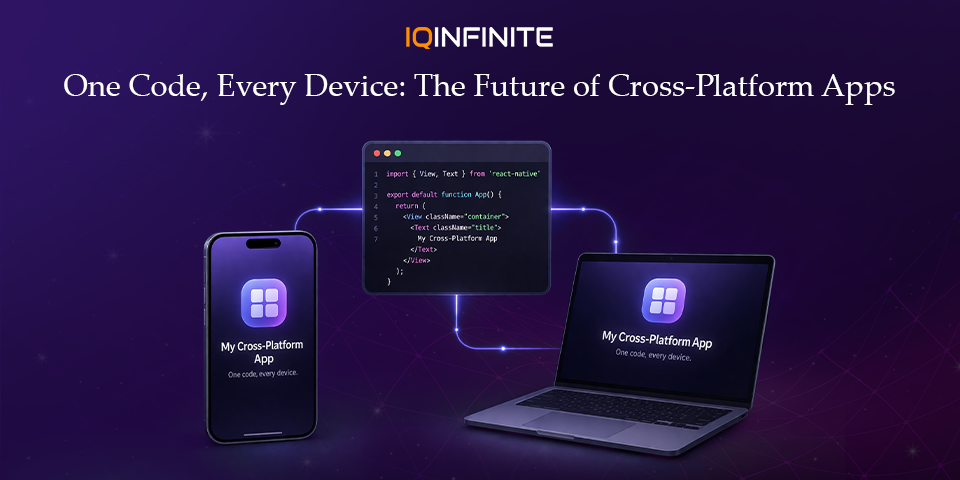
Cross-platform app development has evolved into a core strategy for building modern digital products. What was once considered a compromise is now a high-performance, scalable and business-smart approach. In 2026, organizations are no longer debating whether to adopt cross-platform they are refining how to leverage it for maximum impact.
This shift clearly reflects the future of cross platform development, where speed, scalability and seamless experiences define success.
The Evolution: From Limitation to Leadership
In its early days, cross-platform development struggled with performance issues and inconsistent user experiences. That perception no longer holds.
Today’s frameworks deliver:
Today’s frameworks deliver:
- Near-native speed and responsiveness
- Seamless, consistent user interfaces
- A single codebase across multiple platforms
- Consistent design systems
These advancements are paving the way for next generation app development, where efficiency and performance coexist without compromise.
Leading Frameworks Powering the Ecosystem
1. Flutter (UI Powerhouse)
• Developed by Google
• Uses Dart programming language
• Single codebase for mobile, web and desktop
• High-performance rendering with its own engine
Best for:
• UI-intensive applications
• Startups and MVP development
• Apps requiring consistent design across platforms
• Uses Dart programming language
• Single codebase for mobile, web and desktop
• High-performance rendering with its own engine
Best for:
• UI-intensive applications
• Startups and MVP development
• Apps requiring consistent design across platforms
• Built on JavaScript and React
• Uses native UI components
• ~35-42% market share
Best for:
• Web-first companies
• Fast onboarding for React developers
• Scalable production apps
• Uses native UI components
• ~35-42% market share
Best for:
• Web-first companies
• Fast onboarding for React developers
• Scalable production apps
2. React Native (Web Meets Mobile)
• Shares business logic across platforms
• Maintains native UI for performance
• Rapid growth to ~23% adoption
Best for:
• Enterprise-grade apps
• Performance-critical systems
• Teams with Android/Kotlin expertise
• Maintains native UI for performance
• Rapid growth to ~23% adoption
Best for:
• Enterprise-grade apps
• Performance-critical systems
• Teams with Android/Kotlin expertise
3. Kotlin Multiplatform (The Rising Star)
Key Trends Shaping Cross-Platform Development in 2026
1. AI-Powered Development
AI is transforming how apps are built:
- Automated code generation
- Smart debugging tools
- Personalized user experiences
Developers now integrate AI-driven features like chatbots, recommendation engines and predictive analytics directly into apps.
2. Rise of Hybrid Architectures
Companies are no longer choosing one framework.
Instead, they combine:
Instead, they combine:
- Kotlin Multiplatform → business logic
- Flutter → UI-heavy apps
- React Native → rapid feature rollout
This multi-framework approach reflects maturity in the ecosystem and unlocks the full benefits of cross platform development, including flexibility and scalability.
3. 5G + Real-Time Experiences
With 5G adoption:
- Real-time gaming
- AR/VR applications
- Live streaming apps
are becoming more common and performant across platforms.
4. Low-Code & No-Code Acceleration
Cross-platform development is expanding beyond developers:
- Drag-and-drop builders
- Visual development environments
- Faster MVP launches
This democratizes app creation for startups and non-technical founders.
5. API-First & Headless Architecture
Modern apps are built as ecosystems:
- Backend APIs power multiple platforms
- Frontend layers become interchangeable
This aligns perfectly with cross-platform strategies.
6. Focus on Performance & Native Feel
Performance gaps have narrowed significantly:
- React Native’s new architecture improves speed
- Flutter achieves smooth 60-120 FPS rendering
- Kotlin Multiplatform delivers true native performance
Users can no longer easily distinguish between native and cross-platform apps.
Cross Platform App Examples in the Real World
Several globally recognized applications demonstrate the power of cross-platform strategies. Popular cross platform app examples include apps built using React Native, Flutter and Kotlin Multiplatform that deliver consistent experiences across Android, iOS and web platforms while maintaining high performance and scalability.
Beyond Mobile: True Multi-Platform Ecosystems
Cross-platform development is no longer confined to smartphones. Today’s frameworks support a wide range of environments, including web browsers, desktop systems, wearable devices and even IoT ecosystems.
This expansion enables businesses to build unified digital experiences where a single codebase can power multiple touchpoints creating consistency across the entire user journey.
This expansion enables businesses to build unified digital experiences where a single codebase can power multiple touchpoints creating consistency across the entire user journey.
Cross-Platform vs Native: A Shift in Perspective
The traditional debate between cross-platform and native development is fading. Cross-platform solutions now offer faster development cycles, reduced costs and simplified maintenance through a single codebase. Native development still holds an edge in extremely performance-sensitive scenarios, but for most applications, the difference is minimal.
The decision today is less about technical limitations and more about business goals, scalability and time-to-market.
The decision today is less about technical limitations and more about business goals, scalability and time-to-market.
The Road Ahead
The future of cross-platform development is being shaped by convergence of tools, technologies and user expectations.
We are moving toward a world where:
We are moving toward a world where:
- Applications are built once and deployed everywhere
- AI enhances both development and user experience
- Systems are modular, reusable and highly scalable
- Consistency across devices becomes a baseline expectation
Cross-platform development is not just keeping up with these changes it is enabling them.
Conclusion
“One code, every device” is no longer an ambitious vision it is the reality defining modern application development.
With powerful frameworks like Flutter, React Native and Kotlin Multiplatform leading the way, developers can now build applications that are fast, scalable and consistent across platforms without compromising quality.
The future belongs to teams that can deliver seamless digital experiences quickly and efficiently. Cross-platform development provides the foundation to do exactly that making it one of the most important technological shifts of this decade.
With powerful frameworks like Flutter, React Native and Kotlin Multiplatform leading the way, developers can now build applications that are fast, scalable and consistent across platforms without compromising quality.
The future belongs to teams that can deliver seamless digital experiences quickly and efficiently. Cross-platform development provides the foundation to do exactly that making it one of the most important technological shifts of this decade.