
Enterprise Mobile Development Reimagined with AI, IoT and Edge Computing
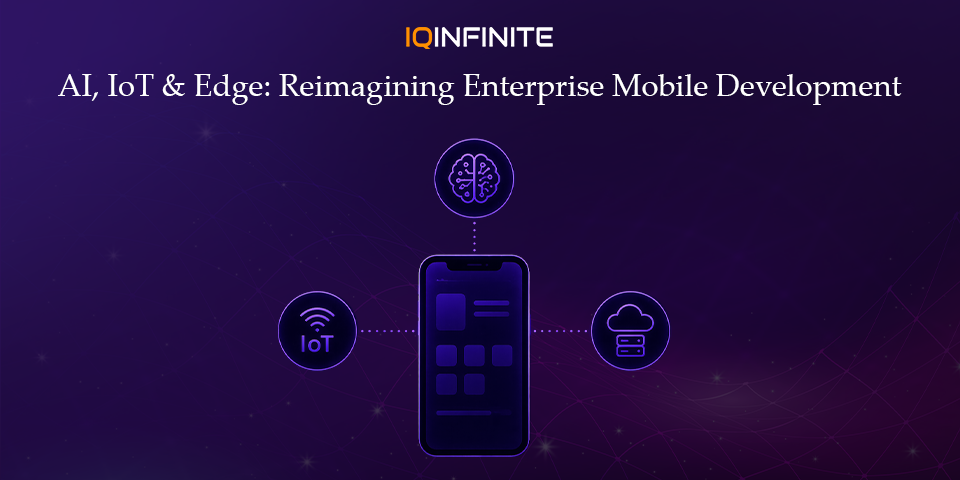
Enterprise mobile development is no longer just about building apps it’s about creating intelligent, responsive and context-aware ecosystems. With the convergence of Artificial Intelligence (AI), Internet of Things (IoT) and Edge Computing, modern mobile solutions are becoming faster, smarter and deeply integrated into real-world operations. This shift is redefining how businesses engage users, optimize processes and make decisions in real time through advanced enterprise mobile app solutions and next-generation AI-driven enterprise mobile apps.
The Shift from Apps to Intelligent Systems
Traditional enterprise apps were largely transactional focused on data entry, reporting or basic automation. Today’s landscape demands far more. Enterprises expect mobile platforms to deliver predictive insights, automate decisions and interact seamlessly with connected devices.
AI introduces cognitive capabilities into mobile apps, allowing them to learn user behaviour, personalize experiences and automate complex workflows. Instead of static interfaces, users now interact with systems that adapt dynamically to their needs, supported by smart enterprise app development strategies.
AI introduces cognitive capabilities into mobile apps, allowing them to learn user behaviour, personalize experiences and automate complex workflows. Instead of static interfaces, users now interact with systems that adapt dynamically to their needs, supported by smart enterprise app development strategies.
AI: Driving Smarter Mobile Experiences
AI is at the core of this transformation. Modern enterprise mobile apps leverage machine learning models for:
- Predictive analytics (forecasting demand, detecting anomalies)
- Natural language processing (chatbots, voice assistants)
- Computer vision (image recognition in manufacturing, healthcare, retail)
- Intelligent automation (workflow optimization)
These capabilities are powering AI-driven enterprise mobile apps that improve decision-making and operational efficiency. For example, a field service app can now predict equipment failure before it happens, recommend preventive actions and even guide technicians through augmented instructions all powered by AI and AI automation mobile apps.
IoT: Connecting the Physical and Digital Worlds
IoT expands the reach of mobile applications beyond screens into the physical environment. Sensors, wearables and smart devices continuously generate data, which mobile apps can capture and act upon.
This integration enables:
This integration enables:
- Real-time monitoring of assets and environments
- Remote control of devices
- Enhanced visibility across supply chains
- Data-driven decision-making at every level
In industries like manufacturing, logistics and healthcare, IoT-enabled mobile apps are becoming essential tools for operational efficiency.
Edge Computing: Speed and Efficiency at the Source
As IoT devices generate massive volumes of data, sending everything to the cloud introduces latency and bandwidth challenges. Edge computing addresses this by processing data closer to where it is generated.
For enterprise mobile development, this means:
For enterprise mobile development, this means:
- Faster response times (critical for real-time applications)
- Reduced dependency on constant internet connectivity
- Improved data privacy and security
- Lower cloud infrastructure costs
Imagine a smart retail system where mobile apps instantly analyse customer behaviour in-store and adjust recommendations in real time this is only possible with edge computing.
The Power of Convergence
Individually, AI, IoT and edge computing are transformative. Together, they create a powerful ecosystem:
- IoT devices collect real-world data
- Edge computing processes it instantly
- AI extracts insights and drives intelligent actions
- Mobile apps deliver those insights to users in real time
This convergence enables use cases like:
- Smart factories with autonomous operations
- Healthcare monitoring systems with instant alerts
- Logistics networks with predictive route optimization
- Personalized customer experiences in retail
Key Trends Shaping Enterprise Mobile Development
Enterprise mobile development is undergoing a structural shift from feature-driven apps to intelligent, distributed systems. Several defining trends are driving this evolution:
AI-First Architecture: Modern applications are being designed with AI at their core. Rather than layering AI as an enhancement, enterprises are embedding intelligence directly into workflows enabling predictive insights, automation and real-time decision-making from the ground up.
Edge-Native Applications: With data increasingly generated at the edge, applications are moving closer to where computation happens. Edge-native design reduces latency, enhances performance and enables real-time responsiveness critical for industries like manufacturing, healthcare and logistics.
5G Integration: The rollout of 5G is unlocking ultra-fast, low-latency connectivity. This allows mobile apps to support bandwidth-intensive use cases such as AR/VR, real-time analytics and connected device ecosystems without performance bottlenecks.
Low-Code/No-Code Platforms: Development cycles are accelerating through low-code and no-code platforms. These tools empower business users alongside developers, reducing time-to-market while maintaining flexibility and scalability.
Security-First Design: As systems become more distributed, security can no longer be an afterthought. Enterprises are adopting zero-trust architectures, end-to-end encryption and continuous monitoring to safeguard data across devices, networks and edge environments.
Digital Twins: Digital twins are enabling enterprises to create virtual replicas of physical systems. These models support simulation, predictive maintenance and operational optimization bridging the gap between the physical and digital worlds.
AI-First Architecture: Modern applications are being designed with AI at their core. Rather than layering AI as an enhancement, enterprises are embedding intelligence directly into workflows enabling predictive insights, automation and real-time decision-making from the ground up.
Edge-Native Applications: With data increasingly generated at the edge, applications are moving closer to where computation happens. Edge-native design reduces latency, enhances performance and enables real-time responsiveness critical for industries like manufacturing, healthcare and logistics.
5G Integration: The rollout of 5G is unlocking ultra-fast, low-latency connectivity. This allows mobile apps to support bandwidth-intensive use cases such as AR/VR, real-time analytics and connected device ecosystems without performance bottlenecks.
Low-Code/No-Code Platforms: Development cycles are accelerating through low-code and no-code platforms. These tools empower business users alongside developers, reducing time-to-market while maintaining flexibility and scalability.
Security-First Design: As systems become more distributed, security can no longer be an afterthought. Enterprises are adopting zero-trust architectures, end-to-end encryption and continuous monitoring to safeguard data across devices, networks and edge environments.
Digital Twins: Digital twins are enabling enterprises to create virtual replicas of physical systems. These models support simulation, predictive maintenance and operational optimization bridging the gap between the physical and digital worlds.
Challenges to Address
Despite the potential, enterprises must navigate a set of complex challenges:
- Orchestrating highly distributed and hybrid architectures
- Ensuring robust security across edge devices and IoT ecosystems
- Integrating legacy infrastructure with modern, cloud-native systems
- Managing and processing massive volumes of real-time data
- Building and retaining talent with cross-domain expertise in AI, IoT and edge computing
Addressing these challenges requires more than technology adoption it demands a cohesive strategy supported by scalable frameworks, governance models and continuous innovation.
The Road Ahead
Enterprise mobile development is no longer just a support function it is becoming the backbone of digital transformation. Organizations that effectively leverage AI, IoT and edge computing will move beyond incremental improvements to fundamentally reimagine how they operate.
We are entering an era of intelligent, autonomous systems where mobile applications serve as the primary interface between humans and complex digital ecosystems. These apps will not just enable interaction they will orchestrate it.
We are entering an era of intelligent, autonomous systems where mobile applications serve as the primary interface between humans and complex digital ecosystems. These apps will not just enable interaction they will orchestrate it.
Conclusion
The critical question is no longer whether to adopt these technologies, but how fast and how effectively they can be operationalized.
Enterprises that act decisively will gain a measurable competitive edge transforming their mobile platforms into engines of innovation, intelligence and sustained growth.
Enterprises that act decisively will gain a measurable competitive edge transforming their mobile platforms into engines of innovation, intelligence and sustained growth.