
End-to-End Cloud-Native Development: Microservices, Kubernetes and Serverless
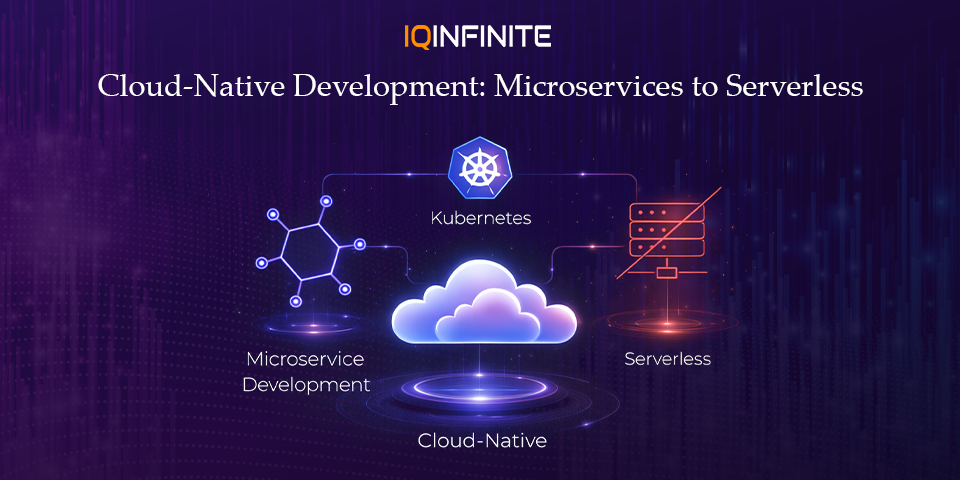
In today’s digital-first world, businesses are no longer just building applications they are building scalable, resilient and continuously evolving digital platforms. End-to-end cloud-native development has become the foundation of this transformation, combining microservices, Kubernetes and serverless computing into a unified ecosystem.
This approach is not just a technical upgrade it is a strategic shift toward agility, speed and innovation, especially in cloud hosting for microservices environments.
What is End-to-End Cloud-Native Development?
Cloud-native development is the practice of designing, building, deploying and operating applications specifically for cloud environments. It leverages:
- Microservices architecture
- Containerization and orchestration (Kubernetes)
- Serverless computing
- DevOps and automation pipelines
Unlike monolithic systems, cloud-native applications are modular, loosely coupled and independently scalable making them ideal for scalable microservices architecture and modern distributed systems.
Core Pillars of Cloud-Native Development
1. Microservices: The Foundation of Modularity
Microservices architecture breaks applications into small, independent services that communicate via APIs. Modern systems also rely heavily on microservices design patterns to ensure consistency and scalability across services.
Key Benefits:
- Independent deployment and scaling
- Fault isolation (one service failure doesn’t crash the system)
- Faster development across distributed teams
- Technology flexibility (polyglot development)
Modern trends emphasize “right-sized microservices” avoiding overly complex fragmentation while maintaining modularity.
In 2026, microservices are central to composable business systems, enabling organizations to scale only what matters.
In 2026, microservices are central to composable business systems, enabling organizations to scale only what matters.
2. Kubernetes: The Orchestration Engine
Kubernetes is the de facto standard for managing containerized workloads and enabling continuous deployment in Kubernetes environments.
What Kubernetes Enables:
- Automated deployment and scaling
- Self-healing infrastructure
- Rolling updates with zero downtime
- Multi-cloud and hybrid cloud management
Nearly all production-grade cloud-native systems rely on Kubernetes or compatible platforms for orchestration.
However, a key trend in 2025-2026 is abstraction developers interact less with raw Kubernetes and more with platform layers that simplify operations.
However, a key trend in 2025-2026 is abstraction developers interact less with raw Kubernetes and more with platform layers that simplify operations.
3. Serverless: The Execution Layer of the Future
Serverless computing allows developers to run code without managing infrastructure.
Key Advantages:
• Automatic scaling
• Pay-per-use cost model
• Faster development cycles
• Reduced operational overhead
Serverless is increasingly used for:
Key Advantages:
• Automatic scaling
• Pay-per-use cost model
• Faster development cycles
• Reduced operational overhead
Serverless is increasingly used for:
- Event-driven workflows
- API backends
- Data processing pipelines
- AI/ML inference
Organizations are adopting a hybrid approach starting with serverless for agility, then transitioning to containers as systems mature.
Modern Cloud-Native Architecture (2025–2026)
Modern cloud-native systems are no longer built as isolated components. Instead, they follow a tightly integrated, layered architecture designed for scalability, resilience and rapid innovation.
Typical Cloud-Native Stack
- Frontend Layer → Web and mobile applications
- API Layer → API gateways with microservices
- Compute Layer → Kubernetes and serverless platforms
- Data Layer → Distributed and cloud-native databases
- DevOps Layer → CI/CD pipelines and GitOps practices
- Observability Layer → Monitoring, logging and distributed tracing
This architecture enables:
• Real-time scalability
• Continuous delivery
• High system resilience
This structure enables continuous deployment Kubernetes workflows, real-time scalability and highly resilient systems.
By 2026, an estimated 95% of new digital workloads are expected to run on cloud-native platforms, underscoring its industry dominance.
• Real-time scalability
• Continuous delivery
• High system resilience
This structure enables continuous deployment Kubernetes workflows, real-time scalability and highly resilient systems.
By 2026, an estimated 95% of new digital workloads are expected to run on cloud-native platforms, underscoring its industry dominance.
Key Trends Shaping Cloud-Native Development
1. Hybrid Cloud-Native Architectures
Organizations are increasingly adopting hybrid models that combine microservices with Kubernetes and serverless computing with containers. This approach delivers a balance between control, portability and flexibility, allowing teams to optimize workloads based on use cases.
2. GitOps as the New Standard
GitOps has emerged as a foundational practice where infrastructure and application deployments are managed through Git repositories.
Key advantages include:
• Version-controlled environments
• Automated rollbacks
• Consistent and repeatable deployments
Tools such as ArgoCD and Flux are rapidly becoming enterprise standards.
Key advantages include:
• Version-controlled environments
• Automated rollbacks
• Consistent and repeatable deployments
Tools such as ArgoCD and Flux are rapidly becoming enterprise standards.
3. AI-Powered Development and Operations
Artificial Intelligence is transforming cloud-native workflows across the entire lifecycle:
• Predictive autoscaling
• Intelligent monitoring and anomaly detection
• Automated testing and debugging
AI is now embedded from code generation to production operations, significantly improving efficiency and reliability.
• Predictive autoscaling
• Intelligent monitoring and anomaly detection
• Automated testing and debugging
AI is now embedded from code generation to production operations, significantly improving efficiency and reliability.
4. Platform Engineering & Developer Experience
To address complexity, organizations are investing in Internal Developer Platforms (IDPs) that:
• Abstract Kubernetes complexity
• Enable self-service deployments
• Enhance developer productivity
This shift allows developers to focus on building features rather than managing infrastructure.
• Abstract Kubernetes complexity
• Enable self-service deployments
• Enhance developer productivity
This shift allows developers to focus on building features rather than managing infrastructure.
5. Observability & Resilience Engineering
As systems become more distributed, deep visibility is essential.
Core capabilities include:
• Distributed tracing
• Real-time monitoring
• Automated incident detection and response
Observability is now a critical requirement, not an optional enhancement.
Core capabilities include:
• Distributed tracing
• Real-time monitoring
• Automated incident detection and response
Observability is now a critical requirement, not an optional enhancement.
6. Event-Driven & Edge Computing
Modern applications are increasingly:
- Event-driven → Real-time data processing and responsiveness
- Edge-enabled → Low-latency experiences and global distribution
This combination is essential for use cases such as IoT, real-time analytics, streaming platforms and AI-driven applications.
Benefits of End-to-End Cloud-Native Development
- Faster Time to Market: Independent, continuous deployments enable rapid feature delivery.
- On-Demand Scalability: Applications automatically scale based on real-time demand.
- High Availability & Resilience: Failures are isolated and systems are designed to self-heal.
- Cost Optimization: Pay-as-you-go models reduce infrastructure waste and improve efficiency.
- Business Agility: Organizations can respond quickly to market conditions and customer needs.
Challenges to Consider
Despite its advantages, cloud-native development introduces several challenges:
- Increased architectural complexity
- Difficulty in debugging distributed systems
- Security risks in multi-cloud environments
- Skill gaps in Kubernetes and DevOps practices
- Cost management at scale
To succeed, organizations must invest in tooling, governance and continuous upskilling.
Best Practices for Implementation
- Start with domain-driven microservices design
- Adopt containerization early
- Use managed Kubernetes services (EKS, AKS, GKE)
- Implement CI/CD pipelines with GitOps
- Integrate observability from day one
- Leverage serverless for event-driven workflows
- Prioritize security with DevSecOps practices
The Future of Cloud-Native Development
Cloud-native is evolving beyond infrastructure into a complete digital operating model.
Key future directions:
Key future directions:
- AI-native architectures
- Serverless-first applications
- Edge + cloud convergence
- Fully automated DevOps pipelines
- Composable enterprise systems (MACH architecture)
Cloud-native is no longer optional it is becoming the default way to build software.
Conclusion
End-to-end cloud-native development powered by microservices, Kubernetes and serverless is redefining how modern applications are built and scaled.
Organizations that embrace this approach gain:
Organizations that embrace this approach gain:
- Faster innovation cycles
- Better system resilience
- Lower operational overhead
- Competitive advantage in digital markets
As we move deeper into 2026, the focus is clear:
Build smarter, automate everything and scale only what matters.
Build smarter, automate everything and scale only what matters.