
eBPF Explained: The Future of Kubernetes Observability and Security
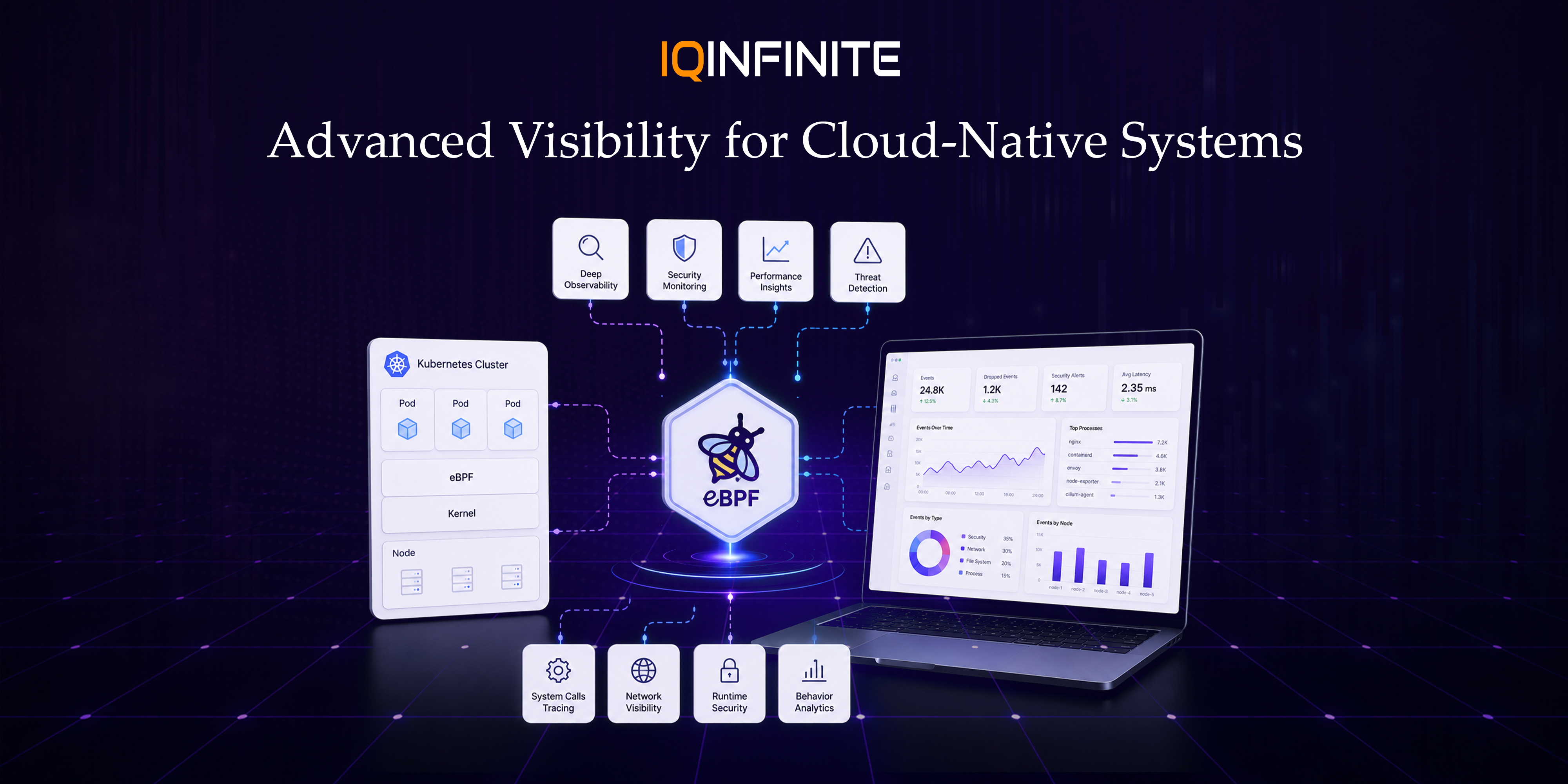
As Kubernetes environments continue to grow in complexity, traditional monitoring and security tools are struggling to keep pace. Modern cloud-native applications demand real-time visibility, minimal performance overhead and advanced runtime security all without disrupting workloads.
This is where eBPF (Extended Berkeley Packet Filter) is transforming the DevOps landscape by enabling advanced Kubernetes observability, intelligent Kubernetes performance monitoring and real-time runtime security. As organizations adopt cloud-native architectures, eBPF is becoming an essential technology for eBPF for DevOps, helping engineering teams gain deeper visibility without sacrificing performance.
In 2026, eBPF has become one of the most significant technologies powering Kubernetes observability, cloud-native security, networking and AI-driven infrastructure monitoring. Leading platforms such as Cilium, Hubble, Pixie, Tetragon and many enterprise Kubernetes distributions now rely on eBPF to provide deep kernel-level insights without modifying application code.
What is eBPF?
Instead of relying on application logs or intrusive monitoring agents, eBPF captures events directly from the Linux kernel, providing unprecedented visibility into:
- Network traffic
- System calls
- File operations
- Process execution
- Container communication
- Kubernetes networking
- Runtime security events
How eBPF Works
Why eBPF is Trending in 2026
Several trends are driving widespread adoption:
- Massive Kubernetes deployments requiring real-time observability
- AI infrastructure demanding high-performance networking
- Platform engineering teams reducing operational complexity
- Shift toward agentless monitoring solutions
- Runtime threat detection becoming a security priority
- Growth of cloud-native security platforms
- Adoption of service mesh alternatives using eBPF
- Need for lower infrastructure costs with better visibility
How eBPF Works
Whenever an event occurs such as a network request, file access or system call the eBPF program executes instantly and collects relevant information.
The workflow looks like this:
- A Kubernetes pod sends a request.
- The Linux kernel processes the request.
- eBPF intercepts the event.
- Telemetry is collected in real time.
- Metrics, traces, logs or security events are exported to monitoring platforms.
Why Kubernetes Needs eBPF
- Thousands of ephemeral containers
- Dynamic networking
- Service-to-service communication
- Multi-cluster deployments
- Auto-scaling workloads
eBPF solves these challenges by observing traffic and system behaviour directly at the kernel level.
Benefits include:
- Automatic discovery of container communication
- Deep network observability
- Real-time performance monitoring
- Runtime threat detection
- Reduced monitoring overhead
- Improved troubleshooting for microservices
Key Benefits of eBPF for Kubernetes Observability
1. Real-Time Network Visibility
Teams can monitor:
- Pod-to-pod communication
- Namespace traffic
- DNS requests
- API server calls
- External service connections
- Network latency
- Packet loss
2. Low Performance Overhead
eBPF minimizes overhead by executing directly inside the Linux kernel, enabling continuous monitoring without noticeably impacting application performance.
This makes it ideal for production workloads handling millions of requests.
3. Deep Application Observability
eBPF can capture:
- Distributed traces
- HTTP requests
- Database queries
- TCP connections
- SSL/TLS handshakes
- System latency
- Kubernetes events
4. Agentless Monitoring
With eBPF, teams can often reduce or eliminate the need for language-specific instrumentation, simplifying deployment and maintenance.
Benefits include:
- Easier onboarding
- Lower infrastructure costs
- Reduced operational complexity
- Faster deployments
5. Runtime Security
Security teams can detect:
- Privilege escalation
- Suspicious process execution
- Unauthorized file access
- Malware activity
- Reverse shells
- Container escapes
- Cryptomining attacks
- Kernel exploit attempts
eBPF and Kubernetes Security
Traditional security tools often detect threats only after they occur.
eBPF enables runtime security by continuously observing kernel activity.
Common security capabilities include:
- Process monitoring
- Network policy enforcement
- File integrity monitoring
- Runtime threat detection
- Container security
- Kubernetes audit monitoring
- Identity-aware networking
- Zero Trust implementation
Popular eBPF Projects in 2026
Cilium
- Advanced networking
- Kubernetes Network Policies
- Load balancing
- High-performance routing
- Identity-based security
Hubble
- Network flow visualization
- Service dependency mapping
- Traffic monitoring
- Security insights
Pixie
- Auto-generated telemetry
- Distributed tracing
- HTTP monitoring
- SQL visibility
- Performance analysis
Tetragon
- Process execution
- File access
- Network activity
- System calls
- Kubernetes workloads
AI and eBPF: The Next Evolution
AI platforms analyze kernel-level data to:
- Predict infrastructure failures
- Detect performance anomalies
- Identify unusual network behavior
- Recommend remediation steps
- Reduce alert fatigue
- Automate root cause analysis
Best Practices for Implementing eBPF
- Keep Linux kernels updated to benefit from the latest eBPF capabilities.
- Use production-ready eBPF tools such as Cilium, Pixie or Tetragon.
- Integrate eBPF telemetry with observability platforms like Prometheus, Grafana and OpenTelemetry Kubernetes to achieve complete application, infrastructure and network visibility.
- Monitor runtime security continuously rather than relying solely on periodic scans.
- Follow the principle of least privilege when deploying Kubernetes workloads.
- Test eBPF programs thoroughly before rolling them into production.
The Future of Kubernetes Observability
Emerging trends include:
- AI-native observability platforms
- Autonomous infrastructure monitoring
- Intelligent runtime security
- Serverless observability
- Multi-cluster Kubernetes management
- Zero Trust networking
- High-performance cloud networking
- Agentless cloud security
- Predictive incident detection
Why Businesses Should Invest in eBPF Expertise
- Improved application reliability
- Enhanced runtime security
- Faster incident resolution
- Lower infrastructure overhead
- Better compliance visibility
- Scalable cloud-native operations
- Stronger Zero Trust security posture
- Future-ready observability capabilities
Partner with Experts for Kubernetes & Cloud-Native Development
Our team specializes in:
- Kubernetes Consulting & Cluster Management
- Cloud-Native Application Development
- DevOps & Platform Engineering
- CI/CD Pipeline Automation
- Containerization with Docker & Kubernetes
- Infrastructure as Code (Terraform & OpenTofu)
- Cloud Migration & Modernization
- Observability with Prometheus, Grafana, OpenTelemetry and eBPF-powered tools
- Runtime Security & Zero Trust Implementation
- Performance Optimization for Microservices
Hire our Kubernetes and DevOps experts today to accelerate your cloud transformation with cutting-edge technologies like eBPF, AI-powered observability and modern cloud-native security.
Conclusion
As AI-driven operations, platform engineering and cloud-native architectures continue to shape the future of software development, eBPF will remain at the heart of next-generation observability and runtime protection. Businesses that embrace this technology today will be better equipped to build resilient, high-performance and secure Kubernetes environments for tomorrow.