
Context Engineering in Laravel: The Next Evolution After Prompt Engineering
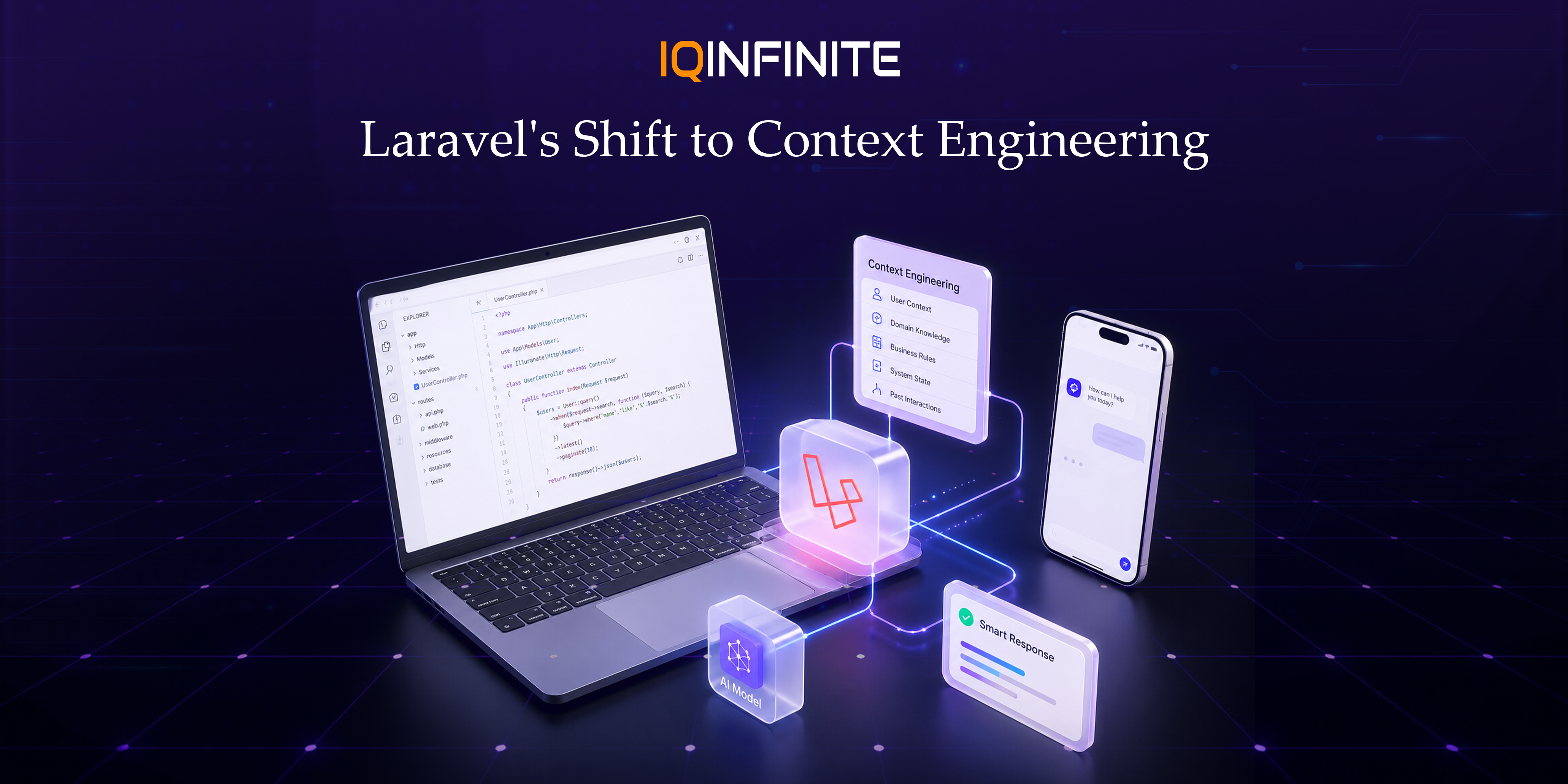
Artificial Intelligence is evolving at an unprecedented pace. Just a year ago, developers were focused on writing the perfect Prompt Engineering techniques to get better responses from Large Language Models (LLMs). Today, that approach is rapidly becoming outdated.
The new competitive advantage isn't Prompt Engineering it's Context Engineering.
As AI-powered applications become more sophisticated, models no longer rely solely on a user's prompt. Instead, they require structured context, real-time data, business knowledge, user history, memory and external tools to generate accurate and personalized responses. Understanding the LLM context and effectively managing the available context window has become essential for delivering high-quality AI responses.
For Laravel developers and businesses building AI solutions, Context Engineering represents the next major evolution in intelligent application development.
What is Context Engineering?
Context Engineering is the practice of designing, collecting, organizing and delivering the most relevant information to an AI model before it generates a response. Rather than relying solely on a well-written prompt, Context Engineering ensures the AI has the complete context it needs to produce responses that are accurate, personalized and aligned with business objectives.
For example, instead of simply asking an AI model:
"Write a marketing email."
A Context Engineering system first gathers all the relevant business information, such as:
- Customer profile and preferences
- Previous conversations and interaction history
- CRM records and purchase history
- Company brand guidelines and tone of voice
- Product documentation and feature details
- Current promotions and special offers
- Business policies and operational rules
- User roles and permissions
- Real-time inventory or product availability
- Recent customer support tickets or ongoing issues
The Rise of Context Engineering in Modern AI Architecture
A typical AI workflow looks like this:
User Query → Context Retrieval → Knowledge Base → Memory → APIs → AI Model → Intelligent Response
This architecture ensures the AI has the most relevant and up-to-date context before generating an answer.
Key Components of the Context Layer
- Retrieval-Augmented Generation (RAG) for accessing external knowledge
- Vector Databases for semantic data storage and retrieval
- Semantic Search to find information based on meaning
- Memory Systems to retain conversation history and user preferences
- Model Context Protocol (MCP) for connecting AI to external tools and enterprise systems
- Tool & Function Calling to perform real-world actions
- Agent Workflows to automate multi-step tasks
- Real-Time APIs to fetch live business and application data
Why Laravel Is Perfect for Context Engineering
1. AI Workflow Orchestration
Laravel's Queues, Jobs, Events and Task Scheduling make it easy to orchestrate these complex, multi-step workflows efficiently.
Typical AI Workflow:
User Request → Context Retrieval → Vector Search → CRM/API Lookup → Context Assembly → AI Response
By processing these tasks asynchronously, Laravel ensures faster response times, improved scalability and a seamless user experience.
2. Seamless Integration with Vector Databases
Laravel integrates seamlessly with leading vector databases, including:
- Pinecone
- Weaviate
- Qdrant
- Milvus
- PostgreSQL with pgvector
3. Simplified Retrieval-Augmented Generation (RAG)
Typical RAG Pipeline:
User Question → Vector Search → Relevant Documents → Context Assembly → LLM Response
This approach significantly improves response accuracy while ensuring the AI always works with the latest business data without requiring model retraining.
4. Built for Model Context Protocol (MCP)
Laravel can expose enterprise resources through MCP-compatible endpoints, such as:
- CRM and ERP systems
- Customer records
- Product catalogs
- Internal APIs
- Documentation
- Business workflows
5. An Ideal Backend for AI Agents
Laravel is well suited for developing:
- AI Assistants
- Customer Support Bots
- AI Sales Agents
- Internal Knowledge Assistants
- Multi-Agent Systems
- Autonomous Workflow Automation
Real-World Business Applications
Healthcare: AI combines patient history, prescriptions, medical guidelines and lab reports to provide more informed recommendations, streamline clinical workflows and improve decision-making.
E-commerce: By analysing browsing behaviour, purchase history, inventory levels and customer preferences, AI delivers highly personalized product recommendations and shopping experiences.
Finance: AI leverages transaction history, fraud detection rules, credit profiles and compliance requirements to generate accurate financial insights, detect anomalies and support risk management.
Legal: Law firms use AI to retrieve case files, legal precedents, contracts and regulatory updates, enabling faster legal research and more efficient document drafting.
Manufacturing: AI integrates data from IoT devices, maintenance logs, production schedules and supply chain systems to predict equipment failures, optimize operations and reduce downtime.
Best Practices for Context Engineering in Laravel
- Design modular and reusable context pipelines.
- Use Retrieval-Augmented Generation (RAG) instead of embedding large datasets directly into prompts.
- Store embeddings in a scalable vector database.
- Maintain secure, user-specific memory for personalized experiences.
- Include only relevant context to reduce token usage and improve response times.
- Protect sensitive business data with role-based access control (RBAC).
- Cache frequently accessed context to optimize performance.
- Continuously evaluate and refine AI outputs to improve accuracy and reliability.
Challenges to Consider
- Managing large volumes of contextual data.
- Ensuring data privacy, security, and regulatory compliance.
- Balancing context quality with LLM token limitations.
- Keeping AI synchronized with live business systems.
- Monitoring and optimizing AI performance over time.
Future Trends in Context Engineering (2026 & Beyond)
- AI-native backend architectures
- Autonomous AI agents
- Persistent AI memory
- Multi-agent collaboration
- Enterprise AI copilots
- Context-aware workflow automation
- Hybrid RAG architectures
- Real-time multimodal AI
- Knowledge graphs for AI reasoning
- Agent-to-agent communication
- Edge AI with localized context processing
Conclusion
For Laravel developers, adopting Context Engineering means building applications that understand users, leverage enterprise knowledge and interact seamlessly with real-world systems.
As technologies like Retrieval-Augmented Generation (RAG), Model Context Protocol (MCP), Vector Databases and AI Agents become standard, Laravel will continue to be a powerful foundation for creating the next generation of AI-driven applications.
Organizations that invest in Context Engineering today will be better equipped to build scalable, secure and context-aware AI solutions that meet the demands of tomorrow.