Search has evolved significantly over the past few years. Traditional keyword-based search often fails to understand user intent, resulting in irrelevant results and poor user experiences. In 2026, businesses are increasingly adopting semantic search powered by Artificial Intelligence (AI) to deliver faster, more personalized and context-aware search experiences.
Whether it's an eCommerce platform, SaaS application, enterprise knowledge base, healthcare portal or customer support system, users now expect search engines to understand what they mean, not just what they type.
Laravel has become one of the most preferred PHP frameworks for building AI-powered applications due to its elegant architecture, scalability, API capabilities and seamless Laravel OpenAI integration. By combining Laravel vector search with AI embeddings and Retrieval-Augmented Generation (RAG), developers can build intelligent applications that understand context instead of relying solely on keywords.
What is Semantic Search?
Semantic search is an advanced search approach that understands the meaning and intent behind a user's query rather than relying solely on keyword matching.
Instead of searching for exact words, it analyzes the relationship between words, phrases and context to deliver more relevant results.
Imagine a user searching for "budget smartphones with excellent cameras."
A traditional search engine will only look for pages containing those exact keywords.
A semantic search engine understands that the user may also be interested in:
-
Affordable camera phones
-
Best smartphones under $500
-
Mid-range Android devices
-
Photography-focused mobile phones
The result is a much smarter and more personalized search experience.
Why Laravel is the Right Framework for Semantic Search
Laravel has evolved into much more than a traditional PHP framework. Today, it powers enterprise applications, SaaS platforms, AI solutions and intelligent semantic search systems. Thanks to seamless Laravel OpenAI integration, scalable APIs and excellent database support, Laravel makes it easy to implement Laravel vector search using modern embedding models.
Laravel offers everything developers need to build AI-powered search systems, including:
-
Clean and scalable architecture
-
RESTful API development
-
Queue processing for AI tasks
-
Secure authentication
-
Redis caching
-
Background job scheduling
-
Easy third-party AI integration
-
Excellent developer experience
These capabilities make Laravel an ideal backend framework for modern AI applications.
Understanding Vector Databases
Vector databases are specifically designed to store AI-generated embeddings.
Unlike relational databases that compare text directly, vector databases compare mathematical representations of data to identify semantic similarity.
Popular vector databases include:
-
Pinecone
-
Qdrant
-
Weaviate
-
Milvus
-
ChromaDB
-
pgvector (PostgreSQL)
Among Laravel developers, pgvector has become increasingly popular because it integrates directly with PostgreSQL while supporting vector similarity search.
What Are Vector Databases?
Vector databases are specialized databases optimized for storing, indexing and searching vector embeddings efficiently.
Unlike relational databases, vector databases perform Approximate Nearest Neighbor (ANN) searches to quickly identify the most semantically similar vectors, even across millions or billions of records.
Key capabilities include:
-
High-speed similarity search
-
Scalable indexing
-
Metadata filtering
-
Hybrid keyword and semantic search
-
Real-time updates
-
AI model integration
-
High availability
Popular Vector Databases for Laravel Developers
Pinecone
Pinecone is one of the most popular managed vector databases for AI-powered applications.
Key Features:
-
Fully managed cloud service
-
High scalability
-
Fast similarity search
-
Automatic indexing
-
Enterprise-grade reliability
Best for:
-
SaaS applications
-
AI assistants
-
Recommendation engines
-
Enterprise search
Qdrant
Qdrant is an open-source vector database known for its speed and flexibility.
Benefits include:
-
REST API
-
Filtering support
-
GPU acceleration
-
Docker deployment
-
Kubernetes support
Perfect for organizations seeking complete control over their infrastructure.
Weaviate
Weaviate combines vector search with graph-like relationships and AI capabilities.
Features include:
-
Built-in AI modules
-
Hybrid search
-
GraphQL API
-
Multi-modal search
-
Cloud deployment
Ideal for AI-powered knowledge bases and intelligent enterprise search.
Milvus
Milvus is designed for handling extremely large-scale AI workloads.
It offers:
-
Billion-scale vector search
-
Distributed architecture
-
GPU optimization
-
Cloud-native deployment
-
High-performance indexing
pgvector
For teams already using PostgreSQL, pgvector provides vector search capabilities without requiring a separate database.
Advantages:
-
Easy integration
-
SQL support
-
Lower operational complexity
-
Suitable for small to medium AI projects
Why Laravel is Perfect for Semantic Search
Laravel's clean architecture and growing AI ecosystem make it an excellent framework for implementing semantic search.
Benefits include:
-
Elegant MVC architecture
-
API development
-
Queue processing
-
Background jobs
-
Caching
-
Event-driven architecture
-
Scalable microservices support
-
AI package compatibility
-
Excellent database integration
Laravel integrates seamlessly with:
-
OpenAI Embeddings API
-
Cohere
-
Voyage AI
-
Hugging Face
-
Azure OpenAI
-
Google Vertex AI
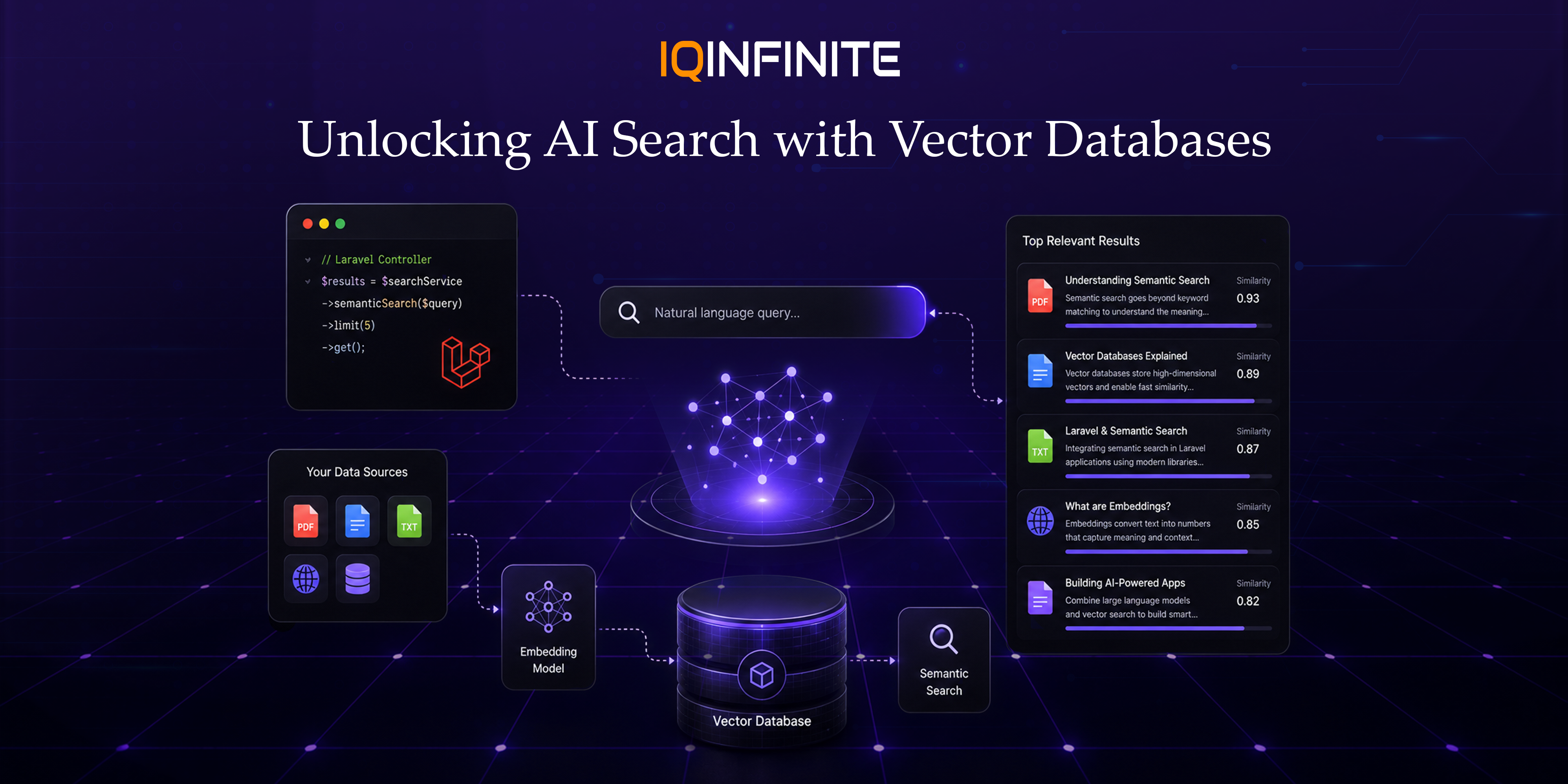
Building a Semantic Search Workflow in Laravel
A typical semantic search pipeline consists of the following steps:
Step 1: Collect Your Data
Gather documents, products, articles, FAQs or knowledge base content that users will search.
Examples include:
-
Blog posts
-
Product catalogs
-
Customer support articles
-
Medical records
-
Documentation
Step 2: Generate Vector Embeddings
Use an embedding model to convert your content into numerical vectors.
Each document receives a semantic representation that captures its meaning.
Step 3: Store Embeddings
Save the generated vectors in a vector database along with metadata such as:
-
Title
-
Category
-
Tags
-
Author
-
Publication Date
-
URL
Step 4: Process User Queries
When a user submits a search query:
-
Convert the query into a vector embedding.
-
Compare it with stored vectors.
-
Retrieve the closest semantic matches.
-
Rank results by similarity score.
-
Return the most relevant content.
This process typically completes in milliseconds, delivering highly relevant results.
Hybrid Search: Combining the Best of Keyword and Semantic Search
While semantic search excels at understanding user intent, keyword search remains valuable for identifying exact matches. By combining the strengths of both approaches, Hybrid Search delivers more accurate, relevant and personalized search results.
A hybrid search engine evaluates multiple ranking factors simultaneously, including:
-
Exact keyword matches
-
Semantic similarity using vector embeddings
-
Metadata filters (categories, tags, authors, etc.)
-
Content popularity and engagement
-
User behavior and search history
-
Content freshness and recency
This multi-layered approach ensures users receive results that are both contextually relevant and aligned with their search intent.
Real-World Use Cases of Semantic Search
Semantic search is transforming how businesses retrieve and organize information across various industries. Here are some of its most impactful applications.
AI-Powered Customer Support
Customer support platforms can instantly retrieve the most relevant FAQs, troubleshooting guides and knowledge base articles based on natural language queries. This reduces response times, improves self-service capabilities and enhances customer satisfaction.
Enterprise Knowledge Management
Organizations generate massive amounts of internal documentation, including policies, meeting notes, project documentation and technical resources. Semantic search enables employees to locate relevant information quickly using conversational queries instead of remembering exact document titles or keywords.
E-commerce Product Discovery
Modern online stores use semantic search to understand customer intent rather than relying solely on product names. For example, a search for "comfortable running shoes for beginners" can return highly relevant products even if those exact words don't appear in the product descriptions, leading to improved product discovery and higher conversion rates.
Legal Document Search
Law firms and legal departments manage thousands of contracts, agreements and compliance documents. Semantic search helps professionals locate relevant clauses, legal precedents and documents based on context, significantly reducing manual review time and improving research efficiency.
Healthcare and Medical Applications
Healthcare providers can quickly search patient records, clinical guidelines, medical research papers and treatment protocols using natural language. By understanding the intent behind medical queries, semantic search supports faster and more informed clinical decision-making.
AI Chatbots and Retrieval-Augmented Generation (RAG)
Semantic search is a core component of Retrieval-Augmented Generation (RAG) architectures. Before generating a response, AI assistants retrieve the most relevant information from trusted knowledge sources, ensuring responses are more accurate, context-aware and up to date.
This approach helps reduce AI hallucinations, improves response quality and enables intelligent assistants to provide reliable answers grounded in business-specific knowledge.
Emerging Trends in Semantic Search for 2026
Semantic search continues to evolve alongside advancements in Artificial Intelligence and Large Language Models (LLMs). As businesses increasingly adopt AI-driven applications, search technology is becoming more intelligent, adaptive and personalized.
Here are some of the biggest trends shaping semantic search in 2026:
Agentic AI Search
Agentic AI systems go beyond retrieving information they can autonomously analyse user intent, perform multi-step reasoning, gather information from multiple sources and deliver comprehensive, context-aware responses with minimal user input.
Multimodal Search
Modern AI systems are moving beyond text-only search. Multimodal search enables users to search using text, images, audio, video or a combination of these inputs, creating richer and more intuitive search experiences.
Retrieval-Augmented Generation (RAG)
RAG has become the foundation of enterprise AI applications. By combining vector search with Large Language Models, organizations can generate accurate, trustworthy responses based on proprietary knowledge instead of relying solely on pretrained model data.
Real-Time Embedding Updates
As business data changes rapidly, organizations are increasingly adopting real-time embedding pipelines that automatically generate and update vector embeddings whenever new content is added or existing content is modified.
Personalized Semantic Search
AI-powered search engines are becoming highly personalized by incorporating user preferences, browsing history, search behaviour and contextual signals to deliver more relevant and individualized search results.
Edge AI Search
With growing concerns around latency, privacy and data security, Edge AI enables semantic search to run closer to users on local infrastructure or edge devices. This reduces response times while minimizing dependence on centralized cloud services.
Hybrid AI Architectures
The future of intelligent search lies in combining Large Language Models (LLMs), vector databases, traditional keyword search, knowledge graphs and recommendation systems. These hybrid AI architectures deliver more accurate, explainable and context-aware search experiences across diverse applications.
Why Businesses Are Investing in Semantic Search
Businesses are investing in semantic search because it delivers faster, smarter and more relevant search experiences. Unlike traditional keyword search, it understands user intent and context, helping users find the right information quickly.
With semantic search, organizations can:
-
Improve customer experience with more accurate search results.
-
Reduce support costs through intelligent self-service.
-
Increase employee productivity with faster access to information.
-
Enhance product discovery and recommendations.
-
Power AI chatbots and RAG-based applications with reliable data.
As AI continues to evolve, semantic search is becoming an essential part of modern, AI-powered applications.
Conclusion
Semantic search is transforming how users interact with modern applications. By combining Laravel with vector databases, AI embeddings and Retrieval-Augmented Generation (RAG), developers can build intelligent, scalable and highly relevant search experiences.
Whether you're building an AI chatbot, enterprise knowledge base, SaaS platform or eCommerce application, understanding how to build semantic search gives your applications a significant competitive advantage. As AI adoption continues to grow in 2026, semantic search is becoming an essential capability for every modern Laravel application.
As AI adoption continues to grow in 2026, integrating semantic search into Laravel applications is no longer just an advantage it's becoming a necessity for building smarter, future-ready digital products.