
Autonomous DevOps: How AI Is Building, Deploying and Healing Systems Without Human Intervention
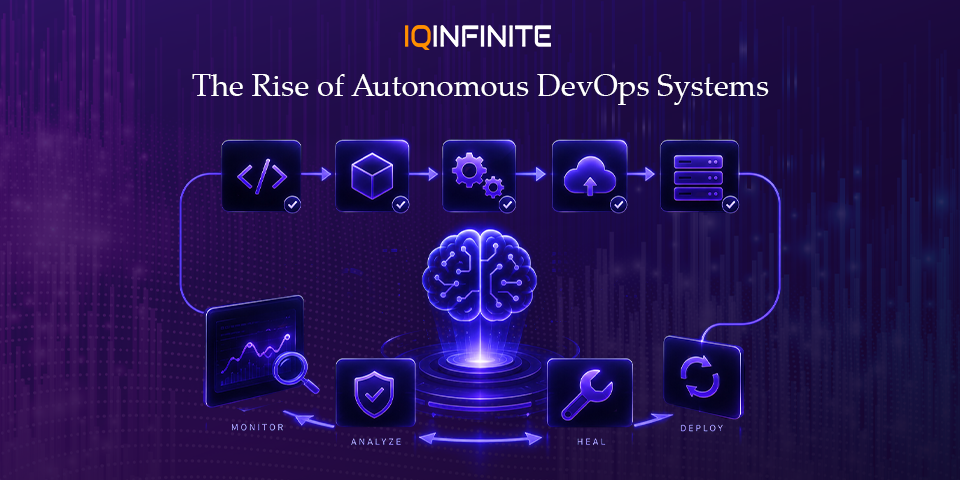
The DevOps pipeline used to require a team of engineers to monitor alerts, approve deployments, investigate incidents and scale infrastructure. In 2026, that picture is changing fundamentally. Autonomous DevOps the convergence of AI agents, self-healing infrastructure and zero-touch delivery pipelines is removing human bottlenecks from the software delivery lifecycle entirely. This is not about replacing engineers. It is about elevating them from operators to architects of systems that think, adapt and recover on their own.
As organizations increasingly explore the future of DevOps with AI, autonomous systems are becoming central to modern engineering strategies.
From Manual Pipelines to Self-Governing Systems
Traditional DevOps was a major leap forward. Automation replaced manual deployments. CI/CD pipelines made releases predictable. Infrastructure as Code made environments reproducible.
But even the most mature DevOps pipelines still required humans to approve production deployments, respond to 3 AM alerts, diagnose flapping services and scale infrastructure manually under load.
Autonomous DevOps eliminates these dependencies by introducing AI agents that observe, decide and act in real time, at machine speed, without waiting for a human to wake up. The shift is built on three foundational pillars:
But even the most mature DevOps pipelines still required humans to approve production deployments, respond to 3 AM alerts, diagnose flapping services and scale infrastructure manually under load.
Autonomous DevOps eliminates these dependencies by introducing AI agents that observe, decide and act in real time, at machine speed, without waiting for a human to wake up. The shift is built on three foundational pillars:
- AI-driven CI/CD - Pipelines that adapt their behavior based on code quality, risk and context
- Self-healing infrastructure - Systems that detect degradation and remediate it automatically
- Autonomous incident response - AI that triages, investigates and resolves incidents before human escalation
This transformation is reshaping modern site reliability engineering practices by reducing operational toil and improving system resilience.
The Core Pillars of Autonomous DevOps
AI-Driven CI/CD Pipelines That Think for Themselves
In a traditional CI/CD pipeline, every stage runs the same way regardless of context. Autonomous pipelines are different they are intelligent.
Modern AI-driven pipelines can:
Modern AI-driven pipelines can:
- Analyze code changes and predict deployment risk before execution
- Skip redundant test suites when unrelated areas of the codebase changed
- Automatically roll back a release if anomalous metrics appear post-deployment
- Adjust pipeline parallelism based on infrastructure availability and cost signals
- Flag security vulnerabilities before a single line reaches staging
This evolution in software deployment automation allows engineering teams to release faster while maintaining reliability and security.
For organizations researching how to automate CI CD pipeline workflows, AI-powered orchestration is becoming the preferred approach in 2026.
For organizations researching how to automate CI CD pipeline workflows, AI-powered orchestration is becoming the preferred approach in 2026.
Self-Healing Infrastructure
Self-healing systems in 2026 can restart failing containers before users notice degradation, reroute traffic away from unhealthy nodes automatically, reapply drifted infrastructure configurations using GitOps reconciliation loops, scale horizontally when latency thresholds are breached and replace corrupted database replicas and resynchronize data autonomously.
What is new in 2026 is the layer of AI observability sitting above Kubernetes tools like Dynatrace Davis AI, Chromosphere and AWS DevOps Guru that correlate signals across hundreds of services and take corrective action without waiting for a runbook.
What is new in 2026 is the layer of AI observability sitting above Kubernetes tools like Dynatrace Davis AI, Chromosphere and AWS DevOps Guru that correlate signals across hundreds of services and take corrective action without waiting for a runbook.
Autonomous Incident Response
Modern AI-driven incident management tools now:
- Correlate alerts from logs, metrics and traces to identify root cause automatically
- Execute predefined remediation playbooks without human approval for low-risk incidents
- Draft incident reports and postmortems based on observed system behaviour
- Route only genuinely novel or high-impact incidents to human engineers
- Learn from past incidents to prevent recurrence patterns
Emerging Technologies Dominating the Future of Autonomous DevOps
AI Agents as First-Class Pipeline Citizens
The biggest architectural shift happening in DevOps right now is the introduction of AI agents directly into delivery workflows. These are not passive assistants they are autonomous actors with tools, memory and the ability to execute multi-step tasks.
In an Autonomous DevOps architecture, agents can monitor a deployment and decide whether to proceed, pause or roll back, run security scans and patch dependencies without human initiation, open pull requests to fix failing tests discovered during a pipeline run and coordinate with other agents across different services and repositories.
In an Autonomous DevOps architecture, agents can monitor a deployment and decide whether to proceed, pause or roll back, run security scans and patch dependencies without human initiation, open pull requests to fix failing tests discovered during a pipeline run and coordinate with other agents across different services and repositories.
GitOps as the Backbone of Autonomous Control
GitOps has become the control plane for Autonomous DevOps. By treating Git as the single source of truth for both application and infrastructure state, autonomous systems always have a clear reference point for the desired state.
When an autonomous agent detects drift whether in a Kubernetes deployment, a Terraform configuration or a security policy it reconciles the live environment back to the Git-defined state automatically. Tools like Argo CD, Flux and Cross plane form the reconciliation layer that makes this possible at scale.
When an autonomous agent detects drift whether in a Kubernetes deployment, a Terraform configuration or a security policy it reconciles the live environment back to the Git-defined state automatically. Tools like Argo CD, Flux and Cross plane form the reconciliation layer that makes this possible at scale.
FinOps Intelligence Built into Pipelines
Autonomous DevOps is not just about reliability it is about efficiency. AI systems are now embedded into infrastructure provisioning with cost awareness built in.
- Right-sizing compute resources after observing actual usage patterns
- Automatically scheduling non-critical workloads to spot instances during off-peak hours
- Flagging idle resources and decommissioning them after predefined inactivity windows
- Predicting monthly cloud spend based on pipeline activity trends
Predictive Quality Gates
Traditional quality gates are binary tests to pass or fail. Predictive quality gates are probabilistic; they score each deployment on its likely impact based on historical patterns, code complexity, test coverage deltas and recent incident history.
A deployment touching a high-risk service with low test coverage will be held for human review automatically. A low-risk change to a well-tested utility function will flow through to production without delay.
A deployment touching a high-risk service with low test coverage will be held for human review automatically. A low-risk change to a well-tested utility function will flow through to production without delay.
Security as an Autonomous Layer
Emerging capabilities include real-time software composition analysis that blocks builds with critical CVEs, autonomous secrets rotation triggered by policy violations, AI-generated threat modelling updated continuously as the codebase evolves and behavioral anomaly detection in production that isolates compromised services without human intervention.
What Autonomous DevOps Means for Engineering Teams
The rise of Autonomous DevOps does not mean engineering teams get smaller. It means their work changes fundamentally. Engineers who thrive in this new paradigm will:
- Design the policies and guardrails that autonomous systems operate within
- Review and approve AI-generated decisions for high-stakes actions
- Investigate novel failure modes that autonomous systems have never seen
- Build and tune the AI agents that power autonomous workflows
- Focus on product innovation rather than operational maintenance
Getting Started with Autonomous DevOps
Adopting Autonomous DevOps does not require rebuilding everything from scratch. A practical adoption roadmap:
- Start with observability - Instrument everything with distributed tracing, structured logging and real-time metrics
- Introduce GitOps for infrastructure - Establish Git as the source of truth and implement drift detection using Argo CD or Flux
- Automate first-response for known incidents - Build runbooks that autonomous systems can execute for your most common alert types
- Add AI to your pipeline risk scoring - Apply proportional approval gates automatically based on deployment risk scores
- Expand agent coverage gradually - Start with low-risk pipeline areas, observe behavior, then expand scope
Conclusion
Autonomous DevOps represents the next evolution of how software is built, delivered and maintained. By combining AI-driven pipelines, self-healing infrastructure, autonomous incident response and intelligent security enforcement, engineering teams are moving from reactive operations to proactive, self-governing systems. The organizations investing in this shift today are not just improving delivery metrics; they are redefining what a high-performing engineering team looks like. In 2026 and beyond, the most competitive software teams will not be the ones with the most engineers on call. They will be the ones who built systems intelligent enough to take care of themselves.