
Ansible Configuration Automation: Powering scalable and error free infrastructure
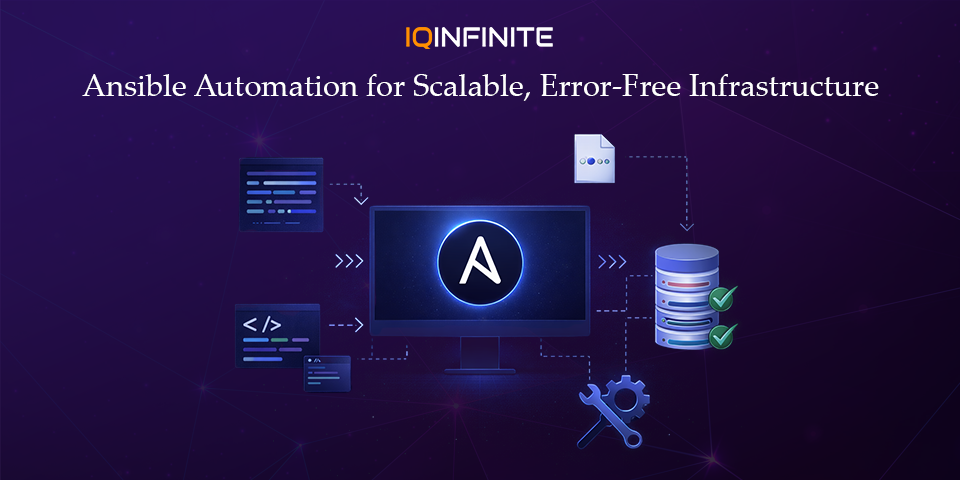
In today’s cloud-first, fast-moving digital ecosystem, managing infrastructure manually is no longer sustainable. Organizations are dealing with hybrid environments, microservices and continuous deployments where even a small misconfiguration can cause major outages.
This is where Ansible configuration automation plays a critical role enabling teams to build scalable, consistent and error-free infrastructure using code.
What is Ansible Configuration Automation?
Ansible is an open-source IT automation tool used for:
- Configuration management
- Application deployment
- Infrastructure provisioning
- Orchestration across environments
It uses simple, human-readable YAML-based playbooks and operates in an agentless architecture, typically connecting over SSH eliminating the need for installing agents on target systems.
This simplicity has made Ansible one of the most widely adopted tools in modern DevOps workflows. Many teams start by exploring how to use Ansible for automation, thanks to its low learning curve and quick setup.
This simplicity has made Ansible one of the most widely adopted tools in modern DevOps workflows. Many teams start by exploring how to use Ansible for automation, thanks to its low learning curve and quick setup.
Why Ansible Matters in Modern Infrastructure
1. Eliminates Human Errors
Manual configuration often leads to inconsistencies and avoidable mistakes, especially at scale. Ansible addresses this with:
- Idempotent execution - ensures the same desired state is achieved every time, regardless of how many times a playbook is run
- Consistent environments - standardize configurations across development, staging and production.
This results in predictable deployments and significantly reduced operational risk. Well-structured Ansible roles and modules further help enforce consistency.
2. Enables Massive Scalability
Modern systems demand the ability to scale rapidly and efficiently. Ansible is built to handle large-scale environments with ease:
• Configure thousands of servers simultaneously
• Ideal for cloud-native architectures and microservices ecosystems
• Supports multi-region and distributed deployments seamlessly
This makes cloud infrastructure automation Ansible a preferred approach for enterprises managing global systems.
• Configure thousands of servers simultaneously
• Ideal for cloud-native architectures and microservices ecosystems
• Supports multi-region and distributed deployments seamlessly
This makes cloud infrastructure automation Ansible a preferred approach for enterprises managing global systems.
3. Agentless & Lightweight
One of Ansible’s key advantages is its simplicity in architecture:
• No agents required on managed nodes
• Uses standard protocols like SSH, reducing setup time
• Lower operational overhead compared to agent-based tools
This makes Ansible faster to adopt, easier to maintain and highly efficient in dynamic environments.
• No agents required on managed nodes
• Uses standard protocols like SSH, reducing setup time
• Lower operational overhead compared to agent-based tools
This makes Ansible faster to adopt, easier to maintain and highly efficient in dynamic environments.
4. Infrastructure as Code (IaC)
Ansible treats infrastructure the same way modern teams treat application code:
• Version-controlled configurations for full traceability
• Easy rollback and auditing of changes
• Encourages team collaboration through shared playbooks
Teams often rely on Ansible playbook examples to standardize deployments and accelerate onboarding.
• Version-controlled configurations for full traceability
• Easy rollback and auditing of changes
• Encourages team collaboration through shared playbooks
Teams often rely on Ansible playbook examples to standardize deployments and accelerate onboarding.
Core Components of Ansible
Understanding Ansible’s building blocks is essential for designing scalable and maintainable automation:
-
Playbooks: Define automation workflows using simple, human-readable YAML syntax.
-
Inventory: Maintains the list of managed nodes (servers, cloud instances, etc.).
-
Modules: Pre-built units of work such as package installation or system updates.
-
Roles: Organize playbooks into reusable and modular structures.
- Collections: Bundled distributions of modules, plugins and roles for extended functionality.
Key Use Cases in 2026
Cloud Infrastructure Automation
Provisioning and managing cloud resources has become seamless with Ansible:
• Automates infrastructure across AWS, Azure and GCP
• Simplifies provisioning, scaling and configuration
• Reduces manual intervention in cloud operations
• Automates infrastructure across AWS, Azure and GCP
• Simplifies provisioning, scaling and configuration
• Reduces manual intervention in cloud operations
Container & Kubernetes Management
Ansible plays a critical role in containerized environments:
• Automates Docker container deployment and lifecycle management
• Simplifies Kubernetes cluster setup and configuration
• Ensures consistency across container orchestration platforms
• Automates Docker container deployment and lifecycle management
• Simplifies Kubernetes cluster setup and configuration
• Ensures consistency across container orchestration platforms
CI/CD Pipeline Integration
Ansible integrates efficiently with modern CI/CD workflows:
• Automates application deployments
• Reduces release cycles and human intervention
• Improves consistency across environments
• Automates application deployments
• Reduces release cycles and human intervention
• Improves consistency across environments
Security & Compliance Automation
Security is no longer optional it must be automated:
• Enforces organizational policies across systems
• Automates patch management and updates
• Ensures compliance across distributed environments
• Enforces organizational policies across systems
• Automates patch management and updates
• Ensures compliance across distributed environments
Latest Trends in Ansible (2025–2026)
AI-Powered Automation
Automation is becoming more intelligent and adaptive:
• AI-driven recommendations for playbook optimization
• Automated troubleshooting and remediation
• Natural language-to-playbook generation
Solutions like Ansible Lightspeed are redefining how teams build and manage automation.
• AI-driven recommendations for playbook optimization
• Automated troubleshooting and remediation
• Natural language-to-playbook generation
Solutions like Ansible Lightspeed are redefining how teams build and manage automation.
Event-Driven Automation
Modern systems require real-time responsiveness:
• Automation triggered by events (alerts, logs, failures)
• Enables proactive incident handling and AIOps workflows
• Reduces downtime through immediate response mechanisms
• Automation triggered by events (alerts, logs, failures)
• Enables proactive incident handling and AIOps workflows
• Reduces downtime through immediate response mechanisms
Integration with Terraform & IaC Ecosystem
A hybrid Infrastructure as Code approach is now standard:
• Terraform → Handles infrastructure provisioning
• Ansible → Manages configuration and application setup
This combination delivers complete, end-to-end automation pipelines.
• Terraform → Handles infrastructure provisioning
• Ansible → Manages configuration and application setup
This combination delivers complete, end-to-end automation pipelines.
GitOps & Version-Controlled Infrastructure
GitOps is reshaping infrastructure management:
• Infrastructure stored and managed via Git repositories
• Automated synchronization with environments
• Full traceability, auditability and rollback capabilities
• Infrastructure stored and managed via Git repositories
• Automated synchronization with environments
• Full traceability, auditability and rollback capabilities
Hybrid & Multi-Cloud Automation
Modern enterprises operate across diverse environments:
• On-premise data centers
• Public cloud platforms
• Edge computing environments
Ansible’s flexibility makes it ideal for managing distributed and hybrid infrastructures.
• On-premise data centers
• Public cloud platforms
• Edge computing environments
Ansible’s flexibility makes it ideal for managing distributed and hybrid infrastructures.
Best Practices for Error-Free Automation
To maximize efficiency and reliability:
-
Use Roles for Reusability: Break configurations into modular, reusable components.
-
Maintain Idempotency: Ensure consistent results regardless of execution frequency.
-
Secure Secrets Properly: Use tools like Ansible Vault or external secret managers.
-
Implement Testing & CI: Validate playbooks through linting and automated testing.
- Version Control Everything: Store playbooks in Git for collaboration, auditing and rollback.
Challenges to Consider
Despite its strengths, Ansible has some limitations:
• Performance overhead in extremely large-scale environments
• Limited native state management compared to tools like Terraform
• Debugging complexity in large and deeply nested playbooks
However, continuous improvements and ecosystem integrations are steadily addressing these challenges.
• Performance overhead in extremely large-scale environments
• Limited native state management compared to tools like Terraform
• Debugging complexity in large and deeply nested playbooks
However, continuous improvements and ecosystem integrations are steadily addressing these challenges.
The Future of Ansible
Ansible is evolving beyond basic automation into a central orchestration engine powered by:
• AI-driven automation workflows
• Event-based infrastructure management
• Deep integration with DevOps and SRE tools
As organizations move toward self-healing, autonomous infrastructure, Ansible remains a critical enabler of this transformation.
• AI-driven automation workflows
• Event-based infrastructure management
• Deep integration with DevOps and SRE tools
As organizations move toward self-healing, autonomous infrastructure, Ansible remains a critical enabler of this transformation.
Conclusion
Ansible configuration automation is no longer just a DevOps tool it is a strategic foundation for scalable, resilient and error-free infrastructure.
• Infrastructure as Code
• AI-driven automation
• Event-based execution
organizations can build systems that are not only efficient but also adaptive and future ready.
• Infrastructure as Code
• AI-driven automation
• Event-based execution
organizations can build systems that are not only efficient but also adaptive and future ready.