
AI Integration in Non-AI Apps: The Future of Smart Mobile App Development
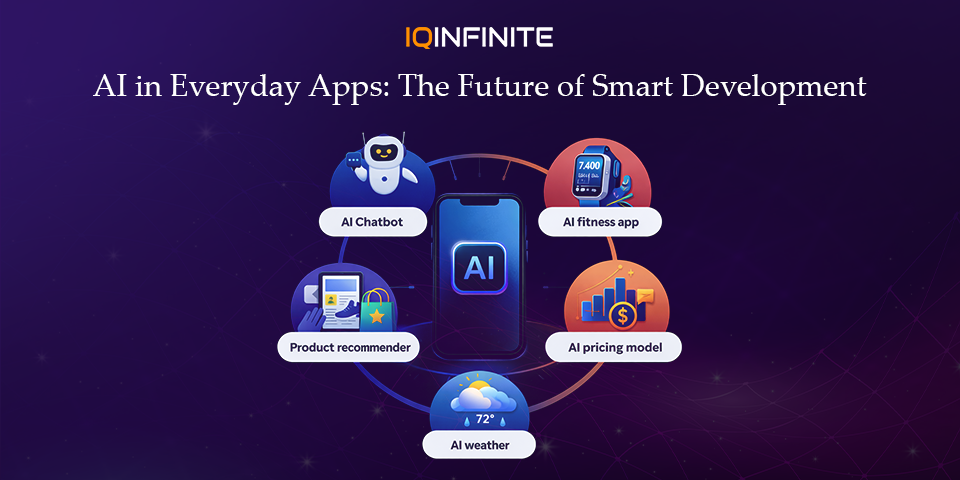
Artificial Intelligence (AI) has moved beyond being a standalone technology it is now deeply embedded into everyday mobile applications. From e-commerce and healthcare to finance and entertainment, even traditionally “non-AI” apps are evolving into intelligent platforms.
Today, businesses are actively looking to integrate AI in mobile applications to stay competitive and meet rising user expectations.
Recent data shows that over 52% of mobile apps already incorporate AI features and this number is expected to rise sharply as 73% of apps will require AI integration by 2026.
The shift is clear: AI is no longer a competitive advantage it is becoming a necessity.
Why AI Integration Is Transforming Non-AI Apps
1. Hyper-Personalization Drives Engagement
Modern users expect apps to understand their preferences. AI enables:
- Real-time recommendations
- Behaviour-based content
- Predictive user journeys
Apps using AI-driven personalization have reported 40-60% higher engagement rates.
These are strong examples of AI in mobile apps, where e-commerce platforms suggest products based on browsing history and OTT apps recommend content tailored to viewing habits.
Example:
E-commerce apps suggest products based on browsing history, while OTT platforms recommend content tailored to viewing habits.
These are strong examples of AI in mobile apps, where e-commerce platforms suggest products based on browsing history and OTT apps recommend content tailored to viewing habits.
Example:
E-commerce apps suggest products based on browsing history, while OTT platforms recommend content tailored to viewing habits.
2. Automation Enhances User Experience
AI automates repetitive and time-consuming tasks:
- Chatbots for customer support
- Smart scheduling
- Automated workflows
AI chatbots alone can reduce response times by up to 60% and save billions in operational costs.
This makes adding AI features to existing apps a practical way to improve user experience without rebuilding applications from scratch.
This makes adding AI features to existing apps a practical way to improve user experience without rebuilding applications from scratch.
3. Predictive Intelligence Improves Decision-Making
AI enables apps to predict user behaviour:
- Churn prediction
- Demand forecasting
- Health monitoring
Businesses using predictive analytics have seen:
• Up to 50% reduction in churn
• 30% increase in retention
This transforms apps from reactive tools into proactive assistants.
• Up to 50% reduction in churn
• 30% increase in retention
This transforms apps from reactive tools into proactive assistants.
4. AI Is Now Mainstream Across All Categories
AI is no longer limited to tech-heavy apps. It is now integrated into:
- Finance apps (fraud detection)
- Fitness apps (personalized workouts)
- Education apps (AI tutors)
- Photo apps (AI editing tools)
In fact, apps mentioning AI were downloaded 7.5 billion times in just the first half of 2025, highlighting widespread adoption.
Latest Trends in AI-Powered Mobile App Development
1. AI as Core Infrastructure (Not Just a Feature)
Artificial Intelligence is no longer an add-on it is becoming the foundation of modern mobile app architecture. Today’s developers are building AI-first applications, where intelligence is deeply embedded into core functionality rather than layered on top. This shift enables apps to make decisions, adapt in real time and deliver highly dynamic user experiences.
2. Rise of Generative AI in Everyday Apps
Generative AI has moved from experimental to essential. It is fundamentally reshaping how users interact with applications by enabling:
- Automated text generation (emails, notes, summaries)
- AI-driven image and video creation
- Real-time code generation and assistance
The scale of adoption is significant. In India alone, generative AI apps recorded over 602 million downloads in 2025, highlighting rapid mainstream acceptance and user demand.
3. Multimodal AI Experiences
Modern applications are increasingly multimodal, integrating multiple forms of interaction:
- Voice
- Text
- Images
- Video
This convergence enables more natural, human-like communication between users and apps. It also enhances accessibility and usability, with studies indicating that multimodal AI can improve user satisfaction by up to 60%.
4. On-Device AI and Edge Computing
A major shift is underway from cloud-dependent AI to on-device intelligence. By processing data locally on smartphones, apps can deliver:
- Faster response times
- Enhanced data privacy
- Reliable offline functionality
This trend is crucial for scalable and smart mobile app development.
5. Autonomous AI Agents
AI is evolving from reactive tools to autonomous agents capable of executing tasks independently. These agents can:
- Schedule appointments
- Manage workflows
- Handle customer interactions
This marks the emergence of self-operating applications, reducing the need for constant user input and significantly improving efficiency.
6. AI-Powered Security and Privacy
Security is becoming smarter with AI-driven protection mechanisms, including:
- Behavioural biometrics
- Real-time fraud detection
- Anomaly detection systems
Organizations implementing AI-based security solutions report up to 70% fewer data breaches, making AI a critical component of modern app security strategies.
Benefits of Integrating AI into Non-AI Apps
For Businesses
- Revenue growth of 10-30% through enhanced engagement
- Up to 50% faster devlopment cycles via AI-assisted coding
- Improved customer retention through personalization
For Users
- Highly personalized experiences
- Faster and more accurate responses
- Intelligent recommendations
- Seamless and intuitive interactions
Challenges to Consider
1. Data Privacy Concerns
With increasing regulatory scrutiny, handling user data responsibly is essential. Compliance and transparency must be built into AI systems from the start.
2. High Development Complexity
AI integration requires specialized expertise, including:
- Skilled AI/ML engineers
- Robust data pipelines
- Continuous model training and maintenance
3. Model Accuracy and Bias
AI systems must be actively monitored to prevent:
- Inaccurate predictions
- Bias in outputs
Ongoing evaluation and fine-tuning are critical to maintaining reliability and fairness.
Outlook: What Lies Ahead?
The trajectory of mobile apps is unmistakably AI-driven. Key developments expected in the coming years include:
- AI embedded across virtually every app category
- Apps evolving into personal digital assistants
- Dominance of voice-first and multimodal interfaces
- A shift from cloud-first to device-first AI experiences
The market reflects this momentum, with projections estimating the mobile AI sector will reach $84.97 billion by 2030.
Conclusion
AI integration in non-AI applications is no longer optional it is a defining factor of modern digital products. It represents a fundamental shift in how apps are designed, developed and experienced.
Businesses that embrace AI will deliver smarter, more adaptive and user-centric applications. Those that fail to evolve risk falling behind in an increasingly intelligent and competitive ecosystem.
Businesses that embrace AI will deliver smarter, more adaptive and user-centric applications. Those that fail to evolve risk falling behind in an increasingly intelligent and competitive ecosystem.